Just sent an excerpt of this email to some veteran sports journalists up in New York whom I read devoutly -and respect immensely- whom I also occasionally drop an email to, because they're straight-shooters when it comes to the facts and behind-the-scenes' forces of current American sports TV and personalities.
This has some additional material -and tangents- to buttress my points, which should be fairly obvious.
It's instructive that when I emailed this to them at 2:35 p.m. this afternoon, that the Dolphins PR folks were still so behind-the-curve that they had yet to inform WIOD radio and the Dolphins' radio broadcast rights holder, WQAM, that the Bill Parcells presser would be (televised) at 6 p.m., which ESPN News was reporting.
What, South Florida news media being scooped again on a Miami-based story?
Just more of what we've gotten used to over the years he said glumly.
______________________________
Thursday December 27th, 2007
Dear X and Y:
Just wanted to shoot you both a line and share some thoughts you might find of interest, as a media friend just called me from out at Dolphins HQ in Davie, quite exasperated, where she's been waiting and waiting... for the grand unveiling of Bill Parcells as the Dolphins' VP.
(I'm against the Parcells move, think he won't make it four years, but...)
She called an hour ago on the very day that's been anticipated ever since last week's big announcement, and yet, typically, the Dolphins are SO dis-organized, that their PR folks are refusing to tell the assembled media -whom in this town, are uniformly puppets of the worst sort to begin with, with absolutely no bark or backbone- what time the press conference will
start. Yeah, that's very professional.
While it's the kind of thing that most people who care about the Dolphins will never ever find out about, it really speaks volumes for why I've wanted Huizenga to sell the team -for years.
Not least of all because if he sells the team, the stadium and the adjacent land he owns, the Marlins stadium could, theoretically, be near the current stadium and the FL Turnpike, I-95 and starting in about 2012, near a Miami-Dade Metrorail station that connects it to points south, instead of at the Orange Bowl site in Little Havana, far from all of that, as well as the
large Broward fan base for a team with a piddling fan base to begin with.
(And, stuck with perhaps the worst ownership in MLB in Jeffrey Loria.
His intelligence and marketing prowess are perhaps best reflected by the team having had their team store being located in Little Havana -see the "Marlins en Miami" cite below- instead of being near modern suburban shopping malls.
You know, where people actually live and work and have disposable income, like they did in the days before and since the Christmas holidays, at Dadeland Mall, Aventura Mall, Pembroke Lakes Mall or Sawgrass Mall...
Free SouthBeachHoosier marketing advice to Marlins: How about a small storefront Marlins store along Brickell Avenue to capture the professional crowd at lunch time, in-between bites or after work?
Yeah, that's the Marlins marketing genius for you, continuing to propagate the failed myth of a vast army of Hispanic baseball fans in Little Havana just itching for the chance to come up to Chez Huizenga for a Marlin ballgame. Or ten.
This gets lip service despite all relevant marketing research showing those Marlin fans rarely attend games, even if they really do know the team inside-and-out well-enough to argue over who should be the Marlins lead-off man.
Here's some breaking news on who really counts: fans who actually show up.
Some time soon in this space, I'll tell you about how it was done -right and wrong- up in the Washington, D.C. area with the Baltimore Orioles team store, in the perfect downtown location
of 17th Street, N.W. and K Street, just blocks from the The White House.
One of my friends was the store manager there before I left, and that's where I first saw the video of the Twin Towers coming down for the first time on 9/11, while walking home to Arlington after being told to evacuate from my office along Pennsylvania Avenue, across the street from the FBI and Department of Justice, after the Pentagon was hit by American Airlines Flight 11.)
How can the Dolphins screw-up something as simple to set-up as a press conference?
Well, sadly for Dolphin fans like me, who grew-up as a season ticket holder in the successful early '70's, and know from professionalism, the forensic evidence for the decline is both overwhelming and self-evident.
Naturally, in the era of an interactive web, the Dolphins have absolutely nothing on their team website about the press conference, either, even though everyone is talking about it in advance.
http://www.miamidolphins.com/newsite/flash_content.asp
Typical!
Adios!
Dave
P.S. One of my former housemates at IU, a cute brunette Alpha Chi from Indy, dated Cam Cameron for a while when he was the back-up QB at IU behind Babe Laufenberg.
________________________________________________
http://florida.marlins.mlb.com/fla/ballpark/guide.jsp#M
Marlins En Miami Store: The Marlins en Miami Store is a full service ticket office and merchandise store. It is located in the heart of the Hispanic community at 3701 S.W. 8th Street. The main focus of the office is to serve as a lasting presence for the Club within this area and service the community by offering general information in Spanish, selling tickets, merchandise and hosting special events.
In Season Hours:
Mon-Fri 9:00 a.m.- 5:00 p.m.
Sat. 10am to 4pm.

South Beach Hoosier by David Bruce Smith, http://www.southbeachhoosier.blogspot.com/

Memorial Stadium, Bloomington, home of the Hoosiers; Fernando Mendoza TD dive on 4th Down leads to IU's first nat'l football title; The Team; The Head Coach, Curt Cignetti and the Hoosiers 2026 football schedule
Showing posts with label Cam Cameron. Show all posts
Showing posts with label Cam Cameron. Show all posts
Thursday, December 27, 2007


Friday, November 23, 2007
...the Miami Dolphins select Darren McFadden, RB, University of Arkansas
In the end, I guess you'll just have to take my word for it.
I've thought this particular thought for months and months now, and have even shared it with others in all sorts of different settings, from the Ojus barber shop to the Hallandale Beach Post Office and the Publix grocery store on Hallandale Beach Blvd., whenever I've heard someone opining out loud about what the Dolphins really need to help make themselves relevant again, and end their many years of despair in the wilderness.
I've continued to think this even while listening to some particularly foolish Miami sports talk radio suggesting, in all seriousness(!), that a.) the Dolphins draft yet another QB with their first pick in April's NFL draft, or, b.) equally implausibly to me, draft down.
Finally, last night, over Thanksgiving turkey with my nephew Mario up in Pembroke Pines, I said it was a no-brainer: with the first choice in the 2008 NFL draft, for the good of their team and the delicate psyches of their fans, the Dolphins simply MUST, MUST, MUST draft Arkansas' do-it-all offensive dynamo, Darren McFadden, playing the role of Reggie Bush.
http://www.5darrenmcfadden.com/SportSelect.dbml?DB_OEM_ID=6100&SPID=2420
http://sports.espn.go.com/ncf/player/profile?playerId=170928
http://www.mcfaddenforheisman.com/
http://www.youtube.com/watch?v=APEFj8Glx7Q aka The Ultimate Weapon - Arkansas' Darren McFadden
Having watched this afternoon's Razorback upset of LSU at Baton Rouge -Buh-bye LSU in BCS title game in New Orleans- I've seen nothing to give me pause and re-think my intuition that the Dolphins grab McFadden, toute-de-suite!
And in any case, as history suggests on my blog, I have a soft spot for folks from Arkansas.
They've seldom let me down.
For next year, to replace the often incoherent offense and inconsistent play-calling -but with an offensive line that's played much better than could've been expected, thanks to Hudson Houck's coaching- let's start with a of John Beck at QB, Ronnie Brown and Ricky Williams at RB, Ted Ginn, Jr. and Marty Booker at the wide-out spots, with McFadden coming in every few plays at different positions to mix-it up a bit, and catch somebody in one-on-one coverage with a slow-stepped LB, or to -yes- "split the seam. "
I like Cam Cameron a lot and NOT simply because he's both a former Hoosier player and coach, and someone that one of my cute former Alpha Chi housemates at Colonial Crest Apts. once dated while he was the back-up QB at IU.
(That was about 10-12 years before Trista Rehn was an Alpha Chi at IU, and 20 years after longtime SouthBeachHoosier legal eagle favorite Victoria Toensing of DC was there. My six-degrees of Cam will be the subject of an upcoming SBH post, one that's been long in the planning.)
I honestly do believe that Cam's got the right kind of character traits and a willingness to adapt, that can lead him to becoming, in time, one of the best coaches in the NFL, even as he's made far too many bad choices in this his first year.
http://www.palmbeachpost.com/dolphins/content/sports/epaper/2007/11/20/a1c_stoda_1120.html
But honestly, IF he can't succeed with all these guys on offense next season, after having gone thru a complete traing camp together, with everyone "on the same page," Cam will be "Gone with the Wind" before the end of the 2008 season. And rightfully so.
I've thought this particular thought for months and months now, and have even shared it with others in all sorts of different settings, from the Ojus barber shop to the Hallandale Beach Post Office and the Publix grocery store on Hallandale Beach Blvd., whenever I've heard someone opining out loud about what the Dolphins really need to help make themselves relevant again, and end their many years of despair in the wilderness.
I've continued to think this even while listening to some particularly foolish Miami sports talk radio suggesting, in all seriousness(!), that a.) the Dolphins draft yet another QB with their first pick in April's NFL draft, or, b.) equally implausibly to me, draft down.
Finally, last night, over Thanksgiving turkey with my nephew Mario up in Pembroke Pines, I said it was a no-brainer: with the first choice in the 2008 NFL draft, for the good of their team and the delicate psyches of their fans, the Dolphins simply MUST, MUST, MUST draft Arkansas' do-it-all offensive dynamo, Darren McFadden, playing the role of Reggie Bush.
http://www.5darrenmcfadden.com/SportSelect.dbml?DB_OEM_ID=6100&SPID=2420
http://sports.espn.go.com/ncf/player/profile?playerId=170928
http://www.mcfaddenforheisman.com/
http://www.youtube.com/watch?v=APEFj8Glx7Q aka The Ultimate Weapon - Arkansas' Darren McFadden
Having watched this afternoon's Razorback upset of LSU at Baton Rouge -Buh-bye LSU in BCS title game in New Orleans- I've seen nothing to give me pause and re-think my intuition that the Dolphins grab McFadden, toute-de-suite!
And in any case, as history suggests on my blog, I have a soft spot for folks from Arkansas.
They've seldom let me down.
As for Kentucky QB Andre Woodson, whom I absolutely love -the spirals in his passes are both silly & mesmerizing- I'd happily grab him in a heartbeat if I wasn't so high on John Beck's leadership upside. I suspect he'll wind up with the Jets, who should've learned their lesson with U of L QBs from the Browning Nagle experience, and take a pass on Brian Brohm.
As for LSU's inconsistent DT Glenn Dorsey, who's been exposed a lot in the second half of the season, perhaps never more so than in a particularly glaring example when CBS-TV's broadcast crew called him out for his invisible play, right before a play where Razorback fullback Peyton Hillis ran right thru Dorsey's spot on his way to a long TD, his stock is going down like a rock.For next year, to replace the often incoherent offense and inconsistent play-calling -but with an offensive line that's played much better than could've been expected, thanks to Hudson Houck's coaching- let's start with a of John Beck at QB, Ronnie Brown and Ricky Williams at RB, Ted Ginn, Jr. and Marty Booker at the wide-out spots, with McFadden coming in every few plays at different positions to mix-it up a bit, and catch somebody in one-on-one coverage with a slow-stepped LB, or to -yes- "split the seam. "
I like Cam Cameron a lot and NOT simply because he's both a former Hoosier player and coach, and someone that one of my cute former Alpha Chi housemates at Colonial Crest Apts. once dated while he was the back-up QB at IU.
(That was about 10-12 years before Trista Rehn was an Alpha Chi at IU, and 20 years after longtime SouthBeachHoosier legal eagle favorite Victoria Toensing of DC was there. My six-degrees of Cam will be the subject of an upcoming SBH post, one that's been long in the planning.)
I honestly do believe that Cam's got the right kind of character traits and a willingness to adapt, that can lead him to becoming, in time, one of the best coaches in the NFL, even as he's made far too many bad choices in this his first year.
http://www.palmbeachpost.com/dolphins/content/sports/epaper/2007/11/20/a1c_stoda_1120.html
But honestly, IF he can't succeed with all these guys on offense next season, after having gone thru a complete traing camp together, with everyone "on the same page," Cam will be "Gone with the Wind" before the end of the 2008 season. And rightfully so.
Hmmm... Dontrelle Willis, Dwyane Wade and Darren McFadden all in South Florida?
I can see lots of W's with these D's.
Yeah, I'll take their natural talent, self-evident desire and strong work-ethic any day.
-------------------------------------------------------------------------------------
Something to think about from the Palm Beach Post's Dolphin beat reporter Edgar Thompson in his forum Q&A chat of Tuesday November 20th, http://www.palmbeachpost.com/dolphins/content/sports/dolphins/chats/112007.html
"...A longtime NFL observers recently told me there’s no team even close to the Dolphins when it comes to botching the draft in the past 10 years. From 1998 to 2003, the Dolphins had 59 draft picks and picked 46 players and used 13 picks in trades. With the return of Ricky W, only one player of the group remains on the team. Wayne H knows this and knows it’s time to do something about it. The scouting department is the logical place to begin. Of the Dolphins’ 14 scouts and player personnel people besides Mueller, six have been around for more than eight seasons. Four have been around for 11 seasons or more. It appears to be time for a shake-up in the scouting department. I don’t know enough about the behind-the-scenes workings of the NFL, but it seems to be pretty clear these guys have been missing on players for a long, long time. I have to believe Randy M, in 22 seasons in the NFL, knows who some of the top scouts are out there. Wayne H needs to open his checkbook and get a couple of them..."
Wednesday, May 23, 2007
Nick Saban the Interloper
After Dave Wannstedt was finally fired, it was hard to find a reasonably sane person down here who didn't agree with the-then conventional wisdom that the Dolphins were lucky to have outbid numerous NFL competitors in grabbing LSU head football coach Nick Saban, just as he was finally willing to make the jump up to the next coaching level.
That Saban was "The Answer," someone who'd help turn the Dolphins around and pull them out of their longstanding doldrums, became, overnight with his hiring, a 'given.'
That there was finally a light at the end of the tunnel went the unspoken assumption.
But as the maxim goes, "be careful what you wish for," since now we recognize that, thanks to Saban's questionable coaching strategy and personnel moves, it was a locomotive barrelling down on us in the tunnel, not a light out of the tunnel, and for our troubles, we just experienced two completely bad years for nothing, because the train engineer bailed out on us.
Now, with the 20/20 vision that hindsight always affords, we recognize that we were all, to differeing degrees, unwitting test subjects in an uncontrolled case study of community hysterical amnesia. Not like that's a first for South Florida!
Now, though, we all see Nick Saban for what he is, and undoubtedly always will be: a very smart but humorless football coach whose particular Achilles heel is that he's not just a belittling lying opportunist, but also chockablock with personality complexes of yet undetermined origins, complexes that will surely get their deserved notoriety once his track record becomes better known nationally while he toils at the University of Alabama.
Fortunately, the Crimson Tide fans will get a taste of their own medicine: they wanted him in the 'worst' way, and that's exactly how they'll get him. In the worst way. Saban's personality quirks, and the consistently shoddy way he treated people who were NOT high-profile folks within the Dolphins organization, like injured player Will Poole for instance, but also including office staffers, will someday become "common knowledge" nationally.
It surely will become a staple of CBS-TV's future football telecasts featuring Alabama during slow-moving third quarters. Then the real debate will begin: are Saban's extra-large bag of personality quirks and lies, like Terrell Owens', ever worth the trouble?
That's a question for another time in the future for most of the country, even while South Florida tries to recover from the petty tyranny of "the Nick-tator," while new Dolphin head coach -and former Hoosier QB and head coach- Cam Cameron continues to charm South Florida media and Dolphin fans in the present by simply being honest and forthright, a nice change of pace after Saban's neverending mendacity.
(I'll be posting my own "Six Degrees" connection to Cam Cameron in just a few days, which in my case, is or more accurately was, just one person removed while I was in Bloomington.)
Yesterday, the Miami Herald's Israel Gutierrez, in perhaps the funniest AND most truthful thing that's been published in the Herald all year, summed it up quite succinctly.
His column precedes excerpts from an email that I sent last December 27th about Saban to some knowledgable folks I know up in the DC area, who usually never miss a thing -but hadn't yet heard about the Poole fiasco.
It's just Saban being Saban.
_____________________________________
http://www.miamiherald.com/632/story/114559.html
Miami Herald
May 22, 2007
Local recruits hold no grudge toward Saban
By ISRAEL GUTIERREZ
This can't possibly sit well with parents.
Knowing that Nick Saban, a unanimously hated figure in South Florida, has come back to town to get his grubby hands on your kids, trying to convince them to move 750 miles to Tuscaloosa, Ala. He will spend anywhere between zero and four years teaching them the value of cowardice, the practice of not following through on your commitments and the lost art of telling bold-faced lies in front of large groups of people.
Yet here he was last week, strutting back through the scene of the crime, hopping from Northwestern to Krop to Dillard to Chaminade-Madonna on high school recruiting trips, having the audacity to move on with his life and his new job in a place where the level of disgust for him hasn't weakened even a little in the four months since he took his tired act to Alabama. The Dolphins haven't even played a preseason game since he bailed for the cash-lined safety net provided by the Crimson Tide, and here he was, throwing his new job in everyone's face, probably sporting a ''Got Twelve?'' T-shirt under his dress shirt that brags about Alabama's tradition-rich football program.
NOT SO FAST
No kid in his right mind would fall for a pitch from this guy, right? Not this soon after he became the biggest villain in South Florida sports history, right? No high school coach would push his players in the direction of a man actually wielding a pitchfork, would he?
Wrong, apparently.
Saban might have disgraced the position of coach of your beloved Miami Dolphins, then somehow turned that into a lucrative college coaching position and left trails of deceit and insincerity the entire way out the door. But to these Division I prospects, he's just another big-time college coach offering a playing opportunity on a big stage. And to these high school coaches, Saban is just another man trying to do right by those kids for the next four years.
One horrific experience with a professional football team isn't going shape their opinions on the coach of the Alabama Crimson Tide.
NO BIG DEAL
''Those kids, they didn't have no hatred toward him because of the Dolphins,'' Dillard coach Keith Franklin said about Saban's visit to his school. ``To be honest, there are a lot of kids who don't even like the Dolphins.''
Fans or not, there would seem to be an easy argument against Saban for student-athletes who witnessed firsthand what he did with the Dolphins. Loyalty and integrity would seem to be principles high school athletes look for in a coach they are about to commit four years to. Saban is hardly a man oozing those qualities these days. It can't possibly be easy to trust a man who just duped an entire sports community and is somehow convinced he did nothing wrong.
But there are no such judgments being made on the recruiting trail -- not even down here. Maybe it's because these students and their coaches have come to terms with an idea that is commonly tossed around in their world: There is no loyalty in sports.
Why worry about Saban's integrity and the possibility he will leave this job, too, when not even the most honorable of coaches can truly promise they will be around for the next four years?
Northwestern High School coach Roland Smith was recruited to the University of Miami by then-coach Jimmy Johnson, who was only around two more years before leaving for the NFL.
Krop coach Rick DiVita sees loyalty and commitment as two-way streets.
''The baseball coach at FIU [Danny Price] was the head baseball coach for 28 years and he got fired [Saturday],'' DiVita said. ``That upsets me more as a coach. Nobody's loyal to you.''
So when it comes to Saban, they will overlook his disastrous exit from the Dolphins. And the kids?
''I hope they're not shallow enough to judge somebody because he made a job choice and moved on,'' DiVita said.
Added Smith: ``You can't fault the man for following his heart.''
So as much as it might disgust Dolphins fans that Saban was back in town, parading in front of high school athletes and selling himself and his latest university to them, it's not worth getting upset about. Because not only do the athletes and coaches still accept Saban, some of them still believe he actually has a beating heart.
If it's any consolation, Saban wasn't welcome onto the St. Thomas Aquinas campus. That has less to do with Saban and everything to do with athletic director and football coach George Smith's disagreement with the way Alabama treated its previous coach Mike Shula, but it's a small victory.
Take that, Saban.
© 2007 Miami Herald Media Company
______________________________________
the aforementioned email from last December, a few days following a Dolphins' Monday Night Football encounter:
"...I say that because I know the AP version of the story you guys would probably read in the Washington Post would necessarily neglect the abject sense of ridiculousness about this latest case of Saban's poor treatment of underlings, morphing into someone from within the Dolphins organization finally deciding that a MNF perch was the perfect venue to drop-the-dime on Saban and the team's funk behind his back.
What goes around goes around, indeed!
Apparently, those bad feelings have been festering for weeks and months, from the absurd to the sublime, with example number one usually being Saban's policy that makes his assistant coaches veritable hostages, unable to speak to the press about anything.
(Such a contrast with the Shula years, glory and not-so glorious years, when Carl Taseff, Bill Arnsbarger, Monte Clark and all the others were always available at some point in the week to help offer some insight to Shula's thinking or coaching technique thru the local media so that the Dolphin fans would have a better idea of what was going on and not be so anxious.)
There are apparently other examples of him undermining people, but they have yet to become public.
In many ways, it reminds me of Mark Maske's lousy, time-delayed coverage of the Orioles at the Washington Post for years, when the late Johnny Oates was Manager, where Oriole fans didn't find out what was really going on with the team until the spring training after he'd been fired. For instance, how Oates and his pitching coach continually undermined the younger pitchers' confidence, with all sorts of stupid comments and actions that only made a shaky staff more insecure.
(As if the Orioles needed more probelems while competing within the same division as the Red Sox and the Yankees, and their loyal fans who make Camden Yards their second home when they came into town, much to Peter Angelos' neverending consternation, as they lead cheers for these teams and drown out loyal Oriole fans, who continue to turn out in lesser numbers every year for a bad product.)
Apparently, Saban's sort of self-absorbed philosophy, month-after- month, with no tangible positive results to show for it on the field, the only result that counts, has finally led some folks behind the scenes within the Dolphin organization to become so upset that they actually hope Saban fails, and say as much to local media.
Yes, the South Florida sports media, the usual suspects cowed by Saban even more than the team's fans, who, par for the course and what experience has taught us about them, kept some of the most shameful and egregious examples of Saban's ire and quirky behavior to themselves, lest they write or talk about it about it and suffer the 'slings and arrows' of Saban's 'outrageous fortune.'
The latter sounds very much like the bad old days last year with Hoosier Nation, under Mike Davis, even though everyone knew he was personally, a very good and classy guy.
The idea that both Saban and Mike Davis are now in the same state, somehow seems delicious irony to this Hoosier!
In an ideal world, equipped with your office answering machine phone number, I'd have at least been able to provide you all some quality/contentious audio clips to hear for yourself, while you prepped your dissection of NFL Weekend # 16.
But since I didn't have it, I couldn't even leave thirty seconds of nuggets on the answering machine, assuming it would give me that long. Here's why I mention this.
My usual routine after a Dolphins game is to throw in a blank cassette and start rolling once WQAM AM-560 Radio's 'Real post-game' coverage begins, hosted by Orlando Alzugaray
http://www.wqam.com/index.php?page=328 and former Giant & Hurricane linebacker Michael Barrow, who are both extremely more knowledgeable and opinionated than these types of football postgame shows usually are around the country.
I like them because they are also MUCH more -when appropriate- insightful/critical of the Dolphins' players and organization, game in and game out, than the Dolphins' current official broadcast partner, WAXY, AM-790.
Usually, about 30-45 minutes after the game, once the players and coaches have said their peace and beat a hasty retreat from the locker room, the South Florida Sun-Sentinel's terrific Dolphin beat reporter Alex Marvez comes on and connects the dots on lot of things you wouldn't have known while the game was going on, that, in almost every case, the network TV talking heads doing the game never mentioned -or knew in the first place.
(Did you happen to catch ESPN's Mike Tirico's two rather obvious errors last night? Nobody's 100%, of course, but these ad lib comments were such obvious screw-ups that I was momentarily taken aback, since he's usually on top of things.
Tirico mentioned that the only Dolphin father-son pairing in history was former DL Randy Crowder and current LB Channing Crowder, forgetting that -HELLO!- Brian Griese was once here not too many months ago.)
Well, this time, Alex really outdid himself, providing an account of the Steve Young-Daunte Culpepper exchange that was very un-like the Herald's coverage that morning, which seemed even worse than usual because it was both a MNF game and a holiday.
Alex on the other hand, calls it pretty much as I usually see it, so I take his
take more seriously than anyone else's.
Last week, Marvez was the first reporter in South Florida to give Dolphin fans the unvarnished truth behind the horribly embarrassing Will Poole publicity disaster, mentioning on the WQAM post-game show, minutes after the 21-0 loss to the Bills, linking it in Dolphin fans' minds as just the latest in a never ending series of Saban screw-ups: Poole's release is news to him
Since Saban subscribes to the Bill Parcells philosophy that says that coaches should be able to pick the groceries they want and cook the meals themself, the fault in the Poole story resides with Saban alone, adding to the lore of his errors of judgment and signs of NFL imbecility.
I wonder if Saban will develop a fear of red hankerchiefs once he gets to Alabama?
Do you remember how I commented in a recent email how things under Saban are rapidly approaching territory that I thought I'd never see again, i.e. the bad, sad and lean Redskin days under Richie Pettibon?
Well if you do, you'll also remember that I said that despite the criticism of Richie's coaching or bad decision making, even the most ardent -yet-critical- Redskin fan always liked or loved Richie the man. Of that there was never any doubt.
They wanted him to succeed.
Well, judging by the caller phone calls I heard -admittedly, not the scientific standard I usually employ, as I usually cringe myself when I hear an insipid caller comment- I'm starting to think that think even I understated the depth of public anger towards Saban and his simple refusal to learn from past mistakes, since Team Saban never publicly accounts for things than a
fair-minded yet knowledgeable objective observer would have to call him on the carpet for.
Saban has done nothing to endear himself with fans or media, from his refusal to allow his assistants to speak to the media -the Mike Mularkey Protection Act if you ask me- to his inability to project even a scintilla of sincerity, promising on even his own childrens' lives at a press conference that he was telling the truth and not bound for Tuscaloosa.
Alex previewed his own SFSS blog on the radio show by connecting these
interesting dots, which speaks volumes:
http://www.sun-sentinel.com/sports/football/pro/dolphins/
December 26, 2006
No news conference for you
For the first time in a decade since I've been covering the team, the Dolphins coach will not hold a news conference the day after a regular-season game.
According to a Dolphins spokesman, the reason a news conference wasn't held today is because Nick Saban's time is more limited than usual because of game-planning responsibilities in a short week, stemming from having to play the Jets on Monday night.
That never kept Jimmy Johnson, Dave Wannstedt or Jim Bates from addressing the media the day after a Monday night game.
SBH
P.S. While down the road in Aventura this afternoon at a nearby Starbuck's , I saw the police escort down Biscayne Blvd. for what I thought at first was Tony Blair, who got into town last night. But it was actually the fabulously tricked out Orange Bowl charter buses escorting the Louisville Cardinals football team.
Not sure if they'll be staying up the street from me at the Westin Diplomat, or whether that will be Wake Forest's home away from home.
Should be a great game!
That Saban was "The Answer," someone who'd help turn the Dolphins around and pull them out of their longstanding doldrums, became, overnight with his hiring, a 'given.'
That there was finally a light at the end of the tunnel went the unspoken assumption.
But as the maxim goes, "be careful what you wish for," since now we recognize that, thanks to Saban's questionable coaching strategy and personnel moves, it was a locomotive barrelling down on us in the tunnel, not a light out of the tunnel, and for our troubles, we just experienced two completely bad years for nothing, because the train engineer bailed out on us.
Now, with the 20/20 vision that hindsight always affords, we recognize that we were all, to differeing degrees, unwitting test subjects in an uncontrolled case study of community hysterical amnesia. Not like that's a first for South Florida!
Now, though, we all see Nick Saban for what he is, and undoubtedly always will be: a very smart but humorless football coach whose particular Achilles heel is that he's not just a belittling lying opportunist, but also chockablock with personality complexes of yet undetermined origins, complexes that will surely get their deserved notoriety once his track record becomes better known nationally while he toils at the University of Alabama.
Fortunately, the Crimson Tide fans will get a taste of their own medicine: they wanted him in the 'worst' way, and that's exactly how they'll get him. In the worst way. Saban's personality quirks, and the consistently shoddy way he treated people who were NOT high-profile folks within the Dolphins organization, like injured player Will Poole for instance, but also including office staffers, will someday become "common knowledge" nationally.
It surely will become a staple of CBS-TV's future football telecasts featuring Alabama during slow-moving third quarters. Then the real debate will begin: are Saban's extra-large bag of personality quirks and lies, like Terrell Owens', ever worth the trouble?
That's a question for another time in the future for most of the country, even while South Florida tries to recover from the petty tyranny of "the Nick-tator," while new Dolphin head coach -and former Hoosier QB and head coach- Cam Cameron continues to charm South Florida media and Dolphin fans in the present by simply being honest and forthright, a nice change of pace after Saban's neverending mendacity.
(I'll be posting my own "Six Degrees" connection to Cam Cameron in just a few days, which in my case, is or more accurately was, just one person removed while I was in Bloomington.)
Yesterday, the Miami Herald's Israel Gutierrez, in perhaps the funniest AND most truthful thing that's been published in the Herald all year, summed it up quite succinctly.
His column precedes excerpts from an email that I sent last December 27th about Saban to some knowledgable folks I know up in the DC area, who usually never miss a thing -but hadn't yet heard about the Poole fiasco.
It's just Saban being Saban.
_____________________________________
http://www.miamiherald.com/632/story/114559.html
Miami Herald
May 22, 2007
Local recruits hold no grudge toward Saban
By ISRAEL GUTIERREZ
This can't possibly sit well with parents.
Knowing that Nick Saban, a unanimously hated figure in South Florida, has come back to town to get his grubby hands on your kids, trying to convince them to move 750 miles to Tuscaloosa, Ala. He will spend anywhere between zero and four years teaching them the value of cowardice, the practice of not following through on your commitments and the lost art of telling bold-faced lies in front of large groups of people.
Yet here he was last week, strutting back through the scene of the crime, hopping from Northwestern to Krop to Dillard to Chaminade-Madonna on high school recruiting trips, having the audacity to move on with his life and his new job in a place where the level of disgust for him hasn't weakened even a little in the four months since he took his tired act to Alabama. The Dolphins haven't even played a preseason game since he bailed for the cash-lined safety net provided by the Crimson Tide, and here he was, throwing his new job in everyone's face, probably sporting a ''Got Twelve?'' T-shirt under his dress shirt that brags about Alabama's tradition-rich football program.
NOT SO FAST
No kid in his right mind would fall for a pitch from this guy, right? Not this soon after he became the biggest villain in South Florida sports history, right? No high school coach would push his players in the direction of a man actually wielding a pitchfork, would he?
Wrong, apparently.
Saban might have disgraced the position of coach of your beloved Miami Dolphins, then somehow turned that into a lucrative college coaching position and left trails of deceit and insincerity the entire way out the door. But to these Division I prospects, he's just another big-time college coach offering a playing opportunity on a big stage. And to these high school coaches, Saban is just another man trying to do right by those kids for the next four years.
One horrific experience with a professional football team isn't going shape their opinions on the coach of the Alabama Crimson Tide.
NO BIG DEAL
''Those kids, they didn't have no hatred toward him because of the Dolphins,'' Dillard coach Keith Franklin said about Saban's visit to his school. ``To be honest, there are a lot of kids who don't even like the Dolphins.''
Fans or not, there would seem to be an easy argument against Saban for student-athletes who witnessed firsthand what he did with the Dolphins. Loyalty and integrity would seem to be principles high school athletes look for in a coach they are about to commit four years to. Saban is hardly a man oozing those qualities these days. It can't possibly be easy to trust a man who just duped an entire sports community and is somehow convinced he did nothing wrong.
But there are no such judgments being made on the recruiting trail -- not even down here. Maybe it's because these students and their coaches have come to terms with an idea that is commonly tossed around in their world: There is no loyalty in sports.
Why worry about Saban's integrity and the possibility he will leave this job, too, when not even the most honorable of coaches can truly promise they will be around for the next four years?
Northwestern High School coach Roland Smith was recruited to the University of Miami by then-coach Jimmy Johnson, who was only around two more years before leaving for the NFL.
Krop coach Rick DiVita sees loyalty and commitment as two-way streets.
''The baseball coach at FIU [Danny Price] was the head baseball coach for 28 years and he got fired [Saturday],'' DiVita said. ``That upsets me more as a coach. Nobody's loyal to you.''
So when it comes to Saban, they will overlook his disastrous exit from the Dolphins. And the kids?
''I hope they're not shallow enough to judge somebody because he made a job choice and moved on,'' DiVita said.
Added Smith: ``You can't fault the man for following his heart.''
So as much as it might disgust Dolphins fans that Saban was back in town, parading in front of high school athletes and selling himself and his latest university to them, it's not worth getting upset about. Because not only do the athletes and coaches still accept Saban, some of them still believe he actually has a beating heart.
If it's any consolation, Saban wasn't welcome onto the St. Thomas Aquinas campus. That has less to do with Saban and everything to do with athletic director and football coach George Smith's disagreement with the way Alabama treated its previous coach Mike Shula, but it's a small victory.
Take that, Saban.
© 2007 Miami Herald Media Company
______________________________________
the aforementioned email from last December, a few days following a Dolphins' Monday Night Football encounter:
"...I say that because I know the AP version of the story you guys would probably read in the Washington Post would necessarily neglect the abject sense of ridiculousness about this latest case of Saban's poor treatment of underlings, morphing into someone from within the Dolphins organization finally deciding that a MNF perch was the perfect venue to drop-the-dime on Saban and the team's funk behind his back.
What goes around goes around, indeed!
Apparently, those bad feelings have been festering for weeks and months, from the absurd to the sublime, with example number one usually being Saban's policy that makes his assistant coaches veritable hostages, unable to speak to the press about anything.
(Such a contrast with the Shula years, glory and not-so glorious years, when Carl Taseff, Bill Arnsbarger, Monte Clark and all the others were always available at some point in the week to help offer some insight to Shula's thinking or coaching technique thru the local media so that the Dolphin fans would have a better idea of what was going on and not be so anxious.)
There are apparently other examples of him undermining people, but they have yet to become public.
In many ways, it reminds me of Mark Maske's lousy, time-delayed coverage of the Orioles at the Washington Post for years, when the late Johnny Oates was Manager, where Oriole fans didn't find out what was really going on with the team until the spring training after he'd been fired. For instance, how Oates and his pitching coach continually undermined the younger pitchers' confidence, with all sorts of stupid comments and actions that only made a shaky staff more insecure.
(As if the Orioles needed more probelems while competing within the same division as the Red Sox and the Yankees, and their loyal fans who make Camden Yards their second home when they came into town, much to Peter Angelos' neverending consternation, as they lead cheers for these teams and drown out loyal Oriole fans, who continue to turn out in lesser numbers every year for a bad product.)
Apparently, Saban's sort of self-absorbed philosophy, month-after- month, with no tangible positive results to show for it on the field, the only result that counts, has finally led some folks behind the scenes within the Dolphin organization to become so upset that they actually hope Saban fails, and say as much to local media.
Yes, the South Florida sports media, the usual suspects cowed by Saban even more than the team's fans, who, par for the course and what experience has taught us about them, kept some of the most shameful and egregious examples of Saban's ire and quirky behavior to themselves, lest they write or talk about it about it and suffer the 'slings and arrows' of Saban's 'outrageous fortune.'
The latter sounds very much like the bad old days last year with Hoosier Nation, under Mike Davis, even though everyone knew he was personally, a very good and classy guy.
The idea that both Saban and Mike Davis are now in the same state, somehow seems delicious irony to this Hoosier!
In an ideal world, equipped with your office answering machine phone number, I'd have at least been able to provide you all some quality/contentious audio clips to hear for yourself, while you prepped your dissection of NFL Weekend # 16.
But since I didn't have it, I couldn't even leave thirty seconds of nuggets on the answering machine, assuming it would give me that long. Here's why I mention this.
My usual routine after a Dolphins game is to throw in a blank cassette and start rolling once WQAM AM-560 Radio's 'Real post-game' coverage begins, hosted by Orlando Alzugaray
http://www.wqam.com/index.php?page=328 and former Giant & Hurricane linebacker Michael Barrow, who are both extremely more knowledgeable and opinionated than these types of football postgame shows usually are around the country.
I like them because they are also MUCH more -when appropriate- insightful/critical of the Dolphins' players and organization, game in and game out, than the Dolphins' current official broadcast partner, WAXY, AM-790.
Usually, about 30-45 minutes after the game, once the players and coaches have said their peace and beat a hasty retreat from the locker room, the South Florida Sun-Sentinel's terrific Dolphin beat reporter Alex Marvez comes on and connects the dots on lot of things you wouldn't have known while the game was going on, that, in almost every case, the network TV talking heads doing the game never mentioned -or knew in the first place.
(Did you happen to catch ESPN's Mike Tirico's two rather obvious errors last night? Nobody's 100%, of course, but these ad lib comments were such obvious screw-ups that I was momentarily taken aback, since he's usually on top of things.
Tirico mentioned that the only Dolphin father-son pairing in history was former DL Randy Crowder and current LB Channing Crowder, forgetting that -HELLO!- Brian Griese was once here not too many months ago.)
Well, this time, Alex really outdid himself, providing an account of the Steve Young-Daunte Culpepper exchange that was very un-like the Herald's coverage that morning, which seemed even worse than usual because it was both a MNF game and a holiday.
Alex on the other hand, calls it pretty much as I usually see it, so I take his
take more seriously than anyone else's.
Last week, Marvez was the first reporter in South Florida to give Dolphin fans the unvarnished truth behind the horribly embarrassing Will Poole publicity disaster, mentioning on the WQAM post-game show, minutes after the 21-0 loss to the Bills, linking it in Dolphin fans' minds as just the latest in a never ending series of Saban screw-ups: Poole's release is news to him
Since Saban subscribes to the Bill Parcells philosophy that says that coaches should be able to pick the groceries they want and cook the meals themself, the fault in the Poole story resides with Saban alone, adding to the lore of his errors of judgment and signs of NFL imbecility.
I wonder if Saban will develop a fear of red hankerchiefs once he gets to Alabama?
Do you remember how I commented in a recent email how things under Saban are rapidly approaching territory that I thought I'd never see again, i.e. the bad, sad and lean Redskin days under Richie Pettibon?
Well if you do, you'll also remember that I said that despite the criticism of Richie's coaching or bad decision making, even the most ardent -yet-critical- Redskin fan always liked or loved Richie the man. Of that there was never any doubt.
They wanted him to succeed.
Well, judging by the caller phone calls I heard -admittedly, not the scientific standard I usually employ, as I usually cringe myself when I hear an insipid caller comment- I'm starting to think that think even I understated the depth of public anger towards Saban and his simple refusal to learn from past mistakes, since Team Saban never publicly accounts for things than a
fair-minded yet knowledgeable objective observer would have to call him on the carpet for.
Saban has done nothing to endear himself with fans or media, from his refusal to allow his assistants to speak to the media -the Mike Mularkey Protection Act if you ask me- to his inability to project even a scintilla of sincerity, promising on even his own childrens' lives at a press conference that he was telling the truth and not bound for Tuscaloosa.
Alex previewed his own SFSS blog on the radio show by connecting these
interesting dots, which speaks volumes:
http://www.sun-sentinel.com/sports/football/pro/dolphins/
December 26, 2006
No news conference for you
For the first time in a decade since I've been covering the team, the Dolphins coach will not hold a news conference the day after a regular-season game.
According to a Dolphins spokesman, the reason a news conference wasn't held today is because Nick Saban's time is more limited than usual because of game-planning responsibilities in a short week, stemming from having to play the Jets on Monday night.
That never kept Jimmy Johnson, Dave Wannstedt or Jim Bates from addressing the media the day after a Monday night game.
SBH
P.S. While down the road in Aventura this afternoon at a nearby Starbuck's , I saw the police escort down Biscayne Blvd. for what I thought at first was Tony Blair, who got into town last night. But it was actually the fabulously tricked out Orange Bowl charter buses escorting the Louisville Cardinals football team.
Not sure if they'll be staying up the street from me at the Westin Diplomat, or whether that will be Wake Forest's home away from home.
Should be a great game!
Tuesday, May 15, 2007
Ted Ginn, Jr.; Warfield Family: ONE FAMILY WITNESSES 60 YEARS OF CHANGE IN SPORTS, AMERICA
Growing up in South Florida in the 1970's as not just a devout Dolphins fan but a season ticket holder, too -and thus able to see things from my very good seat in the lower part of the Orange Bowl that I'd never see on televised games or highlights packages- my two favorite Dolphin players were Bob Griese and Paul Warfield.
Because of this equal parts admiration and affection, I had two t-shirt #12 and #42 jerseys of both players, one white and one aqua, though I always thought I looked best in the aqua jerseys.
While I had the opportunity to see and meet many amazing athletes and coaches while attending the Bob Griese-Karl Noonan sports camp up in Boca Raton at St. Andrews for one week, three summers in a row from 1972-75, one of the highlights for me, one which has stuck with me even thru the present day was the day I was able to watch Paul Warfield, from three feet away, teaching kids the Dolphins' myriad pass patterns after having first run them himself.
Watching and listening to him explain what his thinking process was before, during and after the play -always lookings for an advantage over the DB, whether mental or physical- was magic.
He had the kids in the palm of his hand in a way that's sort of hard to explain nowadays, where kids are often as blase as their parents about seeing or even knowing professional athletes, or, as is the case with Peyton Manning, seeing them so often in ads that they feel like they know them.
Part of this was undoubtedly Paul Warfield's well-known behavior and attitude always geared towards putting the team first and letting the personal stats take care of themselves.
It was so ingrained in even nine and ten-year olds, that he seemed not so much a player and even a Dolphin at that times he was on the field but something much more special.
At camp, whether running the mini, midi or maxi patterns, the flag, hitch-and-go or the hook, it was hard to get over how effortless he appeared as he just flew up the field.
It literally took your breath away.
I regularly watched The Paul Warfield Show on Miami's then-independent Channel 51 -before it became a Spanish language TV station and Telemundo affiliate- that aired right before the Canadian Football League game of the week.
(As promised, I'll have more on the personalities I met at the Griese-Noonan camp in a future posting, including nuggets about my counselor and future friend, Roy Firestone, then a U-M student who also worked at the then-WTVJ, Channel 4, as well as shaking hands with Jack Nicklaus, after finding his son Jackie's missing baseball glove.)
To me, though, he was most in his element in important game situations aginst tough, veteran defensive backs; think Oakland Raiders and Baltimore Colts.
At those times, seeing him jog from the huddle to his position on the left flanker, looking back at Bob Griese under center, with Howard Twilley split right, and then make his initial move or break, he seemed to almost be moving in slow motion, so fluid and graceful was his every movement, with nary a movement or muscle wasted.
At moments like that, Warfield's importance to the team and aura of sheer physical ability left little room for doubt in me that regardless of the stats, he was THE wide receiver I wanted late in the game to make the tough catch over the middle, when the linebacker and safety were going to sandwich him in the air when he caught the ball -as he would every time.
And unlike many recent Dolphin receivers, he didn't feel the need to ape a referee and point out that it was a first down by putting his arms out in front to make the first down signal.
He had too much class to do that, and simply let his playmaking on the field say it all.
To me, that combination of talent, power and grace has been something that Dolphin fans like me have really, really hungered for on the team ever since Warfield left, even with Mark Duper and Mark Clayton, great and consistently wonderful though they were for so many years.
It's a hunger that has never been satisfied.
Unlike the NFL draftniks I was surrounded by a few Saturdays ago at Dolphin HQ up in Davie
-a post upcoming soon on that trip- I not only have very high hopes for another Ohio Sate Buckeye, Ted Ginn, Jr., but also a correspondingly high degree of expectation that he'll satisfy those hopes because he has so many of the characteristics that Cam Cameron likes in playmakers.
Something which local South Florida sports media have become almost blase to despite how truly impressive and unusual it is: Ginn is a big-time player who makes big plays in big games.
Routinely!
He is not streaky or lucky -he is the picture of consistency- something the Dolphins receiving corps has lacked for years.
Against All-American DBs in the biggest games of the year, he proved against Texas and Michigan, which each had a star DB drafted in the first round of the recent draft, he excelled and burned them. Consistently!
Broward Palm Beach New Times columnist Bob Norman would seem to be a fellow Ginn believer, based on his May 3rd blog:
http://blogs.browardpalmbeach.com/pulp/2007/05/sports_considered.php
_________________________________________
http://www.miamiherald.com/588/story/105391.html
Miami Herald
Sunday, May 13, 2007
Fins' draft pick exhibits strength of character
BY MICHAEL WALLACE
CLEVELAND -- The slogan is printed in black ink on white paper and taped to a long, red counter in Glenville High's main office.
It rests just beneath a cluttered countertop that proudly displays trophies, plaques, T-shirts and other championship memorabilia -- all evidence that Ted Ginn not only once attended this school, but he blossomed here, too.
The two-line motivational message greets every visitor who enters the heart of a school located in one of the most dilapidated areas of this town. Inside, there is an oasis of optimism:
Become the most positive and enthusiastic person you know.
If only it were that easy. But those who know Ginn insist nothing here personifies him more than those nine words. Not the awards stacked in the office. Not the T-shirts printed for his NFL Draft party here two weeks ago. Not the brick soon to be inscribed and placed alongside those of other famous Glenville alumni, such as comedian Steve Harvey.
This is where it began. This is where Ginn celebrated the moment the Dolphins selected him with the ninth overall pick on April 28. This is where he cried after addressing 500 fans at his draft party. This is where he returned after a brief trip to Miami, with jersey in tow, to show the dreamers that it's all really real.
''Forget the other things he's done -- the great things he's accomplished on that field,'' said Glenville chief administrator Jacqueline Bell, who has known Ginn since he was 12. ``He's overcome all of the odds against him and will continue to do so. There's just something about him. You just know the special ones from the moment you see them.''
Bell has just about seen them all. In her 10 years at Glenville, thousands of students have graduated, and gone on to lead successful lives. Yet hundreds have dropped out, and dozens have ended up in jail. She has even seen a few die much too young.
And that's why the special ones stand out. The ones such as Ginn, who just might be the most positive and enthusiastic person she knows.
NOT A FAVORITE -- YET
Ginn's attitude might be his best trait next to his speed. And it could come in handy, considering many questions still surround this wide receiver from Ohio State a week after he sat out of minicamp.
Ginn was an unpopular choice among fans who gathered at the Dolphins' practice facility on draft day and vehemently booed when the team chose him instead of Notre Dame quarterback Brady Quinn.
Some believe the Dolphins are investing millions of dollars in a fragile phenom who has yet to heal from a foot injury he sustained Jan. 8, on the first play of the Bowl Championship Series title game against Florida.
Others believe a franchise that has missed the playoffs for five consecutive seasons had more pressing needs than a player whose impact might be limited to special teams.
But if character weighed as heavily in the Dolphins' decision as catches and toughness as much as touchdowns, those around Ginn believe Miami landed the steal of the draft.
''One beautiful thing about Teddy is he's got a calmness and confidence about him that [the doubters] aren't going to affect him,'' Ohio State coach Jim Tressel said. ``What's most important to him is making sure he contributes to his veterans being successful. With all of the ability he has, it would have been easy to get caught up in what was good for him. I can't wait to see the reaction when he becomes the toast of that town. They'll soon be cheering for him.''
Few question the skills Ginn brings to a football field. He was regarded as one of the nation's best players while at Ohio State, where he set a Big Ten record with six punt returns for touchdowns. He also scored twice on kickoffs and caught 135 passes for 1,943 yards and 15 touchdowns in three seasons.
EARLY START
But beneath the speed, tucked below all of the talent and tenacity with which he played every snap, is a grounded 22-year-old who has been groomed for this moment -- this pressure -- since he was a toddler.
''When he was real young, we used to go out front and play catch with the football,'' said Ginn's father, Ted Sr., Glenville's longtime football and track coach. ``And I'd always tell him that if he dropped it, I'm going in the house and that would be it.''
Those were the only times Ginn had to worry about his father walking away from him. Ted Sr. worked his way up from Glenville's security guard to a position as one of the city's most successful high school coaches.
''Everywhere Big Ted went, Little Ted went,'' Jeannette Ginn said of her husband and son. ``And it was always about family, even through some of the tough times.''
The Ginns said they never feared they would lose their son to the distractions that claimed some of his relatives and peers. Ted Sr.'s constant presence at school helped keep his son on the right path, but several other incidents made sure he never strayed.
''He's seen a couple of his cousins, our relatives, go the wrong way,'' Ted Sr. said. ``There were a couple of guys who I coached who were shot and killed. They weren't necessarily doing the wrong thing . . . just in the wrong place.
``Any kid has the possibility to go the wrong way. But I was never worried about Ted because I was always there.''
Tameka Hughes, 23, attended Glenville with Ginn and said even when he was away from his father, he knew there were boundaries.
''He saw a lot of what other guys were getting into, but he wouldn't go there,'' Hughes said. ''A lot had to do with his daddy, but a lot had to do with him. It's no surprise he made it this far because he's been set on getting where he is for a long time.''
USED TO SPOTLIGHT
Responding to pressure was nothing to Ginn then, either. Bell, the Glenville administrator, said Ginn was classified as learning disabled in junior high school but left Glenville in the top 10 percent of his class.
''He was told, unfortunately by educators at an early age, what he was and wasn't able to do,'' Bell said. ``He never bought into it.''
Ginn left Glenville rated as the nation's top defensive back by USA Today and SuperPrep magazine. He also was a two-time national champion sprinter. He arrived at Ohio State with big-time hype.
''He was always No. 1 in the nation in something, and he still lived up to expectations,'' said David Lighty, who grew up around the corner from Ginn and followed him to Ohio State. ``So what he's going into now is nothing new.''
That's what made coming to South Florida so special for the Ginns. Dolphins coach Cam Cameron, who met the Ginns 10 years ago as a college football coach at Indiana, said he was drafting the ''entire family,'' not just a receiver.
Ginn also has a built-in bond with veteran Dolphins receiver Chris Chambers, a Cleveland native who played for Ginn's father at Glenville.
''I called him up and told him that little brother is coming down,'' Ginn said after he was drafted. ``He's going to take good care of me. That's all you look for. It's always good to have somebody in your corner. He is going to show me the ropes.''
FAMILY TIES
Family and faith are just as important as football in the Ginn household. And if Ginn needed another lesson to keep in all in proper perspective, it came just before the draft.
Ted Sr. had a recurring health problem that forced him into emergency surgery March 22, about a month before the draft. His second surgery in 14 months came at a time when his son was concerned about how his foot would hold up in workouts for NFL scouts.
Suddenly, there were more important issues than workout numbers and draft status. Family trumped football, and the focus was on faith.
''Fortunately, this happened when it did and he was able to get to a doctor, have surgery and be back up on his feet,'' said Larry Howard, pastor at Greater Friendship Baptist Church, where the Ginns attend. ``I was there when Ted Sr. woke up in recovery.
``You could tell that it meant so much to him that he was able to come through and be there for his son at the highest point of his life.''
In the days leading up to the draft, Ted Sr. challenged his son again, just like he did when they used to toss the ball around in the front yard. Along the living room floor, he spread out a collection of about 50 photos of his son at various stages of his life.
Ted Sr. pointed farthest to his left at the photo of his son as a 1-year-old, wearing a Louisville Slugger cap and clutching a baseball in his tiny hand.
'I asked, `What was I told you then?' '' Ted Sr. said. 'Ted Jr. looked at me and said, `You were my dad.' ''
The father pointed to another picture taken later in his son's life and repeated the question. Ginn replied with the same answer.
The routine continued until they got to a photo taken at the BCS title game in January. Same question from dad, same answer from son.
''Sometimes you have to challenge your kids,'' Ginn said as he recounted the exchange, with the photos still lining the floor. 'I tried to show Ted that I was the same person. I didn't change. I was the same person with the same values all of his life. Then I asked him, `Now that you're at this point, what are you going to do? Will you change?' ''
The folks back home insist he won't.
''I have no doubt,'' Bell said. ``And I pray he never gets to the point where his head is so large when he comes back here that he has to turn sideways to walk through that door.''
MEET TED GINN
• Position: Wide receiver
• Hometown/birth date: Cleveland/April 12, 1985
• Ht./Wt.: 6-0, 180
• College: Ohio State
• Quick look: Selected by the Dolphins with the ninth overall pick in the draft. Was a Heisman Trophy candidate as a senior and scored on the opening kickoff in Ohio State's loss to Florida in the Bowl Championship Series title game in January. Played for his father, Ted Sr., at Cleveland's Glenville High, where he received scholarship offers in football, track and basketball. His mother, Jeanette, plans to move to Miami in the coming months. His first major purchase as a pro athlete was a Cadillac Escalade. Could join Dwyane Wade (Heat) and Dontrelle Willis (Marlins) as a 25-and-under star with a local pro franchise.
© 2007 Miami Herald Media Company
______________________________________________
The first time I read this excellent story on the Warfield family by the Washington Post's Ken Denlinger -a 2001 inducteee into the US Basketball Writers Ass'n's Hall of Fame- while over breakfast up in Arlington, it only confirmed everything I'd always suspected about Paul Warfield: he's first class all the way -just like his father.
_________________________________________________________
What the Warfield story looked like in The Washington Post back in 1990.
Captions are located at end.


The Washington Post
ONE FAMILY WITNESSES 60 YEARS OF CHANGE IN SPORTS, AMERICA
April 29, 1990
Sports, page B1
By Ken Denlinger, Washington Post Staff Writer
Listen to the grandfather: "I remember my first baseball glove. Cost me $2.98 -- and I saved more than four months to get it." Imagine him back then, a black and poor teenager in Tennessee during the early 1930s, having fallen in love with academics and athletics but knowing neither would be possible beyond high school.
Listen to the son: "I was a high school all-American halfback {in 1960}. Had about 75 or 80 scholarship offers. Yet I could not go to college in the southeastern or southwestern portions of this country." See him now, prosperous from sport, a member of three National Football League championship teams and in the Pro Football Hall of Fame.
Listen to the grandson: "My dream is to play baseballprofessionally." An infielder, like his grandfather, he can climb as high as his abilities allow on the field. Off it, will he be able to run the team for whom he ran?
So often the evolution of America's playground gets explained only in weighty and complicated ways. Franchise movement. Race relations. Free agency. Salary escalation. Proposition 48.
What if we could examine most of those issues and concepts through some flesh-and-blood humans who experienced them? What if we got lucky and found three generations of a single family who could tie 60-some years of sport together simply by talking about themselves?
Spend some time with the Warfields of central and northeastern Ohio and the abstract comes alive. Sadness for 74-year-old Dryden Warfield and hope for 17-year-old Malcolm Warfield. Denial, opportunity and glory for the link, Paul Warfield, a son and a father at 47.
As the Warfield story unfolds, from Dryden to Paul and to Malcolm, so do the attitudes Americans have about sports -- and about ourselves.
Six decades ago, major league baseball was a small triangular slice of the United States, extending from Boston to St. Louis, back to Washington, D.C., and up the East Coast. The National Football League was a loose collection of teams that included the Milwaukee Badgers and Staten Island Stapletons. Pro basketball was even less stable. Worse for Dryden Warfield, the chalky lines on his field of dreams might as well have been barricades.
In the den of a home in Columbus that would be elegant in all but a few neighborhoods nationwide, Paul Warfield used his wide receiver's hands to illustrate progress from generation to generation to generation.
My father's chances were this limited, he said, one palm almost touching the other. My chances had improved this much, he went on, spreading his hands perhaps two feet apart. Malcolm's chances are this grand, he was pleased to acknowledge by throwing his hands almost as far apart as they would go. Only upper management positions in corporations, and corporate sport, still are limited for blacks.
"I was one of the first players in the National Football League paid enough not to have to work in the offseason," Paul Warfield said, adding with a smile that the rookie salary, in 1964, that made leisure an option was $20,000. This season, 27 major league baseball players will earn at least $2 million.
How It Was
Guthrie in the 1930s was a town of about 1,500 split both by race and the Kentucky-Tennessee border. Dryden Warfield was born and raised on the Tennessee side. Anticipating a girl, his parents had decided on the name Lena Dryden weeks before his birth and stuck with it, Dryden being the first name of the doctor who delivered his mother.
"We were baseball crazy," Dryden said. "Played baseball on Christmas if the weather was nice. Baseball. Baseball. I didn't think I could love anything more than baseball, until I got into football."
That came later, in high school.
"Everything was segregated," Dryden said. "But, really and truthfully, where we were from, whites and blacks got along. Never diehard segregation like in the Deep South. Everything amiable as long as you took care of your own affairs. You knew your road; you took that."
At age 12 or 13, Dryden knew he had to have the baseball glove that all but crooked a leather finger at him from the window of a store offering things both practical and dreamy. To a youngster, a glove is a necessity of life; to Ed Warfield, trying to support a wife and 10 children on a railroad yardman's pay, it might as well have been the Hope Diamond.
"I saw it a little before Christmas," Dryden said. "Think I finally bought it early in April. If you wanted something, well, you put the money back and waited until you got enough. I worked at real little jobs. White people wanted you to do this, that and the other."
With that glove, Dryden and his buddies occasionally played white teams. Twice a year at least. So even then some barriers in sport were stretched, if nowhere close to broken. Never was Dryden at shortstop able to look to his right and see a white third baseman.
Harder to deal with than baseball and race for Dryden was baseball and religion. That was a black-and-white issue on which most blacks and whites agreed: no sport on Sunday.
Keep in mind that in the mid '20s and early '30s much of America was rural and small town, connected in large part by the railroad and the Bible.
Until he left for work in Warren, Ohio, in early October 1936, Dryden never ventured more than 20 miles from Guthrie. His daily routine as a youngster was nearly as confined, weekdays being for school and baseball and Sundays for morning and evening worship.
"You know how boys are," said Dryden, about to explain small devilment. "Sundays {after noon} were our free day. One time, I might have been 12 or so, six or seven of us went down Kentucky."
He laughed. The experience, still vivid, might only have been three quarters of a mile from home, but that's what youngsters from the Tennessee side called it. Down Kentucky.
Anyway, Dryden and his buddies this Sunday afternoon came upon some other boys playing baseball -- and everyone was having a fine time. His friends wondered: Can anything so pure and pleasurable as baseball ever be a sin? They decided no and, with some coaxing, Dryden shortly joined them.
Dryden was a fine player, a right-handed-hitting shortstop with power, something on the order of a shorter and slightly more compact Ernie Banks. Quietly, he offered a comparison with his son, considered a major league prospect 30 years later before choosing pro football: "Paul never could hit a ball as far as I could."
That Sunday, Dryden was powerless in every way you could imagine. Powerless against temptation; powerless at bat.
"Popup, groundout," he said, mystified to this day. "That wasn't my nature. It looked like something was in the way. I couldn't concentrate. Just something about Sunday ball. It was bred in me."
Boys being boys even when they officially are young men, Dryden gave Sunday baseball another go several years later, at about age 18. He fared fairly well in two games, but had run out on his duties with the church choir to play in them. Ed Warfield talked with his son one evening and said a decision had to be made: quit the church or quit baseball. The choice being so rigidly either-or, Dryden said: "I never played any more baseball on Sunday." Which mostly explains why Paul Warfield has no memories of Dryden Warfield at play.
When he went to high school, he became infatuated with a new game called football. "I fell in love with it," he said. "Because of the contact. Boy against boy; muscle against muscle."
Football was 12 miles from home, that being the distance to the closest black high school in Tennessee, Burt, named for the man who financed its construction. Monday through Friday, Dryden would ride a Louisville & Nashville train to and from the Clarksville school.
During three years with the Burt varsity, Dryden played left guard on offense, then stayed along the line of scrimmage and played left guard on defense. Bursts of the kind of speed Paul would flash for the Cleveland Browns and Miami Dolphins during a dozen seasons in the NFL were frequent enough for Dryden to drop off into pass coverage now and then.
"All that was wrong with football was that the season was too short," he said. "After Thanksgiving, it was over. I just hated to see Thanksgiving come."
Much more upsetting was the end of high school, in 1934, for it ended not only sports for Dryden but also the education he had taken to with almost as much enthusiasm. His father had been retired two years earlier; his seven older brothers and sisters had left home. Still, Ed's railroad pension was not nearly enough to keep the dwindling family going without help. No way was college an option, although Dryden did take time to talk with his high school principal about finding one.
"Let's face it," he said. "We were too poor. Just couldn't do it. I couldn't go." Had the times not been so tough, Dryden would have followed the rail line to Nashville and attended Tennessee State or Fisk. Football? Dryden Warfield didn't even own one."
After high school," he said, "there was no work. Period. It was just a matter of trying to exist, really. If something didn't happen to pass through, or some job was created, well, you just didn't have it."
An older brother, William, had gone to Warren and gotten a job with Republic Steel. In the summer of 1936, home on vacation, he told Dryden steadier work in the mill at far better pay was available.
A couple of months later, two years out of high school, Dryden and his new wife, Omelia, took the train about 550 miles and joined William in the Ohio mill town near the Pennsylvania border. Twenty-four years in the future, Dryden's son would bring a small measure of lasting fame to Warren.
Looking back at Guthrie, Dryden said: "My life doesn't sound exciting. But I had a great time. I had a great childhood. There just wasn't the money."
Half a generation before Jackie Robinson broke the color line in the major leagues, there was opportunity for young blacks in pro baseball. And many a fan in Guthrie pegged Dryden Warfield as a future star in the Negro league.
"But those teams were far away," he said. "And I don't think I would have liked the lifestyle. Eating and sleeping on buses. Up all night and playing the next day {including Sunday}. I was comfortable at home. That way of living wouldn't have suited me at all."
Dryden chooses to look more kindly on Guthrie and its ways than Paul. The son recalled his first time there, in the early '50s, when he was about 11. Inside a movie theater, striding toward front row center, he had his arm gently tugged by a cousin. We must go this way, he was told. Upstairs.
The father shook his head and said, as that memory and another flashed into his mind: "I used to clean up that theater." It was one of the ways he stayed alive.
No Son of the South
In the fall of of 1959 and the winter of 1960, Woody Hayes and lots of coaches only slightly less famous made their way east on Park Street in Warren, Ohio, turned right on Federal and immediately into a double-car driveway. Inside a small house, they all but begged Paul Warfield to accept their offer of a college scholarship -- courtesy of football. What sweet irony that was to Dryden, for whom structured sport and formal education had not been possible after high school.
By happy coincidence, the area that provided steady work and decent wages in the mid '30s for the father had, a quarter-century later, given the son maximum athletic exposure in high school. Elite Ohioans in football, baseball and track and field also crack the national who's who lists -- and Paul Warfield was exceptional in all three.
"He got the love of the games from me," Dryden said. "His mother didn't care for sports. And my father had no athletic ability at all. Never thought of sports. Too busy trying to support his family."
Major league baseball and football in the late '50s were becoming coast-to-coast businesses. Advances in airline travel were such that even Southern Cal felt there was a chance Paul would accept its offer of a football scholarship.
"But there was not the ghost of a chance I could consider schools like the University of Alabama," Paul Warfield said. "I recall very vividly Governor Wallace standing on the schoolhouse steps, defying a U.S. marshal {to admit black students}. I was pretty much restricted, in big-time college football, to the area of the Big Ten."
Dryden remembers a handwritten letter from Darrell Royal pitching the University of Texas, so the Deep South was not totally off-limits. But Paul felt most comfortable near home, with Woody Hayes and Ohio State. The Warfields turned down tempting offers from the Tigers, Indians and White Sox out of high school; Paul walked away from baseball his second spring in college.
"I told the coach one of the reasons I wouldn't be playing baseball was because of a 14-day swing the team took each season through the Deep South," Paul said. "I said there's no way you can guarantee me I won't face an embarrassing situation. Or a threatening situation. As a youngster, I was terrified of the prospect of going into the Deep South."
Paul's offseason sport at Ohio State was track and field, specifically the long jump. In 1962 he and a black sprinter from Purdue stayed in a dorm at the University of Houston while taking part in a meet prior to the NCAA outdoor championships. They thought little of it, until students at Texas Southern, with whom they visited while in town, made such a fuss.
Warfield and his wife were denied an apartment that caught their fancy his first year as a professional football player, in Cleveland in 1964. He and three Browns teammates could not get their shoes shined in Birmingham two years later, even though the men who would be doing the job also were black. That and some other reasons were why his son would be named in honor of Malcolm X.
Paul got his degree from Ohio State, but not until four years after he left. Dryden pushed him to earn the few remaining credits; the main motivation came from Hayes, who greeted his former star so similarly for Paul to think his name had been changed to Did You Graduate Yet.
There was competition between the American and National leagues when Paul turned professional, although the big money started a year later, in 1965, when Joe Namath bestrode Broadway. Paul did hit football's lottery, about a decade later, when he, Larry Csonka and Jim Kiick bolted the Dolphins for a fling with Memphis of the quickly deflated World Football League.
"My base salary was four times what I'd been getting" with the Dolphins after winning back-to-back Super Bowls, he said. "Here we were, three top players on the best team in the NFL and none of us was making six figures. And our bonuses were astronomical. We were in disbelief.
"So in addition to playing better than all but a benchful of players in the history of pro football, Warfield was among the few who had control, however briefly, of his career. But he also was traded, in 1970, from the Browns to a team that didn't exist when he turned pro, the Dolphins. And Miami "isn't exactly the Deep South."
Since retiring in 1977, Warfield has worked in television and in personnel with the Browns and currently does commentary on Ohio State football. He owns a temporary-employment services business, which means he has an easier time attending Malcolm's games than Dryden had breaking free for his.
The New Generation
Malcolm began to fully appreciate his father when he watched him being inducted into the Pro Football Hall of Fame in 1983. Only 11, he had not realized Paul's immense impact on the NFL and it made being "son of" much easier to tolerate. But his sport of choice was baseball.
Paul cannot recall his father in an athletic moment, mainly because Dryden often worked the night and overnight shifts at Republic. Saturday was for keeping up the house, Sunday devoted to church. Even if there had been time for, say, bowling, Paul recalls, they probably would not have been comfortable in many alleys. Also, fathers of Dryden's generation are not inclined to brag about themselves. Paul's exploits are as close to Malcolm as a tape popped into a VCR.
For an 11th-grade speech required for graduation, Malcolm a few weeks ago chose life with a former NFL player and executive. The bright side was obvious, being around famous players, fooling around with the computer on Paul's desk that stored every salary in the league.
"I also talked about Don Rogers," the Browns safety whose death by drug-related causes came not long after Len Bias's in 1986, Malcolm said. "I was a big fan of his; my father and he were close. When he died, that showed me athletes really aren't immortal. I'd always thought of them as being superior to everyone else . . . I really grew up after that."Growing up as an infielder majoring in third base just now, Malcolm is almost certain to be recruited heavily by college baseball teams. Only football and basketball scholarships were prevalent when Paul was a teenager; college baseball more and more is becoming an accepted path toward the majors -- and Deep South colleges unwilling to recruit Paul may be anxious to woo Malcolm.
Malcolm will be eligible to play as a freshman, the restrictive academic hurdle called Proposition 48 almost surely easy for him to leap over. In his college era, Paul could not play varsity sports as a freshman -- and is grateful for it.
For Dryden Warfield, Paul's induction into the Pro Football Hall of Fame was a proud day made more emotional because Omelia had passed away almost exactly seven years earlier. Still, fathers never strut quite so airily as when their sons excel in high school.
"It's all new then," he said.
Dryden recalled walking through the parking lot after the Warren G. Harding Panthers of Warren had gone across the nearby Pennsylvania line and beaten a team from Sharon. To a Harding woman who did not know him, Dryden could not help teasing: "That Warfield isn't so great. He had a terrible game."
Well, the woman all but went for his throat. How dare you say anything bad about Paul Warfield? She was white.
Paul's middle name is Dryden, same as his father's; serious consideration is being given to changing Malcolm's middle name from Joseph to Dryden. Still firmly ensconced about 130 miles away in Warren, the grandfather stretches on an easy chair in his den and declares: "I am 74. My father was 99 years and 6 months when he died. I hope to top him."
That offers the chance for another Warfield generation, the fourth, to grow and mature. Who knows what wonders Dryden might find available for a great-grandchild
_____________________________________________________
Photo captions from above: Dryden Warfield, 74, for whom baseball gave way to breadwinning, with son Paul and a Hall of Fame football; right, Paul and his son Malcolm.
Paul Warfield poses with (from left) high school coach Gene Slaughter, Dryden Warfield and Woody Hayes.
Not pictured here, unfortunately: For 17-year-old Malcolm Warfield, opportunities knock in baseball in front office as well as the ballpark
PHOTO Timothy E. Black
Copyright 1990 The Washington Post
__________________________________
Washington Post
Sports
Dolphin Dynasty Denied by WFL, AFC
November 9, 1979
By Ken Denlinger
MIAMI, Nov. 8, 1979
The subject was sustained excellence -- the most difficult achievement in team sports -- and Bob Kuechenberg said of the decline, although hardly the fall, of the Dolphins: "The WFL succeeded in doing what the NFL could not. It broke us up."
Clearly, Kuechenberg had given this considerable thought of late, this matter of the best NFL team of the '70s, for when it was suggested the Steelers have captured a decade that seemed destined to belong to the Dolphins, he snapped:
"What if after Pittsburgh won its second Super Bowl it lost Lynn Swann, Franco Harris and Rocky Bleier? With no compensation. Just lost 'em. That's the equivalent of our losing (Larry) Csonka, (Jim) Kiick and (Paul) Warfield. Tell me that wouldn't have had a dramatic effect."
We are now in what amounts to the two-minute drill of the '70s and three teams -- the Dolphins, Steelers and Cowboys -- can offer compelling arguments for being the decade's superior team. Which is remarkable considering that one team, the Packers in the '60s and the Browns in the '50s, dominated each of the prior two decades.
Dallas has won the most regular-season games to this point (102); Miami has the best single-season feat in NFL history (17-0 in '72); Pittsburgh has won the most Super Bowls (3), although circumstances could allow either Miami or Dallas to gain a tie this season.
Entertaining and tough as they have been for so long, however, the Cowboys at the moment seem to fall slightly short of the Dolphins and Steelers. They have won more games, but played inferior teams. The major lesson of the '70s, after all, has been that the AFC is vastly better than the NFC.
"I would give half my salary for the Dolphins to have been in the NFC the past nine-10 years," said Kuechenberg. "Look at the Rams in the '70s, the Vikings. The Cowboys can give it a late-season push, play one good game in the playoffs, against a Ram team that will fold, and be in the Super Bowl.
"Our AFC teams that get to the Super Bowl are battered, bruised, torn and barely breathing. Except Pittsburgh. The Steelers have been breathing quite well."
Kuechenberg's credentials for such a debate are impressive. He is the most publicly candid Dolphin and has watched the team rise rocket-like under Don Shula and lose just enough boost -- because of that "Wiffle Whack" -- to watch the Steelers fly by. A blocker capable of manning all three offensive line positions, he is arguably the most underrated player in the league.
For four years, from '71 through '74, Miami was as good as any team in NFL history, winning 47 of 56 regular-season games, winning two Super Bowls, losing in a third and failing to make the '74 AFC title game on Ken Stabler's flukish completion to Clarence Davis.
After the '74 season, the WFL, whose checks frequently bounced higher than its footballs, raided the NFL and pirated Csonka, Kiick and Warfield from the Dolphins. The team has not been the same. It still has won as many games as most teams; it has not had that tiny edge that allows some teams to win important games and keeps other teams from even playing in them.
Those were dizzy years for NFL teams, when the WFL and the courts were bindsiding them time after time. For the Dolphins, no compensation meant the severe interruption of what could have been the orderly patchwork that would have kept them in the Super Bowl for years.
Special football teams thrive on dominant areas, but they rarely stay the same more than a few years. When the Steelers were winning with a peerless front four and fullback, they were bright enough to draft and develop the linebackers and wide receivers who now make them awesome.
They also were patient enough to wait for quarterback Terry Bradshaw to get past the Sesame Street level of reading defenses.
"For years, Bradshaw was their weakness," Kuechenberg said. "You could count on him to mess up. Now he's their big-play man."
Surprisingly, the major Dolphin void created by the WFL raid was not fullback. The toughest of the trio to replace, according to Kuechenberg, was the wide receiver, Warfield.
"Even though he caught just 25 or so passes a year, his threat dictated an awful lot to a defense," Kuechenberg said." He was nonpareil as a receiver. We always knew the defense would rotate his way, that there would be two men on him.That made it easier for our ball-control offense."
The Dolphins have won at least 10 games three of the last four years, but have made the playoffs only once. And lost last year in the first round to Houston. They are 6-4 at the moment, and where that would put them in fine position for the playoffs in the NFC, it makes them tenuous in the AFC.
In addition, one of those splendid areas that meant so much for so long to the Dolphins -- the offensive line -- has begun to weaken noticeably. It was composed of five free agents, but it made Csonka and quarterback Bob Griese richer and more famous than their own unique skills would be elsewhere.
Three of the five blockers remain. But the center, Jim Langer, is injured and insisting he will not play another year in Miami. In addition to guard, Kuechenberg has played tackle and center, and Larry Little, the most famous of the linemen, is considering retirement after this season.
"Nothing lasts forever," said Kuechenberg, at 32 a 10-year veteran. "All I can say is that we were disappointed Pittsburgh was the first to win three Super Bowls. But I'm wearing that 17-0 ring. The rings get bigger and have flashier diamonds each year, but I don't think there'll be another one like that."
Copyright (c) 1979 The Washington Post
Because of this equal parts admiration and affection, I had two t-shirt #12 and #42 jerseys of both players, one white and one aqua, though I always thought I looked best in the aqua jerseys.
While I had the opportunity to see and meet many amazing athletes and coaches while attending the Bob Griese-Karl Noonan sports camp up in Boca Raton at St. Andrews for one week, three summers in a row from 1972-75, one of the highlights for me, one which has stuck with me even thru the present day was the day I was able to watch Paul Warfield, from three feet away, teaching kids the Dolphins' myriad pass patterns after having first run them himself.
Watching and listening to him explain what his thinking process was before, during and after the play -always lookings for an advantage over the DB, whether mental or physical- was magic.
He had the kids in the palm of his hand in a way that's sort of hard to explain nowadays, where kids are often as blase as their parents about seeing or even knowing professional athletes, or, as is the case with Peyton Manning, seeing them so often in ads that they feel like they know them.
Part of this was undoubtedly Paul Warfield's well-known behavior and attitude always geared towards putting the team first and letting the personal stats take care of themselves.
It was so ingrained in even nine and ten-year olds, that he seemed not so much a player and even a Dolphin at that times he was on the field but something much more special.
At camp, whether running the mini, midi or maxi patterns, the flag, hitch-and-go or the hook, it was hard to get over how effortless he appeared as he just flew up the field.
It literally took your breath away.
I regularly watched The Paul Warfield Show on Miami's then-independent Channel 51 -before it became a Spanish language TV station and Telemundo affiliate- that aired right before the Canadian Football League game of the week.
(As promised, I'll have more on the personalities I met at the Griese-Noonan camp in a future posting, including nuggets about my counselor and future friend, Roy Firestone, then a U-M student who also worked at the then-WTVJ, Channel 4, as well as shaking hands with Jack Nicklaus, after finding his son Jackie's missing baseball glove.)
To me, though, he was most in his element in important game situations aginst tough, veteran defensive backs; think Oakland Raiders and Baltimore Colts.
At those times, seeing him jog from the huddle to his position on the left flanker, looking back at Bob Griese under center, with Howard Twilley split right, and then make his initial move or break, he seemed to almost be moving in slow motion, so fluid and graceful was his every movement, with nary a movement or muscle wasted.
At moments like that, Warfield's importance to the team and aura of sheer physical ability left little room for doubt in me that regardless of the stats, he was THE wide receiver I wanted late in the game to make the tough catch over the middle, when the linebacker and safety were going to sandwich him in the air when he caught the ball -as he would every time.
And unlike many recent Dolphin receivers, he didn't feel the need to ape a referee and point out that it was a first down by putting his arms out in front to make the first down signal.
He had too much class to do that, and simply let his playmaking on the field say it all.
To me, that combination of talent, power and grace has been something that Dolphin fans like me have really, really hungered for on the team ever since Warfield left, even with Mark Duper and Mark Clayton, great and consistently wonderful though they were for so many years.
It's a hunger that has never been satisfied.
Unlike the NFL draftniks I was surrounded by a few Saturdays ago at Dolphin HQ up in Davie
-a post upcoming soon on that trip- I not only have very high hopes for another Ohio Sate Buckeye, Ted Ginn, Jr., but also a correspondingly high degree of expectation that he'll satisfy those hopes because he has so many of the characteristics that Cam Cameron likes in playmakers.
Something which local South Florida sports media have become almost blase to despite how truly impressive and unusual it is: Ginn is a big-time player who makes big plays in big games.
Routinely!
He is not streaky or lucky -he is the picture of consistency- something the Dolphins receiving corps has lacked for years.
Against All-American DBs in the biggest games of the year, he proved against Texas and Michigan, which each had a star DB drafted in the first round of the recent draft, he excelled and burned them. Consistently!
Broward Palm Beach New Times columnist Bob Norman would seem to be a fellow Ginn believer, based on his May 3rd blog:
http://blogs.browardpalmbeach.com/pulp/2007/05/sports_considered.php
_________________________________________
http://www.miamiherald.com/588/story/105391.html
Miami Herald
Sunday, May 13, 2007
Fins' draft pick exhibits strength of character
BY MICHAEL WALLACE
CLEVELAND -- The slogan is printed in black ink on white paper and taped to a long, red counter in Glenville High's main office.
It rests just beneath a cluttered countertop that proudly displays trophies, plaques, T-shirts and other championship memorabilia -- all evidence that Ted Ginn not only once attended this school, but he blossomed here, too.
The two-line motivational message greets every visitor who enters the heart of a school located in one of the most dilapidated areas of this town. Inside, there is an oasis of optimism:
Become the most positive and enthusiastic person you know.
If only it were that easy. But those who know Ginn insist nothing here personifies him more than those nine words. Not the awards stacked in the office. Not the T-shirts printed for his NFL Draft party here two weeks ago. Not the brick soon to be inscribed and placed alongside those of other famous Glenville alumni, such as comedian Steve Harvey.
This is where it began. This is where Ginn celebrated the moment the Dolphins selected him with the ninth overall pick on April 28. This is where he cried after addressing 500 fans at his draft party. This is where he returned after a brief trip to Miami, with jersey in tow, to show the dreamers that it's all really real.
''Forget the other things he's done -- the great things he's accomplished on that field,'' said Glenville chief administrator Jacqueline Bell, who has known Ginn since he was 12. ``He's overcome all of the odds against him and will continue to do so. There's just something about him. You just know the special ones from the moment you see them.''
Bell has just about seen them all. In her 10 years at Glenville, thousands of students have graduated, and gone on to lead successful lives. Yet hundreds have dropped out, and dozens have ended up in jail. She has even seen a few die much too young.
And that's why the special ones stand out. The ones such as Ginn, who just might be the most positive and enthusiastic person she knows.
NOT A FAVORITE -- YET
Ginn's attitude might be his best trait next to his speed. And it could come in handy, considering many questions still surround this wide receiver from Ohio State a week after he sat out of minicamp.
Ginn was an unpopular choice among fans who gathered at the Dolphins' practice facility on draft day and vehemently booed when the team chose him instead of Notre Dame quarterback Brady Quinn.
Some believe the Dolphins are investing millions of dollars in a fragile phenom who has yet to heal from a foot injury he sustained Jan. 8, on the first play of the Bowl Championship Series title game against Florida.
Others believe a franchise that has missed the playoffs for five consecutive seasons had more pressing needs than a player whose impact might be limited to special teams.
But if character weighed as heavily in the Dolphins' decision as catches and toughness as much as touchdowns, those around Ginn believe Miami landed the steal of the draft.
''One beautiful thing about Teddy is he's got a calmness and confidence about him that [the doubters] aren't going to affect him,'' Ohio State coach Jim Tressel said. ``What's most important to him is making sure he contributes to his veterans being successful. With all of the ability he has, it would have been easy to get caught up in what was good for him. I can't wait to see the reaction when he becomes the toast of that town. They'll soon be cheering for him.''
Few question the skills Ginn brings to a football field. He was regarded as one of the nation's best players while at Ohio State, where he set a Big Ten record with six punt returns for touchdowns. He also scored twice on kickoffs and caught 135 passes for 1,943 yards and 15 touchdowns in three seasons.
EARLY START
But beneath the speed, tucked below all of the talent and tenacity with which he played every snap, is a grounded 22-year-old who has been groomed for this moment -- this pressure -- since he was a toddler.
''When he was real young, we used to go out front and play catch with the football,'' said Ginn's father, Ted Sr., Glenville's longtime football and track coach. ``And I'd always tell him that if he dropped it, I'm going in the house and that would be it.''
Those were the only times Ginn had to worry about his father walking away from him. Ted Sr. worked his way up from Glenville's security guard to a position as one of the city's most successful high school coaches.
''Everywhere Big Ted went, Little Ted went,'' Jeannette Ginn said of her husband and son. ``And it was always about family, even through some of the tough times.''
The Ginns said they never feared they would lose their son to the distractions that claimed some of his relatives and peers. Ted Sr.'s constant presence at school helped keep his son on the right path, but several other incidents made sure he never strayed.
''He's seen a couple of his cousins, our relatives, go the wrong way,'' Ted Sr. said. ``There were a couple of guys who I coached who were shot and killed. They weren't necessarily doing the wrong thing . . . just in the wrong place.
``Any kid has the possibility to go the wrong way. But I was never worried about Ted because I was always there.''
Tameka Hughes, 23, attended Glenville with Ginn and said even when he was away from his father, he knew there were boundaries.
''He saw a lot of what other guys were getting into, but he wouldn't go there,'' Hughes said. ''A lot had to do with his daddy, but a lot had to do with him. It's no surprise he made it this far because he's been set on getting where he is for a long time.''
USED TO SPOTLIGHT
Responding to pressure was nothing to Ginn then, either. Bell, the Glenville administrator, said Ginn was classified as learning disabled in junior high school but left Glenville in the top 10 percent of his class.
''He was told, unfortunately by educators at an early age, what he was and wasn't able to do,'' Bell said. ``He never bought into it.''
Ginn left Glenville rated as the nation's top defensive back by USA Today and SuperPrep magazine. He also was a two-time national champion sprinter. He arrived at Ohio State with big-time hype.
''He was always No. 1 in the nation in something, and he still lived up to expectations,'' said David Lighty, who grew up around the corner from Ginn and followed him to Ohio State. ``So what he's going into now is nothing new.''
That's what made coming to South Florida so special for the Ginns. Dolphins coach Cam Cameron, who met the Ginns 10 years ago as a college football coach at Indiana, said he was drafting the ''entire family,'' not just a receiver.
Ginn also has a built-in bond with veteran Dolphins receiver Chris Chambers, a Cleveland native who played for Ginn's father at Glenville.
''I called him up and told him that little brother is coming down,'' Ginn said after he was drafted. ``He's going to take good care of me. That's all you look for. It's always good to have somebody in your corner. He is going to show me the ropes.''
FAMILY TIES
Family and faith are just as important as football in the Ginn household. And if Ginn needed another lesson to keep in all in proper perspective, it came just before the draft.
Ted Sr. had a recurring health problem that forced him into emergency surgery March 22, about a month before the draft. His second surgery in 14 months came at a time when his son was concerned about how his foot would hold up in workouts for NFL scouts.
Suddenly, there were more important issues than workout numbers and draft status. Family trumped football, and the focus was on faith.
''Fortunately, this happened when it did and he was able to get to a doctor, have surgery and be back up on his feet,'' said Larry Howard, pastor at Greater Friendship Baptist Church, where the Ginns attend. ``I was there when Ted Sr. woke up in recovery.
``You could tell that it meant so much to him that he was able to come through and be there for his son at the highest point of his life.''
In the days leading up to the draft, Ted Sr. challenged his son again, just like he did when they used to toss the ball around in the front yard. Along the living room floor, he spread out a collection of about 50 photos of his son at various stages of his life.
Ted Sr. pointed farthest to his left at the photo of his son as a 1-year-old, wearing a Louisville Slugger cap and clutching a baseball in his tiny hand.
'I asked, `What was I told you then?' '' Ted Sr. said. 'Ted Jr. looked at me and said, `You were my dad.' ''
The father pointed to another picture taken later in his son's life and repeated the question. Ginn replied with the same answer.
The routine continued until they got to a photo taken at the BCS title game in January. Same question from dad, same answer from son.
''Sometimes you have to challenge your kids,'' Ginn said as he recounted the exchange, with the photos still lining the floor. 'I tried to show Ted that I was the same person. I didn't change. I was the same person with the same values all of his life. Then I asked him, `Now that you're at this point, what are you going to do? Will you change?' ''
The folks back home insist he won't.
''I have no doubt,'' Bell said. ``And I pray he never gets to the point where his head is so large when he comes back here that he has to turn sideways to walk through that door.''
MEET TED GINN
• Position: Wide receiver
• Hometown/birth date: Cleveland/April 12, 1985
• Ht./Wt.: 6-0, 180
• College: Ohio State
• Quick look: Selected by the Dolphins with the ninth overall pick in the draft. Was a Heisman Trophy candidate as a senior and scored on the opening kickoff in Ohio State's loss to Florida in the Bowl Championship Series title game in January. Played for his father, Ted Sr., at Cleveland's Glenville High, where he received scholarship offers in football, track and basketball. His mother, Jeanette, plans to move to Miami in the coming months. His first major purchase as a pro athlete was a Cadillac Escalade. Could join Dwyane Wade (Heat) and Dontrelle Willis (Marlins) as a 25-and-under star with a local pro franchise.
© 2007 Miami Herald Media Company
______________________________________________
The first time I read this excellent story on the Warfield family by the Washington Post's Ken Denlinger -a 2001 inducteee into the US Basketball Writers Ass'n's Hall of Fame- while over breakfast up in Arlington, it only confirmed everything I'd always suspected about Paul Warfield: he's first class all the way -just like his father.
_________________________________________________________
What the Warfield story looked like in The Washington Post back in 1990.
Captions are located at end.


The Washington Post
ONE FAMILY WITNESSES 60 YEARS OF CHANGE IN SPORTS, AMERICA
April 29, 1990
Sports, page B1
By Ken Denlinger, Washington Post Staff Writer
Listen to the grandfather: "I remember my first baseball glove. Cost me $2.98 -- and I saved more than four months to get it." Imagine him back then, a black and poor teenager in Tennessee during the early 1930s, having fallen in love with academics and athletics but knowing neither would be possible beyond high school.
Listen to the son: "I was a high school all-American halfback {in 1960}. Had about 75 or 80 scholarship offers. Yet I could not go to college in the southeastern or southwestern portions of this country." See him now, prosperous from sport, a member of three National Football League championship teams and in the Pro Football Hall of Fame.
Listen to the grandson: "My dream is to play baseballprofessionally." An infielder, like his grandfather, he can climb as high as his abilities allow on the field. Off it, will he be able to run the team for whom he ran?
So often the evolution of America's playground gets explained only in weighty and complicated ways. Franchise movement. Race relations. Free agency. Salary escalation. Proposition 48.
What if we could examine most of those issues and concepts through some flesh-and-blood humans who experienced them? What if we got lucky and found three generations of a single family who could tie 60-some years of sport together simply by talking about themselves?
Spend some time with the Warfields of central and northeastern Ohio and the abstract comes alive. Sadness for 74-year-old Dryden Warfield and hope for 17-year-old Malcolm Warfield. Denial, opportunity and glory for the link, Paul Warfield, a son and a father at 47.
As the Warfield story unfolds, from Dryden to Paul and to Malcolm, so do the attitudes Americans have about sports -- and about ourselves.
Six decades ago, major league baseball was a small triangular slice of the United States, extending from Boston to St. Louis, back to Washington, D.C., and up the East Coast. The National Football League was a loose collection of teams that included the Milwaukee Badgers and Staten Island Stapletons. Pro basketball was even less stable. Worse for Dryden Warfield, the chalky lines on his field of dreams might as well have been barricades.
In the den of a home in Columbus that would be elegant in all but a few neighborhoods nationwide, Paul Warfield used his wide receiver's hands to illustrate progress from generation to generation to generation.
My father's chances were this limited, he said, one palm almost touching the other. My chances had improved this much, he went on, spreading his hands perhaps two feet apart. Malcolm's chances are this grand, he was pleased to acknowledge by throwing his hands almost as far apart as they would go. Only upper management positions in corporations, and corporate sport, still are limited for blacks.
"I was one of the first players in the National Football League paid enough not to have to work in the offseason," Paul Warfield said, adding with a smile that the rookie salary, in 1964, that made leisure an option was $20,000. This season, 27 major league baseball players will earn at least $2 million.
How It Was
Guthrie in the 1930s was a town of about 1,500 split both by race and the Kentucky-Tennessee border. Dryden Warfield was born and raised on the Tennessee side. Anticipating a girl, his parents had decided on the name Lena Dryden weeks before his birth and stuck with it, Dryden being the first name of the doctor who delivered his mother.
"We were baseball crazy," Dryden said. "Played baseball on Christmas if the weather was nice. Baseball. Baseball. I didn't think I could love anything more than baseball, until I got into football."
That came later, in high school.
"Everything was segregated," Dryden said. "But, really and truthfully, where we were from, whites and blacks got along. Never diehard segregation like in the Deep South. Everything amiable as long as you took care of your own affairs. You knew your road; you took that."
At age 12 or 13, Dryden knew he had to have the baseball glove that all but crooked a leather finger at him from the window of a store offering things both practical and dreamy. To a youngster, a glove is a necessity of life; to Ed Warfield, trying to support a wife and 10 children on a railroad yardman's pay, it might as well have been the Hope Diamond.
"I saw it a little before Christmas," Dryden said. "Think I finally bought it early in April. If you wanted something, well, you put the money back and waited until you got enough. I worked at real little jobs. White people wanted you to do this, that and the other."
With that glove, Dryden and his buddies occasionally played white teams. Twice a year at least. So even then some barriers in sport were stretched, if nowhere close to broken. Never was Dryden at shortstop able to look to his right and see a white third baseman.
Harder to deal with than baseball and race for Dryden was baseball and religion. That was a black-and-white issue on which most blacks and whites agreed: no sport on Sunday.
Keep in mind that in the mid '20s and early '30s much of America was rural and small town, connected in large part by the railroad and the Bible.
Until he left for work in Warren, Ohio, in early October 1936, Dryden never ventured more than 20 miles from Guthrie. His daily routine as a youngster was nearly as confined, weekdays being for school and baseball and Sundays for morning and evening worship.
"You know how boys are," said Dryden, about to explain small devilment. "Sundays {after noon} were our free day. One time, I might have been 12 or so, six or seven of us went down Kentucky."
He laughed. The experience, still vivid, might only have been three quarters of a mile from home, but that's what youngsters from the Tennessee side called it. Down Kentucky.
Anyway, Dryden and his buddies this Sunday afternoon came upon some other boys playing baseball -- and everyone was having a fine time. His friends wondered: Can anything so pure and pleasurable as baseball ever be a sin? They decided no and, with some coaxing, Dryden shortly joined them.
Dryden was a fine player, a right-handed-hitting shortstop with power, something on the order of a shorter and slightly more compact Ernie Banks. Quietly, he offered a comparison with his son, considered a major league prospect 30 years later before choosing pro football: "Paul never could hit a ball as far as I could."
That Sunday, Dryden was powerless in every way you could imagine. Powerless against temptation; powerless at bat.
"Popup, groundout," he said, mystified to this day. "That wasn't my nature. It looked like something was in the way. I couldn't concentrate. Just something about Sunday ball. It was bred in me."
Boys being boys even when they officially are young men, Dryden gave Sunday baseball another go several years later, at about age 18. He fared fairly well in two games, but had run out on his duties with the church choir to play in them. Ed Warfield talked with his son one evening and said a decision had to be made: quit the church or quit baseball. The choice being so rigidly either-or, Dryden said: "I never played any more baseball on Sunday." Which mostly explains why Paul Warfield has no memories of Dryden Warfield at play.
When he went to high school, he became infatuated with a new game called football. "I fell in love with it," he said. "Because of the contact. Boy against boy; muscle against muscle."
Football was 12 miles from home, that being the distance to the closest black high school in Tennessee, Burt, named for the man who financed its construction. Monday through Friday, Dryden would ride a Louisville & Nashville train to and from the Clarksville school.
During three years with the Burt varsity, Dryden played left guard on offense, then stayed along the line of scrimmage and played left guard on defense. Bursts of the kind of speed Paul would flash for the Cleveland Browns and Miami Dolphins during a dozen seasons in the NFL were frequent enough for Dryden to drop off into pass coverage now and then.
"All that was wrong with football was that the season was too short," he said. "After Thanksgiving, it was over. I just hated to see Thanksgiving come."
Much more upsetting was the end of high school, in 1934, for it ended not only sports for Dryden but also the education he had taken to with almost as much enthusiasm. His father had been retired two years earlier; his seven older brothers and sisters had left home. Still, Ed's railroad pension was not nearly enough to keep the dwindling family going without help. No way was college an option, although Dryden did take time to talk with his high school principal about finding one.
"Let's face it," he said. "We were too poor. Just couldn't do it. I couldn't go." Had the times not been so tough, Dryden would have followed the rail line to Nashville and attended Tennessee State or Fisk. Football? Dryden Warfield didn't even own one."
After high school," he said, "there was no work. Period. It was just a matter of trying to exist, really. If something didn't happen to pass through, or some job was created, well, you just didn't have it."
An older brother, William, had gone to Warren and gotten a job with Republic Steel. In the summer of 1936, home on vacation, he told Dryden steadier work in the mill at far better pay was available.
A couple of months later, two years out of high school, Dryden and his new wife, Omelia, took the train about 550 miles and joined William in the Ohio mill town near the Pennsylvania border. Twenty-four years in the future, Dryden's son would bring a small measure of lasting fame to Warren.
Looking back at Guthrie, Dryden said: "My life doesn't sound exciting. But I had a great time. I had a great childhood. There just wasn't the money."
Half a generation before Jackie Robinson broke the color line in the major leagues, there was opportunity for young blacks in pro baseball. And many a fan in Guthrie pegged Dryden Warfield as a future star in the Negro league.
"But those teams were far away," he said. "And I don't think I would have liked the lifestyle. Eating and sleeping on buses. Up all night and playing the next day {including Sunday}. I was comfortable at home. That way of living wouldn't have suited me at all."
Dryden chooses to look more kindly on Guthrie and its ways than Paul. The son recalled his first time there, in the early '50s, when he was about 11. Inside a movie theater, striding toward front row center, he had his arm gently tugged by a cousin. We must go this way, he was told. Upstairs.
The father shook his head and said, as that memory and another flashed into his mind: "I used to clean up that theater." It was one of the ways he stayed alive.
No Son of the South
In the fall of of 1959 and the winter of 1960, Woody Hayes and lots of coaches only slightly less famous made their way east on Park Street in Warren, Ohio, turned right on Federal and immediately into a double-car driveway. Inside a small house, they all but begged Paul Warfield to accept their offer of a college scholarship -- courtesy of football. What sweet irony that was to Dryden, for whom structured sport and formal education had not been possible after high school.
By happy coincidence, the area that provided steady work and decent wages in the mid '30s for the father had, a quarter-century later, given the son maximum athletic exposure in high school. Elite Ohioans in football, baseball and track and field also crack the national who's who lists -- and Paul Warfield was exceptional in all three.
"He got the love of the games from me," Dryden said. "His mother didn't care for sports. And my father had no athletic ability at all. Never thought of sports. Too busy trying to support his family."
Major league baseball and football in the late '50s were becoming coast-to-coast businesses. Advances in airline travel were such that even Southern Cal felt there was a chance Paul would accept its offer of a football scholarship.
"But there was not the ghost of a chance I could consider schools like the University of Alabama," Paul Warfield said. "I recall very vividly Governor Wallace standing on the schoolhouse steps, defying a U.S. marshal {to admit black students}. I was pretty much restricted, in big-time college football, to the area of the Big Ten."
Dryden remembers a handwritten letter from Darrell Royal pitching the University of Texas, so the Deep South was not totally off-limits. But Paul felt most comfortable near home, with Woody Hayes and Ohio State. The Warfields turned down tempting offers from the Tigers, Indians and White Sox out of high school; Paul walked away from baseball his second spring in college.
"I told the coach one of the reasons I wouldn't be playing baseball was because of a 14-day swing the team took each season through the Deep South," Paul said. "I said there's no way you can guarantee me I won't face an embarrassing situation. Or a threatening situation. As a youngster, I was terrified of the prospect of going into the Deep South."
Paul's offseason sport at Ohio State was track and field, specifically the long jump. In 1962 he and a black sprinter from Purdue stayed in a dorm at the University of Houston while taking part in a meet prior to the NCAA outdoor championships. They thought little of it, until students at Texas Southern, with whom they visited while in town, made such a fuss.
Warfield and his wife were denied an apartment that caught their fancy his first year as a professional football player, in Cleveland in 1964. He and three Browns teammates could not get their shoes shined in Birmingham two years later, even though the men who would be doing the job also were black. That and some other reasons were why his son would be named in honor of Malcolm X.
Paul got his degree from Ohio State, but not until four years after he left. Dryden pushed him to earn the few remaining credits; the main motivation came from Hayes, who greeted his former star so similarly for Paul to think his name had been changed to Did You Graduate Yet.
There was competition between the American and National leagues when Paul turned professional, although the big money started a year later, in 1965, when Joe Namath bestrode Broadway. Paul did hit football's lottery, about a decade later, when he, Larry Csonka and Jim Kiick bolted the Dolphins for a fling with Memphis of the quickly deflated World Football League.
"My base salary was four times what I'd been getting" with the Dolphins after winning back-to-back Super Bowls, he said. "Here we were, three top players on the best team in the NFL and none of us was making six figures. And our bonuses were astronomical. We were in disbelief.
"So in addition to playing better than all but a benchful of players in the history of pro football, Warfield was among the few who had control, however briefly, of his career. But he also was traded, in 1970, from the Browns to a team that didn't exist when he turned pro, the Dolphins. And Miami "isn't exactly the Deep South."
Since retiring in 1977, Warfield has worked in television and in personnel with the Browns and currently does commentary on Ohio State football. He owns a temporary-employment services business, which means he has an easier time attending Malcolm's games than Dryden had breaking free for his.
The New Generation
Malcolm began to fully appreciate his father when he watched him being inducted into the Pro Football Hall of Fame in 1983. Only 11, he had not realized Paul's immense impact on the NFL and it made being "son of" much easier to tolerate. But his sport of choice was baseball.
Paul cannot recall his father in an athletic moment, mainly because Dryden often worked the night and overnight shifts at Republic. Saturday was for keeping up the house, Sunday devoted to church. Even if there had been time for, say, bowling, Paul recalls, they probably would not have been comfortable in many alleys. Also, fathers of Dryden's generation are not inclined to brag about themselves. Paul's exploits are as close to Malcolm as a tape popped into a VCR.
For an 11th-grade speech required for graduation, Malcolm a few weeks ago chose life with a former NFL player and executive. The bright side was obvious, being around famous players, fooling around with the computer on Paul's desk that stored every salary in the league.
"I also talked about Don Rogers," the Browns safety whose death by drug-related causes came not long after Len Bias's in 1986, Malcolm said. "I was a big fan of his; my father and he were close. When he died, that showed me athletes really aren't immortal. I'd always thought of them as being superior to everyone else . . . I really grew up after that."Growing up as an infielder majoring in third base just now, Malcolm is almost certain to be recruited heavily by college baseball teams. Only football and basketball scholarships were prevalent when Paul was a teenager; college baseball more and more is becoming an accepted path toward the majors -- and Deep South colleges unwilling to recruit Paul may be anxious to woo Malcolm.
Malcolm will be eligible to play as a freshman, the restrictive academic hurdle called Proposition 48 almost surely easy for him to leap over. In his college era, Paul could not play varsity sports as a freshman -- and is grateful for it.
For Dryden Warfield, Paul's induction into the Pro Football Hall of Fame was a proud day made more emotional because Omelia had passed away almost exactly seven years earlier. Still, fathers never strut quite so airily as when their sons excel in high school.
"It's all new then," he said.
Dryden recalled walking through the parking lot after the Warren G. Harding Panthers of Warren had gone across the nearby Pennsylvania line and beaten a team from Sharon. To a Harding woman who did not know him, Dryden could not help teasing: "That Warfield isn't so great. He had a terrible game."
Well, the woman all but went for his throat. How dare you say anything bad about Paul Warfield? She was white.
Paul's middle name is Dryden, same as his father's; serious consideration is being given to changing Malcolm's middle name from Joseph to Dryden. Still firmly ensconced about 130 miles away in Warren, the grandfather stretches on an easy chair in his den and declares: "I am 74. My father was 99 years and 6 months when he died. I hope to top him."
That offers the chance for another Warfield generation, the fourth, to grow and mature. Who knows what wonders Dryden might find available for a great-grandchild
_____________________________________________________
Photo captions from above: Dryden Warfield, 74, for whom baseball gave way to breadwinning, with son Paul and a Hall of Fame football; right, Paul and his son Malcolm.
Paul Warfield poses with (from left) high school coach Gene Slaughter, Dryden Warfield and Woody Hayes.
Not pictured here, unfortunately: For 17-year-old Malcolm Warfield, opportunities knock in baseball in front office as well as the ballpark
PHOTO Timothy E. Black
Copyright 1990 The Washington Post
__________________________________
Washington Post
Sports
Dolphin Dynasty Denied by WFL, AFC
November 9, 1979
By Ken Denlinger
MIAMI, Nov. 8, 1979
The subject was sustained excellence -- the most difficult achievement in team sports -- and Bob Kuechenberg said of the decline, although hardly the fall, of the Dolphins: "The WFL succeeded in doing what the NFL could not. It broke us up."
Clearly, Kuechenberg had given this considerable thought of late, this matter of the best NFL team of the '70s, for when it was suggested the Steelers have captured a decade that seemed destined to belong to the Dolphins, he snapped:
"What if after Pittsburgh won its second Super Bowl it lost Lynn Swann, Franco Harris and Rocky Bleier? With no compensation. Just lost 'em. That's the equivalent of our losing (Larry) Csonka, (Jim) Kiick and (Paul) Warfield. Tell me that wouldn't have had a dramatic effect."
We are now in what amounts to the two-minute drill of the '70s and three teams -- the Dolphins, Steelers and Cowboys -- can offer compelling arguments for being the decade's superior team. Which is remarkable considering that one team, the Packers in the '60s and the Browns in the '50s, dominated each of the prior two decades.
Dallas has won the most regular-season games to this point (102); Miami has the best single-season feat in NFL history (17-0 in '72); Pittsburgh has won the most Super Bowls (3), although circumstances could allow either Miami or Dallas to gain a tie this season.
Entertaining and tough as they have been for so long, however, the Cowboys at the moment seem to fall slightly short of the Dolphins and Steelers. They have won more games, but played inferior teams. The major lesson of the '70s, after all, has been that the AFC is vastly better than the NFC.
"I would give half my salary for the Dolphins to have been in the NFC the past nine-10 years," said Kuechenberg. "Look at the Rams in the '70s, the Vikings. The Cowboys can give it a late-season push, play one good game in the playoffs, against a Ram team that will fold, and be in the Super Bowl.
"Our AFC teams that get to the Super Bowl are battered, bruised, torn and barely breathing. Except Pittsburgh. The Steelers have been breathing quite well."
Kuechenberg's credentials for such a debate are impressive. He is the most publicly candid Dolphin and has watched the team rise rocket-like under Don Shula and lose just enough boost -- because of that "Wiffle Whack" -- to watch the Steelers fly by. A blocker capable of manning all three offensive line positions, he is arguably the most underrated player in the league.
For four years, from '71 through '74, Miami was as good as any team in NFL history, winning 47 of 56 regular-season games, winning two Super Bowls, losing in a third and failing to make the '74 AFC title game on Ken Stabler's flukish completion to Clarence Davis.
After the '74 season, the WFL, whose checks frequently bounced higher than its footballs, raided the NFL and pirated Csonka, Kiick and Warfield from the Dolphins. The team has not been the same. It still has won as many games as most teams; it has not had that tiny edge that allows some teams to win important games and keeps other teams from even playing in them.
Those were dizzy years for NFL teams, when the WFL and the courts were bindsiding them time after time. For the Dolphins, no compensation meant the severe interruption of what could have been the orderly patchwork that would have kept them in the Super Bowl for years.
Special football teams thrive on dominant areas, but they rarely stay the same more than a few years. When the Steelers were winning with a peerless front four and fullback, they were bright enough to draft and develop the linebackers and wide receivers who now make them awesome.
They also were patient enough to wait for quarterback Terry Bradshaw to get past the Sesame Street level of reading defenses.
"For years, Bradshaw was their weakness," Kuechenberg said. "You could count on him to mess up. Now he's their big-play man."
Surprisingly, the major Dolphin void created by the WFL raid was not fullback. The toughest of the trio to replace, according to Kuechenberg, was the wide receiver, Warfield.
"Even though he caught just 25 or so passes a year, his threat dictated an awful lot to a defense," Kuechenberg said." He was nonpareil as a receiver. We always knew the defense would rotate his way, that there would be two men on him.That made it easier for our ball-control offense."
The Dolphins have won at least 10 games three of the last four years, but have made the playoffs only once. And lost last year in the first round to Houston. They are 6-4 at the moment, and where that would put them in fine position for the playoffs in the NFC, it makes them tenuous in the AFC.
In addition, one of those splendid areas that meant so much for so long to the Dolphins -- the offensive line -- has begun to weaken noticeably. It was composed of five free agents, but it made Csonka and quarterback Bob Griese richer and more famous than their own unique skills would be elsewhere.
Three of the five blockers remain. But the center, Jim Langer, is injured and insisting he will not play another year in Miami. In addition to guard, Kuechenberg has played tackle and center, and Larry Little, the most famous of the linemen, is considering retirement after this season.
"Nothing lasts forever," said Kuechenberg, at 32 a 10-year veteran. "All I can say is that we were disappointed Pittsburgh was the first to win three Super Bowls. But I'm wearing that 17-0 ring. The rings get bigger and have flashier diamonds each year, but I don't think there'll be another one like that."
Copyright (c) 1979 The Washington Post
Tuesday, April 24, 2007
Dolphins' 2007 NFL Draft needs: Is Trent Edwards the new Bob Griese?
Just wanted to get in my two cents like everyone else -before it was too late- about what's shaping up to be THE most important Dolphins draft since the 1967 draft that produced my childhood mentor-by-example, the 1966 Heisman Trophy runner-up to Steve Spurrier, Purdue's Bob Griese, once the subject of a forty-page paper I wrote while at Fulford Elementary in North Miami Beach, circa 1971, complete down to having his PAT stats while at Purdue.
[I'll have much more on my Griese connection in the future, including one of the highlights of my childhood, scoring a TD after intercepting a pass of his in a flag football game, while up at the sports camp he operated in the early 70's with then-Dolphins wide receiverand former Iowa Hawkeye and holder for Garo's kicks, Karl Noonan, in Boca Raton at St. Andrew's School, site of the the Dolphins' first training camp.
(One of my counselors was a young Roy Firestone, the future 7-time Emmy winner, but then just a very smart and funny University of Miami student who also did some work at the then-Channel 4, WTVJ.)
I returned it the equivalent of about 70 yards for a TD, twice faking him out so bad that the last time, he wound up rolling on the ground, something I was somewhat used to since I was usually the fastest kid by far on any team I played on.
Afterwards, while standing in the end zone being congratulated by my teammates -which for that game, included one of my counselors/instructors, Dave Elliott, the University of Michigan DB and son of University of Miami head coach and future Pro Football Hall of Fame Director, Pete Elliott- still somewhat stunned by what I'd done, Griese walked over to me and yanked HARD on my flags to make sure that I hadn't cheated by tieing each side within itself, thereby making them shorter, then, after seeing them come off, said, "The touchdown is good."
Then, he turned towards me and said "Congratulations, but how did you know to roll from one side of the field to another, the weak side to the strong side?" or words to that effect.
I told him that the moment I saw the pattern he'd given the receiver I was covering, I recognized it as a pass play he'd often employed successfully to Paul Warfield, whereby Griese looked hard at the CB to make him bite and commit, and then open up his body and throw in the opposite direction towards the outside, where the CB thinks he has a play but is almost always beaten by the wide receiver."
As a devout Dolphin fan who'd had season tickets starting with the perfect 17-0 season of '72, and who'd only missed two home games -whether exhibition, regular season or playoff - from 1971-78, I knew their plays like the back of my hand.
After listening to my explanation, Griese smiled and laughed and said that I'd been 100% right.
Later that week, I was with him the moment he first learned thru the newspaper that the NFL had decided to outlaw his favorite means of drawing a defense offsides by bobbing his head, which had resulted in so many favorable penalties extending drives over the years.
The play I described to Griese is sort of like the play that QB1, Jason Street demonstrated to Matt Saracen in Dillon Panther Stadium at midnight with "Smash" Williams and Tim Riggins in one of the best scenes of the year of Friday Night Lights, one of my favorite TV shows from Day One. http://www.nbc.com/Friday_Night_Lights/ ]
I came late to this Sun-Sentinel QB story after having already read most of Armando Salguero's Herald QB stories, and having made copious notes in my legal pads about various players that WQAM radio hosts Orlando Alzugary,
http://www.wqam.com/index.php?page=328 , Jim Mandich,
http://www.wqam.com/index.php?page=332 and "The Hammer," Hank Goldberg, http://www.wqam.com/index.php?page=329 have discussed at length over the past few weeks on their respective shows, especially after the NFL player workouts in Indy.
I thought I'd share some thoughts about whom I think the Dolphins should draft, QB-wise -in the second round- of this weekend's NFL Draft, but first, I feel the need to go over this particular Sun-Sentinel story with a red pencil.
First, for information purposes, keeping with the intent of this blog's name, Michigan State's Drew Stanton, consistently mentioned as being part of the second-tier QB group who'll be available to the Dolphins with their second pick on Saturday, is, according to numerous local media reports, now living just down the street from me over the county line in Aventura, the so-called "City of Excellence," so he can train in a climate and atmosphere more conducive to his getting maximum potential out of his natural talent, and give him a chance to work out in person for Cam Cameron.
(That "Excellence" moniker can't be said for the city's email system, which marked as "spam" an email I sent to the Aventura mayor and the city manager recently to alert them to a water leak on the sidewalk off Biscayne Blvd., after the SFWMD and the media were bombarding us with info about calling in any water leaks you spotted on account of the new water restrictions and the longstanding drought conditions at Lake Okechobee, http://www.sfwmd.gov/site/index.php?id=16 )
Also, curiously, reference is made in the story to the "radio comments" of Giants' Hall of Famer and CBS NFL analyst Phil Simms without any specific show be credited. Just for the record, Phil has been making his comments on Hank Goldberg's program of late, just as he does during the NFL season.
Yours truly has originally planned to write down Phil's prescient comments just as quickly as possible, while taping the program, to share his insightful comments with you here, but that plan was too hopeful and not accomplished with the exceptions of a few notes below.
For more of Phil, see the Sun-Sentinel's usually prescient Ethan Skolnick's interview:
http://blogs.sun-sentinel.com/sports_football_dolphins/2007/04/simms_sizes_up_.html
More than any other current NFL TV analyst, I tend to agree with Phil's intuition close to 100% of the time, which is saying something.
Sort of like the NFL version of Slate's Mickey Kaus,
http://www.slate.com/?id=3944&cp=2065132 whom I used to talk to occasionally when I lived in DC and he was still toiling at The New Republic, while yours truly worked his second job at the Border's Books on 18th & L Street, which was the bookstore that most of DC's media flocked to at lunch or after work due to its great location, near the DC bureaus of ABC News, the Wall Street Journal, the New York Times, Baltimore Sun, et al.
WQAM's NFL draft programming starts Saturday with pre-draft material starting at
10am Kenny, Bo and Alex Marvez 12pm QAM's NFL Draft Coverage and then settles in for the afternoon at noon 'till the 6:30 Marlins coverage.
You might want to avail yourself of the info package they've assembled on the station's draft page, http://www.wqam.com/index.php?page=412, which, conveniently, includes the Phil interviews as well as ones Hank and Jim have conducted with other guests on various draft prospects.
Stanton is not Phil's "type of quarterback," per se, and while describing Toby Karotti as "not a great thrower," he did say that he'd heard that he was the second-best thrower at the Indy workout, while lumping Ohio State's Troy Smith and the gators Chris Leak as "projects," doubting they'll ever get a real chance to start at QB in the NFL.
Phil also described Sooner RB Adrian Peterson in two words, "take him!" He's "as dynamic
an RB as I've watched since paying attention to the NFL Draft. Incredible physical talent."
"Can't miss." High praise indeed!
Though the internet's the answer to an NFL Draftnik's prayers, despite the many sites that are out there passing along info that ranges from prescient to slander, I've found that in the weeks leading up to this weekend's draft extravaganza that besides the NFL's own site, http://www.nfl.com/ , which most of you probably already have bookmarked -or should-
http://nfldraftscout.com/ , another site has filled in a lot of the black holes for me.
People down here, esp. initial skeptics of Culpepper trade, like me, are VERY disappointed that we only heard two weeks ago about extent of the Culpepper injury timeline, and while nearly everyone wishes that Culpepper works out okay, the Dolphins are deep behind the eight-ball with their current crop of QBs, since without mobility, Culpepper is useless and even more fumble-prone with the offensive line the Dolphins have currently.
I like Cleo Lemon and Dolphins head coach Cam Cameron, the subject of an upcoming posting, had Lemon while out in San Diego while he was Chargers' offensive coordinator
and likes his athleticism and his command of the huddle.
The other players really seem to like him and try hard for him, which I can't say was always the case for the last few Dolphin QBs, for whatever reason.
(I should mention here that, for the benefit of those of you who aren't in the South Florida area, lots of callers to local sports radio shows are opining that Nick Saban, aka the Devil, with his "only one voice" top-down management style, intentionally left this injury situation below the surface as his ultimate screw-you to South Florida on his way out.
Word is that even the more partisan sports writers and TV reporters who cover Alabama, the ones who thought this area was "unfair" to Saban, are now starting to see that all the things they were told by South Florida media folks about Saban only a few months ago, really are TRUE.)
Due to the above news, it looks more and more likely that former Hoosier and Redskin Trent Green will be coming here after this weekend's draft, since he has already indicated to the beleaguered Browns that he wants no part of them.
At this point, it's just a question of whether the Dolphins will blink and give in to the Chiefs' draft pick demands, or whether the Dolphins will hold firm.
Personally, after reading what I could about all the potential QB candidates, I'd like to see the Dolphins draft Stanford QB Trent Edwards
(see http://gostanford.cstv.com/sports/m-footbl/mtt/edwards_trent00.html
and http://www.mymockdraft.com/725/PlayerDetail.aspx ) in the 2nd round, since Green is, even under the best of circumstances, a two-year option -though I'm open to the idea of being proven wrong.
Though the knock on him is that he is a "system" QB, I was VERY impressed with Houston's Kevin Kobb in his game against the Hurricanes last year down here.
I'll be going to the Dolphins' training facility in Davie on Saturday, catching the fan over-analysis over there "up- close and personal," while also touring the facilities and checking the new crop of Dolphin cheerleaders, and will try to post some photographs in the days to follow.
This will mark my first trip to the Davie facility, though I was a regular for the Dolphins' training camp at the then-Biscayne College in the early 70's, the outside sauna, which is where I first became a charter subscriber to Dolphin Digest, back in the day before those sorts of niche sports publications exploded on the scene.
For whatever reason, I've never had any urge to go up to their "new" place in Davie.
Here's hoping that Mueller & Cameron really do stick to their guns and pick ONLY smart talented players for a change!
A good start would be getting Penn State's Levi Brown with the 9th pick and nabbing Trent Edwards in the second round.
_________________________________________________________________
http://www.sun-sentinel.com/sports/sfl-spdrqbs24apr24,0,5910968.story?coll=sfla-sports-front
Dolphins' Cameron, Mueller feeling own QB pressure
By Harvey Fialkov
South Florida Sun-Sentinel
April 24, 2007
More than a year after seemingly solving their quarterback problems with the acquisition of three-time Pro Bowl selection Daunte Culpepper, the Dolphins find themselves back at the drawing board as draft day approaches.
And a drawing board is exactly what Dolphins coach Cam Cameron wanted from former Notre Dame quarterback Brady Quinn during a February interview at the NFL Scouting Combine in Indianapolis.
Cameron told Quinn he had seven minutes to diagram every run and pass formation, as well as each pass protection scheme, in the Notre Dame playbook, according to a report on Sports Illustrated's Web site. A former college quarterback at Indiana, Cameron recently explained why he wanted Quinn to perform such a harrowing mental exercise.
"Guys need to be able to think to play the position," Cameron said. "I want to try to find out, `Can they think fast?' ... Then the ultimate test is, `Can they think fast under pressure?'
Cameron and General Manager Randy Mueller are facing pressure to fix the quarterback situation for a team that has gone five seasons without a playoff appearance. Whether the still-gimpy Culpepper or imminent acquisition Trent Green is this season's starter, Mueller has made it clear that he wants a young quarterback to develop.
Most draft analysts believe that Quinn and Louisiana State's JaMarcus Russell will be gone by the Dolphins' turn at No. 9. Russell seems destined for the quarterback-starved Oakland Raiders at No. 1, while the Lions (No. 2) and Browns (No. 3) would be hard-pressed to pass up Quinn, who seems most NFL-ready after playing for former New England Patriots offensive coordinator Charlie Weis the past two seasons.
The Dolphins could trade up for Quinn and draft a quarterback in the first round for the first time since taking Dan Marino at No. 27 in 1983. More likely, the Dolphins will use one of their two second-round picks to snare a second-tier quarterback such as Stanford's Trent Edwards, Michigan State's Drew Stanton or Brigham Young's John Beck.
All have question marks.
Edwards has durability issues, with the most recent injury being a broken right foot that ended his senior season after the Cardinal's 0-7 start.
At 6 feet 3 and 226 pounds, Stanton is a classic pocket passer. Stanton recently moved to South Florida and has worked out several times for Cameron.
NFL Network draft analyst Mike Mayock said Stanton lacks consistency, while ESPN's Mel Kiper Jr. questioned his arm strength. Former New York Giants quarterback Phil Simms also recently said during a radio interview that Stanton is "not a good enough pocket thrower."
Cameron made a trip to Provo, Utah, to visit Beck, who finished his BYU career as the school's second-most prolific quarterback (11,021 yards). But because Beck served a two-year church mission in Portugal, he will be a 26-year-old NFL rookie.
"His size, arm strength and mobility are all better than advertised," according to Rob Rang of nfldraftscout.com.
Mueller, a former NAIA Division II quarterback who drafted Marc Bulger and the unheralded J.T. O'Sullivan during three New Orleans Saints drafts from 2000-02, realizes that drafting a quarterback early isn't always a recipe for success.
"Most of the time they're thrown out there and have to carry a team, a franchise and a city right away, and that's a lot," Mueller said. "Ask David Carr [Houston's underachieving top pick of 2002, now with Carolina] and some of these other guys, and I think you can evaluate for days and weeks and months and you won't know the answer to that question."
But at least it's a start for a team that hasn't drafted a quarterback since Josh Heupel in 2001.
Harvey Fialkov can be reached at hfialkov@sun-sentinel.com.
Copyright © 2007, South Florida Sun-Sentinel
___________________________________________________________
http://www.miamiherald.com/616/story/84456.html
Miami Herald
Tuesday, April 24, 2007
Draft might provide Fins QB of future
By ARMANDO SALGUERO
Lost in the Trent Green trade speculation and the intrigue about Daunte Culpepper's soon-to-follow trade or release is the fact the Dolphins still will be looking for their future quarterback even after the two dramas finally play out.
And that's where this weekend's NFL Draft serves as the climax to Miami's offseason quarterback search.
Because the Dolphins aren't just searching for one starting-caliber quarterback, but rather, they're trying to find two. The first player is expected to be a veteran to serve as steward over the 2007 season, the short-term fix to Miami's long-standing and long-term quarterback woes.
The second is supposed to be the heir to Miami's passing game. That rookie, drafted sometime Saturday, will be asked to carry Miami's quarterback hopes into the next decade.
''That's something that coach [Cam Cameron] and I have spent a lot of time on,'' Dolphins general manager Randy Mueller said. ``It's no secret we'd like to make the right choice, if a quarterback is in the future for us. Again, we don't know because I can't tell you what else is going to be there and what our other choices will be.
``But I do know this: All of the guys, and there are five or six guys who are probably first-day worthy, all have ability to play in this league. I think the hardest part is sorting out the intangibles and we've spent a lot of time on that.''
THE BIG RIDDLE
In fact, the Dolphins have spent more time trying to solve the quarterback riddle than they have spent on practically any other position.
Mueller and Cameron traveled to South Bend, Ind., to meet and work out Notre Dame's Brady Quinn. They traveled to Baton Rouge, La., for an on-campus workout of Louisiana State's JaMarcus Russell. But realizing both those players likely will be out of reach barring a Saturday trade-up scenario, the Miami brain trust also has done homework on likely second-round picks.
The Dolphins have two second-round picks and one of those could be used on Brigham Young's John Beck, Stanford's Trent Edwards or Michigan State's Drew Stanton. All have met with Cameron, Mueller or both at least twice in recent weeks. East Carolina's James Pinkney is a later-round possibility.
Mueller and Cameron are conducting a wide-ranging search while looking for a focused set of skills, with the ability to think quickly among the most important of those.
''I think guys need to be able to think to play the position,'' Cameron said. 'But, it's a lot more than that and that's kind of why guys tend to think, `Well, I'm a smart guy, I can play quarterback in the NFL.' Then you try to find out if they can think fast.''
Cameron has tested the mental speed of the quarterbacks he has talked to this offseason by simply asking them to diagram their passing schemes -- under pressure of a time limit.
''What I like to try to do -- usually we'll have it down to the group of guys that we think can think at the level that we need to run this system, but then I want to try find out, can they think fast? That is kind of the next step,'' Cameron said. ``Then the ultimate test is, can they think fast under pressure?
``Take anything we think we know and decrease the time element, it's amazing what happens to people. We are looking for that guy that when there is five seconds on that 40-second clock or five seconds in the game, that's like two days to him, the game is in slow motion. We've all seen those guys operate and that's the guy we're looking for. I would say the guys that have a tough time thinking fast under pressure are going to struggle in this business.''
The Dolphins don't think Quinn is one of those that will struggle. People within the organization say Quinn is the quarterback most likely to succeed in a system similar to the one Miami runs and that is why the Dolphins covet Quinn.
That does not cast aspersions on Russell's potential and great athletic skill. But the Dolphins simply think Quinn is a quicker thinker.
And Quinn, not surprisingly, agrees.
THE TOP CHOICE?
Although he is not nearly as gifted as Russell physically or athletically, Quinn thinks he should be the first quarterback chosen, something the Dolphins are frankly rooting against.
''I'm a competitor and as a competitor I want to be the best, I want to be first,'' Quinn said. ``The best player in the draft is the one that gets picked first. That's why I want to get picked first. Nothing against any of the other guys, but that's how I'm thinking.''
Draft experts have criticized Quinn for not playing well in big games although he has never thrown more interceptions than touchdowns in a game against a winning team. They've also criticized his ability to throw on the move and throw long passes with accuracy.
But Notre Dame coach Charlie Weis, who mentored Tom Brady during his days as New England's offensive coordinator, believes the team that gets Quinn is getting a star.
''They're going to get a combination of Tommy and Peyton [Manning],'' Weis said. ``I've heard from at least 20 teams that have talked to Brady [Quinn] and say this is the closest interview they've seen to Peyton.''
© 2007 Miami Herald Media Company. All Rights Reserved.http://www.miamiherald.com
[I'll have much more on my Griese connection in the future, including one of the highlights of my childhood, scoring a TD after intercepting a pass of his in a flag football game, while up at the sports camp he operated in the early 70's with then-Dolphins wide receiverand former Iowa Hawkeye and holder for Garo's kicks, Karl Noonan, in Boca Raton at St. Andrew's School, site of the the Dolphins' first training camp.
(One of my counselors was a young Roy Firestone, the future 7-time Emmy winner, but then just a very smart and funny University of Miami student who also did some work at the then-Channel 4, WTVJ.)
I returned it the equivalent of about 70 yards for a TD, twice faking him out so bad that the last time, he wound up rolling on the ground, something I was somewhat used to since I was usually the fastest kid by far on any team I played on.
Afterwards, while standing in the end zone being congratulated by my teammates -which for that game, included one of my counselors/instructors, Dave Elliott, the University of Michigan DB and son of University of Miami head coach and future Pro Football Hall of Fame Director, Pete Elliott- still somewhat stunned by what I'd done, Griese walked over to me and yanked HARD on my flags to make sure that I hadn't cheated by tieing each side within itself, thereby making them shorter, then, after seeing them come off, said, "The touchdown is good."
Then, he turned towards me and said "Congratulations, but how did you know to roll from one side of the field to another, the weak side to the strong side?" or words to that effect.
I told him that the moment I saw the pattern he'd given the receiver I was covering, I recognized it as a pass play he'd often employed successfully to Paul Warfield, whereby Griese looked hard at the CB to make him bite and commit, and then open up his body and throw in the opposite direction towards the outside, where the CB thinks he has a play but is almost always beaten by the wide receiver."
As a devout Dolphin fan who'd had season tickets starting with the perfect 17-0 season of '72, and who'd only missed two home games -whether exhibition, regular season or playoff - from 1971-78, I knew their plays like the back of my hand.
After listening to my explanation, Griese smiled and laughed and said that I'd been 100% right.
Later that week, I was with him the moment he first learned thru the newspaper that the NFL had decided to outlaw his favorite means of drawing a defense offsides by bobbing his head, which had resulted in so many favorable penalties extending drives over the years.
The play I described to Griese is sort of like the play that QB1, Jason Street demonstrated to Matt Saracen in Dillon Panther Stadium at midnight with "Smash" Williams and Tim Riggins in one of the best scenes of the year of Friday Night Lights, one of my favorite TV shows from Day One. http://www.nbc.com/Friday_Night_Lights/ ]
I came late to this Sun-Sentinel QB story after having already read most of Armando Salguero's Herald QB stories, and having made copious notes in my legal pads about various players that WQAM radio hosts Orlando Alzugary,
http://www.wqam.com/index.php?page=328 , Jim Mandich,
http://www.wqam.com/index.php?page=332 and "The Hammer," Hank Goldberg, http://www.wqam.com/index.php?page=329 have discussed at length over the past few weeks on their respective shows, especially after the NFL player workouts in Indy.
I thought I'd share some thoughts about whom I think the Dolphins should draft, QB-wise -in the second round- of this weekend's NFL Draft, but first, I feel the need to go over this particular Sun-Sentinel story with a red pencil.
First, for information purposes, keeping with the intent of this blog's name, Michigan State's Drew Stanton, consistently mentioned as being part of the second-tier QB group who'll be available to the Dolphins with their second pick on Saturday, is, according to numerous local media reports, now living just down the street from me over the county line in Aventura, the so-called "City of Excellence," so he can train in a climate and atmosphere more conducive to his getting maximum potential out of his natural talent, and give him a chance to work out in person for Cam Cameron.
(That "Excellence" moniker can't be said for the city's email system, which marked as "spam" an email I sent to the Aventura mayor and the city manager recently to alert them to a water leak on the sidewalk off Biscayne Blvd., after the SFWMD and the media were bombarding us with info about calling in any water leaks you spotted on account of the new water restrictions and the longstanding drought conditions at Lake Okechobee, http://www.sfwmd.gov/site/index.php?id=16 )
Also, curiously, reference is made in the story to the "radio comments" of Giants' Hall of Famer and CBS NFL analyst Phil Simms without any specific show be credited. Just for the record, Phil has been making his comments on Hank Goldberg's program of late, just as he does during the NFL season.
Yours truly has originally planned to write down Phil's prescient comments just as quickly as possible, while taping the program, to share his insightful comments with you here, but that plan was too hopeful and not accomplished with the exceptions of a few notes below.
For more of Phil, see the Sun-Sentinel's usually prescient Ethan Skolnick's interview:
http://blogs.sun-sentinel.com/sports_football_dolphins/2007/04/simms_sizes_up_.html
More than any other current NFL TV analyst, I tend to agree with Phil's intuition close to 100% of the time, which is saying something.
Sort of like the NFL version of Slate's Mickey Kaus,
http://www.slate.com/?id=3944&cp=2065132 whom I used to talk to occasionally when I lived in DC and he was still toiling at The New Republic, while yours truly worked his second job at the Border's Books on 18th & L Street, which was the bookstore that most of DC's media flocked to at lunch or after work due to its great location, near the DC bureaus of ABC News, the Wall Street Journal, the New York Times, Baltimore Sun, et al.
WQAM's NFL draft programming starts Saturday with pre-draft material starting at
10am Kenny, Bo and Alex Marvez 12pm QAM's NFL Draft Coverage and then settles in for the afternoon at noon 'till the 6:30 Marlins coverage.
You might want to avail yourself of the info package they've assembled on the station's draft page, http://www.wqam.com/index.php?page=412, which, conveniently, includes the Phil interviews as well as ones Hank and Jim have conducted with other guests on various draft prospects.
Stanton is not Phil's "type of quarterback," per se, and while describing Toby Karotti as "not a great thrower," he did say that he'd heard that he was the second-best thrower at the Indy workout, while lumping Ohio State's Troy Smith and the gators Chris Leak as "projects," doubting they'll ever get a real chance to start at QB in the NFL.
Phil also described Sooner RB Adrian Peterson in two words, "take him!" He's "as dynamic
an RB as I've watched since paying attention to the NFL Draft. Incredible physical talent."
"Can't miss." High praise indeed!
Though the internet's the answer to an NFL Draftnik's prayers, despite the many sites that are out there passing along info that ranges from prescient to slander, I've found that in the weeks leading up to this weekend's draft extravaganza that besides the NFL's own site, http://www.nfl.com/ , which most of you probably already have bookmarked -or should-
http://nfldraftscout.com/ , another site has filled in a lot of the black holes for me.
People down here, esp. initial skeptics of Culpepper trade, like me, are VERY disappointed that we only heard two weeks ago about extent of the Culpepper injury timeline, and while nearly everyone wishes that Culpepper works out okay, the Dolphins are deep behind the eight-ball with their current crop of QBs, since without mobility, Culpepper is useless and even more fumble-prone with the offensive line the Dolphins have currently.
I like Cleo Lemon and Dolphins head coach Cam Cameron, the subject of an upcoming posting, had Lemon while out in San Diego while he was Chargers' offensive coordinator
and likes his athleticism and his command of the huddle.
The other players really seem to like him and try hard for him, which I can't say was always the case for the last few Dolphin QBs, for whatever reason.
(I should mention here that, for the benefit of those of you who aren't in the South Florida area, lots of callers to local sports radio shows are opining that Nick Saban, aka the Devil, with his "only one voice" top-down management style, intentionally left this injury situation below the surface as his ultimate screw-you to South Florida on his way out.
Word is that even the more partisan sports writers and TV reporters who cover Alabama, the ones who thought this area was "unfair" to Saban, are now starting to see that all the things they were told by South Florida media folks about Saban only a few months ago, really are TRUE.)
Due to the above news, it looks more and more likely that former Hoosier and Redskin Trent Green will be coming here after this weekend's draft, since he has already indicated to the beleaguered Browns that he wants no part of them.
At this point, it's just a question of whether the Dolphins will blink and give in to the Chiefs' draft pick demands, or whether the Dolphins will hold firm.
Personally, after reading what I could about all the potential QB candidates, I'd like to see the Dolphins draft Stanford QB Trent Edwards
(see http://gostanford.cstv.com/sports/m-footbl/mtt/edwards_trent00.html
and http://www.mymockdraft.com/725/PlayerDetail.aspx ) in the 2nd round, since Green is, even under the best of circumstances, a two-year option -though I'm open to the idea of being proven wrong.
Though the knock on him is that he is a "system" QB, I was VERY impressed with Houston's Kevin Kobb in his game against the Hurricanes last year down here.
I'll be going to the Dolphins' training facility in Davie on Saturday, catching the fan over-analysis over there "up- close and personal," while also touring the facilities and checking the new crop of Dolphin cheerleaders, and will try to post some photographs in the days to follow.
This will mark my first trip to the Davie facility, though I was a regular for the Dolphins' training camp at the then-Biscayne College in the early 70's, the outside sauna, which is where I first became a charter subscriber to Dolphin Digest, back in the day before those sorts of niche sports publications exploded on the scene.
For whatever reason, I've never had any urge to go up to their "new" place in Davie.
Here's hoping that Mueller & Cameron really do stick to their guns and pick ONLY smart talented players for a change!
A good start would be getting Penn State's Levi Brown with the 9th pick and nabbing Trent Edwards in the second round.
_________________________________________________________________
http://www.sun-sentinel.com/sports/sfl-spdrqbs24apr24,0,5910968.story?coll=sfla-sports-front
Dolphins' Cameron, Mueller feeling own QB pressure
By Harvey Fialkov
South Florida Sun-Sentinel
April 24, 2007
More than a year after seemingly solving their quarterback problems with the acquisition of three-time Pro Bowl selection Daunte Culpepper, the Dolphins find themselves back at the drawing board as draft day approaches.
And a drawing board is exactly what Dolphins coach Cam Cameron wanted from former Notre Dame quarterback Brady Quinn during a February interview at the NFL Scouting Combine in Indianapolis.
Cameron told Quinn he had seven minutes to diagram every run and pass formation, as well as each pass protection scheme, in the Notre Dame playbook, according to a report on Sports Illustrated's Web site. A former college quarterback at Indiana, Cameron recently explained why he wanted Quinn to perform such a harrowing mental exercise.
"Guys need to be able to think to play the position," Cameron said. "I want to try to find out, `Can they think fast?' ... Then the ultimate test is, `Can they think fast under pressure?'
Cameron and General Manager Randy Mueller are facing pressure to fix the quarterback situation for a team that has gone five seasons without a playoff appearance. Whether the still-gimpy Culpepper or imminent acquisition Trent Green is this season's starter, Mueller has made it clear that he wants a young quarterback to develop.
Most draft analysts believe that Quinn and Louisiana State's JaMarcus Russell will be gone by the Dolphins' turn at No. 9. Russell seems destined for the quarterback-starved Oakland Raiders at No. 1, while the Lions (No. 2) and Browns (No. 3) would be hard-pressed to pass up Quinn, who seems most NFL-ready after playing for former New England Patriots offensive coordinator Charlie Weis the past two seasons.
The Dolphins could trade up for Quinn and draft a quarterback in the first round for the first time since taking Dan Marino at No. 27 in 1983. More likely, the Dolphins will use one of their two second-round picks to snare a second-tier quarterback such as Stanford's Trent Edwards, Michigan State's Drew Stanton or Brigham Young's John Beck.
All have question marks.
Edwards has durability issues, with the most recent injury being a broken right foot that ended his senior season after the Cardinal's 0-7 start.
At 6 feet 3 and 226 pounds, Stanton is a classic pocket passer. Stanton recently moved to South Florida and has worked out several times for Cameron.
NFL Network draft analyst Mike Mayock said Stanton lacks consistency, while ESPN's Mel Kiper Jr. questioned his arm strength. Former New York Giants quarterback Phil Simms also recently said during a radio interview that Stanton is "not a good enough pocket thrower."
Cameron made a trip to Provo, Utah, to visit Beck, who finished his BYU career as the school's second-most prolific quarterback (11,021 yards). But because Beck served a two-year church mission in Portugal, he will be a 26-year-old NFL rookie.
"His size, arm strength and mobility are all better than advertised," according to Rob Rang of nfldraftscout.com.
Mueller, a former NAIA Division II quarterback who drafted Marc Bulger and the unheralded J.T. O'Sullivan during three New Orleans Saints drafts from 2000-02, realizes that drafting a quarterback early isn't always a recipe for success.
"Most of the time they're thrown out there and have to carry a team, a franchise and a city right away, and that's a lot," Mueller said. "Ask David Carr [Houston's underachieving top pick of 2002, now with Carolina] and some of these other guys, and I think you can evaluate for days and weeks and months and you won't know the answer to that question."
But at least it's a start for a team that hasn't drafted a quarterback since Josh Heupel in 2001.
Harvey Fialkov can be reached at hfialkov@sun-sentinel.com.
Copyright © 2007, South Florida Sun-Sentinel
___________________________________________________________
http://www.miamiherald.com/616/story/84456.html
Miami Herald
Tuesday, April 24, 2007
Draft might provide Fins QB of future
By ARMANDO SALGUERO
Lost in the Trent Green trade speculation and the intrigue about Daunte Culpepper's soon-to-follow trade or release is the fact the Dolphins still will be looking for their future quarterback even after the two dramas finally play out.
And that's where this weekend's NFL Draft serves as the climax to Miami's offseason quarterback search.
Because the Dolphins aren't just searching for one starting-caliber quarterback, but rather, they're trying to find two. The first player is expected to be a veteran to serve as steward over the 2007 season, the short-term fix to Miami's long-standing and long-term quarterback woes.
The second is supposed to be the heir to Miami's passing game. That rookie, drafted sometime Saturday, will be asked to carry Miami's quarterback hopes into the next decade.
''That's something that coach [Cam Cameron] and I have spent a lot of time on,'' Dolphins general manager Randy Mueller said. ``It's no secret we'd like to make the right choice, if a quarterback is in the future for us. Again, we don't know because I can't tell you what else is going to be there and what our other choices will be.
``But I do know this: All of the guys, and there are five or six guys who are probably first-day worthy, all have ability to play in this league. I think the hardest part is sorting out the intangibles and we've spent a lot of time on that.''
THE BIG RIDDLE
In fact, the Dolphins have spent more time trying to solve the quarterback riddle than they have spent on practically any other position.
Mueller and Cameron traveled to South Bend, Ind., to meet and work out Notre Dame's Brady Quinn. They traveled to Baton Rouge, La., for an on-campus workout of Louisiana State's JaMarcus Russell. But realizing both those players likely will be out of reach barring a Saturday trade-up scenario, the Miami brain trust also has done homework on likely second-round picks.
The Dolphins have two second-round picks and one of those could be used on Brigham Young's John Beck, Stanford's Trent Edwards or Michigan State's Drew Stanton. All have met with Cameron, Mueller or both at least twice in recent weeks. East Carolina's James Pinkney is a later-round possibility.
Mueller and Cameron are conducting a wide-ranging search while looking for a focused set of skills, with the ability to think quickly among the most important of those.
''I think guys need to be able to think to play the position,'' Cameron said. 'But, it's a lot more than that and that's kind of why guys tend to think, `Well, I'm a smart guy, I can play quarterback in the NFL.' Then you try to find out if they can think fast.''
Cameron has tested the mental speed of the quarterbacks he has talked to this offseason by simply asking them to diagram their passing schemes -- under pressure of a time limit.
''What I like to try to do -- usually we'll have it down to the group of guys that we think can think at the level that we need to run this system, but then I want to try find out, can they think fast? That is kind of the next step,'' Cameron said. ``Then the ultimate test is, can they think fast under pressure?
``Take anything we think we know and decrease the time element, it's amazing what happens to people. We are looking for that guy that when there is five seconds on that 40-second clock or five seconds in the game, that's like two days to him, the game is in slow motion. We've all seen those guys operate and that's the guy we're looking for. I would say the guys that have a tough time thinking fast under pressure are going to struggle in this business.''
The Dolphins don't think Quinn is one of those that will struggle. People within the organization say Quinn is the quarterback most likely to succeed in a system similar to the one Miami runs and that is why the Dolphins covet Quinn.
That does not cast aspersions on Russell's potential and great athletic skill. But the Dolphins simply think Quinn is a quicker thinker.
And Quinn, not surprisingly, agrees.
THE TOP CHOICE?
Although he is not nearly as gifted as Russell physically or athletically, Quinn thinks he should be the first quarterback chosen, something the Dolphins are frankly rooting against.
''I'm a competitor and as a competitor I want to be the best, I want to be first,'' Quinn said. ``The best player in the draft is the one that gets picked first. That's why I want to get picked first. Nothing against any of the other guys, but that's how I'm thinking.''
Draft experts have criticized Quinn for not playing well in big games although he has never thrown more interceptions than touchdowns in a game against a winning team. They've also criticized his ability to throw on the move and throw long passes with accuracy.
But Notre Dame coach Charlie Weis, who mentored Tom Brady during his days as New England's offensive coordinator, believes the team that gets Quinn is getting a star.
''They're going to get a combination of Tommy and Peyton [Manning],'' Weis said. ``I've heard from at least 20 teams that have talked to Brady [Quinn] and say this is the closest interview they've seen to Peyton.''
© 2007 Miami Herald Media Company. All Rights Reserved.http://www.miamiherald.com
Subscribe to:
Posts (Atom)
In the Heart of a Great Country, Beats the Soul of Hoosier Nation
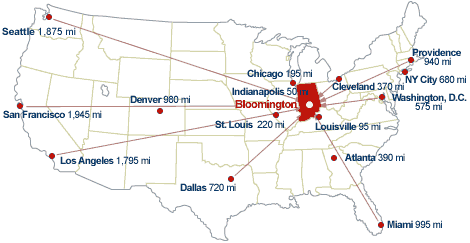
"In the Heart of a Great Country, Beats the Soul of Hoosier Nation." -South Beach Hoosier, 2007
#IUBB, #bannersix
Assembly Hall, Indiana University, Bloomington, Indiana; Click photo to see video of Straight No Chaser's version of Back Home Again In Indiana, 2:37
Hallandale Beach's iconic beachball-colored Water Tower, between beach and A1A/South Ocean Drive

Hallandale Beach, FL; February 16, 2008 photo by South Beach Hoosier
Hollywood in Cartoons, The New Yorker

"Gentlemen, I am happy to announce that as of today we are closing down our Washington news bureau and moving the entire operation to L.A."
Hollywood in Cartoons, The New Yorker
"O.K., so I dig a hole and put the bone in the hole. But what's my motivation for burying it?"
Hollywood in cartoons, 10-21-06 Non-Sequitur by Wiley, www-NON-SEQUITUR.COM
The Magic of Hollywood: A motion has been put forth that we should seek to create rather than imitate. All in favor of killing this silly notion, nod in mindless agreement...
Miami Dolphins
South Beach Hoosier's first Dolphin game at the Orange Bowl came in Dec. 1970, aged 9, a 45-3 win over Buffalo that propelled them into their first ever playoff appearance.
Sebastian the Ibis, the Spirited Mascot of the University of Miami Hurricanes

Before going to my first U-M game at the Orange Bowl in 1972, a friend's father often would bring me home an extra 'Canes game program. That's how I came to have the Alabama at U-M game program from Nov. 16, 1968, which was the first nationally-televised college football night game in color. (A 14-6 loss to the Crimson Tide.) After that first ballgame against Tulane, as l often did for Dolphin games if my father wasn't going, I'd get dropped off at the Levitz parking lot near the 836 & I-95 Cloverleaf in NMB, and catch a Dade County Park & Ride bus, going straight to the Orange Bowl. Onboard, I'd get next to the window and listen to WIOD's pre-game show on my Radio Shack transistor radio. A few times, I was just about the only person onboard besides the bus driver, which was alright by me. Once at the Orange Bowl, if I didn't already have a ticket, I'd buy a game program for myself and one or two for friends or teachers before heading to the ticket window, since you usually couldn't find a program vendor once inside. I probaly had a friend or my father with me for just under 40% of the U-M games I ever went to, but you have to remember that the team, though blessed with several talented players, like Chuck Foreman and Burgess Owens, was just so-so to average at best, and the games were usually played on Friday nights, so it wasn't exactly high on everyone's list of things to do. Depending upon the opponent, if I was alone, I'd often have entire areas of the Orange Bowl to myself. (Wish I had photos of that now!) For instance, I had a good portion of the East (open) End Zone to myself against Oklahoma in the mid-70's, when the Boomer Schooner and the Schooner Crew went out on the field after an Oklahoma TD, and the Schooner received an unsportsmanlike conduct penalty from the refs, as would happen years later in an Orangle Bowl Classic game. (Against FSU?) I was there for the wins and losses under Pete Elliott, Carl Selmer & Lou Saban, and the huge on-field fight in '73 when under eventual national champion Notre Dame (under Ara Parseghian), they called a time-out with less than a minute to go, and already up 37-0. Their rationale? To score another TD and impress the AP football writers; final score 44-0. Well, they got their wish and beat Alabama 24-23 for the title at the Sugar Bowl. A year later, thanks to my Mom's boss, she and I saw Ara's last game as head coach of the Irish in the Orange Bowl Game from the East End Zone -in front of the Alabama cheerleaders!!!- in an exciting 13-11 Notre Dame win over Alabama and Bear Bryant, a rematch of the '73 national title game. I was also present for the U-M's huge 20-15 win under Pete Elliott against Darrel Royal's Texas Longhorns, the week Sports Illustrated's College Football preview issue came out with Texas on the cover, below. I was also present for lots of wins against schools called College of the Pacific, UNLV and Cal-Poly San Luis Obsispo, which I'd then never heard of before.
Miami Dolphins Cheerleaders, April 28, 2007

Photo by Mario J. Bermudez. April 28, 2007 at Dolphins NFL Draft Party at Dolphin HQ, Davie, FL
It's All About "The U"

South Beach Hoosier's first U-M football game at the Orange Bowl was in 1972, age 11, against Tulane in the infamous "Fifth Down" game. In order to drum up support and attendance for the U-M at the Orange Bowl, that game had a promotion whereby South Florida kids who were school safety patrols could get in for free IF they wore their sash. I did. Clearly they knew that it was better to let kids in for free, knowing their parents would give them money to buy food and souvenirs, perhaps become a fan and want to return for future games. The ballgame made an interesting impression on The New York Times, resulting in this gem from the "View of Sport" column of Oct, 14, 1990, labeled 'Fifth Down or Not, It's Over When It's Over.' -"In 1972, aided by a fifth-down officiating gift in the last moments of the game, Miami of Florida defeated Tulane, 24-21. The country and the world was a much different place that fall because The New York Times took time and space to editorialize on the subject. ''Is it right for sportsmen, particularly young athletes, to be penalized or deprived of the goals for which they earnestly competed because responsible officials make mistakes? The ideal of true sportsmanship would be better served if Miami forfeited last week's game.' South Beach Hoosier hardly needs to tell you that this was YET another New York Times editoral that was completely ignored!
The issue I took with me the night of U-M's 20-15 upset of #1 Texas at the Orange Bowl
College Football, Texas No. 1, Hook 'em Horns, Sept. 10, 1973. Living in North Miami Beach in the '70's, my Sports Illustrated usually showed up in my mailbox on the Thursday or Friday before the Monday cover date. And was read cover-to-cover by Sunday morning.
The Perfect Storm
U-M QB Ken Dorsey, Miami Hurricanes Undefeated National Champions 2001, Jan. 2002
Miami's Romp in the Rose
Miami running back Clinton Portis, Jan. 7, 2002
Why the University of Miami should drop football
June 12, 1995
REVENGE!
Steve McGuire and Miami Overpower No.1 Notre Dame, Dec. 4, 1989
How Sweet It Is!
Miami Whips Oklahoma For The National Championship, Pictured: Dennis Kelleher, Jan. 11, 1988
My, Oh My, Miami!
Steve Walsh and the Canes Stun FSU, Oct. 12, 1987
Why Is Miami No. 1?

QB Vinny Testaverde, Nov. 24, 1986
Miracle In Miami
The Hurricanes Storm Past Nebraska, Halfback Keith Griffin, Jan. 9, 1984
Special Issue: College Football
The Best Passer, George Mira of Miami, Sept. 23, 1963
1984 College & Pro Spectatcular
A Pair Of Aces: U-M QB Bernie Kosar & Miami Dolphin QB Dan Marino, Sept. 5, 1984
Pro Football Hall of Fame Special Issue

Dan Marino, Class of 2005, Aug. 2005
FACES OF THE NFL
A Portfolio by Walter Iooss Jr., Ricky Williams, Miami Dolphins, Dec. 9, 2002
Coming Back
Jay Fiedler rallies Miami to a last-second win over Oakland, Oct. 1, 2001
Dan's Last Stand
At 38 and under siege, Dan Marino refuses to go down without a fight, Dec. 13, 1999
The War Zone
In the NFL's toughest division, the surprising Dolphins are on top, Lamar Smith, Dec. 11, 2000
Down and Dirty
Jimmy Johnson's Dolphins Bury The Patriots, Steve Emtman, Sept. 9, 1996
The Sunshine Boys

Now Playing in Miami: The Dan Marino and Jimmy Johnson Show, May 11, 1996
HOT & NOT
Miami loves Pat Riley but wants to give Don Shula the boot, Dec. 11, 1995
NFL PREVIEW 1995
Which of today's stars are locks for the Hall of Fame? Dan Marino for sure. But who else? To find out, we polled the men who do the voting. Sept. 14, 1995
Sportsman Of The Year
Don Shula, Dec. 20, 1993
Dan The Man
Dan Marino Saves The Day For The Dolphins, Jan. 14, 1991
Dangerous Dan
Dan Marino Passes Miami Into The Super Bowl, Jan. 14, 1985
Super Duper!

Wide Receiver Mark Duper Of The Undefeated Dolphins, Nov. 19, 1984
Air Raid! Miami Bombs Washington
+Sep+10,+1984.jpg)
Mark Clayton (burning Darryl Green) Sept. 10, 1984
Rookies On The Rise
Dan Marino: Miami's Hot Quarterback, Nov. 14, 1983
New Life In The WFL
Warfield, Csonka and Kiick of Memphis, July 28, 1975
Zonk! Miami Massacres Minnesota
Larry Csonka, Jan. 21, 1974
Pro Football, Miami Is Rough And Ready
Larry Csonka & Bob Griese, Sept. 17, 1973
Miami All The Way
Bob Griese, Jan. 22, 1973
It's Miami and Washington
Mercury Morris Speeds Past The Steelers, Jan. 8, 1973
Kiick and Csonka, Miami's Dynamic Duo

Larry Csonka & Jim Kiick, Aug. 7, 1972
Sudden Death at Kansas City
Miami's Garo Yepremian Ends the Longest Game; (kneeling) placekick holder Karl Noonan, Jan. 3, 1972
New Pro in a New Town

Miami's Frank Emanuel, Aug. 8, 1966
Old-style "Obie" the Orange Bowl Committee mascot

The iconic image I grew-up with in Miami, before FedEx got into the picture