I grew-up in South Florida as a huge sports fan in the 1970's, played three sports competitively -baseball, football and soccer- and was the Team Manager for two North Miami Beach Senior High School teams that won the Florida State championship.
http://en.wikipedia.org/wiki/North_Miami_Beach_Senior_High_School
(I wrote about 80% of the above Wiki definition.)
To see Street Scene of NMBHS: http://maps.google.com/maps?q=North+Miami+Beach+Senior+High+School&ie=UTF8&ll=25.934659,-80.174553&spn=0.008684,0.010343&t=h&z=16&layer=tc&cbll=25.929149,-80.175365&panoid=iSypIXGVnW7S2RAEg6qT5A&cbp=1,0.6870095273476409,,0,5
The first State Championship was Boys Soccer in 1975 under head coach Vic Cappillo, and then Girls Gymnastics in 1979 under Pete Saponaro, two wonderfully talented and enthusiastic men whom I admired and respected enormously.
For all those reasons, by the time I graduated from NMB in 1979, I had many talented friends around the greater Miami area who were fortunate enough to be offered -and accept- D-1 college athletic scholarships in myriad sports.
Because of those factors, more than most people, I was very familiar with the enormous football talent pool around here, and foresaw the inevitable rise of the Hurricanes, Seminole and Gators' football programs to where we became accustomed down here to the idea of the three of them being ranked in the Top Ten at the beginning and end of every college football season.
To me, it was completely predictable.
So with that in mind, while I was at IU from 1979-83, I was continually frustrated at the number of very talented kids from South Florida -and Central Florida, too- who'd wind up going to smaller schools like the Central, Western or Eastern Michigan, or the like.
Kids who'd be just the sort who'd give IU some much-needed depth so they wouldn't have the sort of second-half collapses against good teams as has long been the norm in Bloomington.
And I wasn't alone in my frustration.
Not to name drop, per se, but Jim Thomas of FT. Lauderdale the-then IU basketball team was a good friend of mine at the time, despite Jim's living over at Teter Quad while I was at Briscoe Quad., near the IU Fieldhouse and Assembly Hall.
(Jim and I were friends despite his single-handily knocking off my school, North Miami Beach, in the state playoffs, at his school's gym, the one year we were arguably THE best team in the state of Florida and favored to win the state championship.)
As both students and sports fans who loved IU, we'd continually bemoan IU's chronic inability to get South Florida kids up to Bloomington, who, while perhaps not stars, were exactly the sorts of very solid, well-rounded kids that make the difference between a solid 7-4 or 8-3 team, and a floundering 5-6 team that raises more questions than they answer.
(Like are they really a 4-7 team that simply got lucky?)
All this frustrating talk of ours was conducted in an era when Michigan had a bona fide South Florida superstar like wideout Anthony Carter and Michigan State had RB Lorenzo White, each of whom were winning games of national importance.
I understand implicitly why someone of their unique caliber were, necessarily, out-of-reach for IU in the Lee Corso years, but must everyone down here with any talent remain un-touchable?
Having finally gotten Direct TV before last Fall, and the Big Ten Network, it's very discouraging as a Hoosier fan to see so many South Florida kids performing for not only Big Ten schools, of course, but, also seeing them play Michigan and Michigan State as the pride of Ypsilanti or Mt. Pleasant, MI, too.
Kids who could've been making a difference in Bloomington, but weren't.
Logically, why in the world should Eastern Michigan continually have better luck at recruiting kids in South and Central Florida than IU? Or Western Michigan for that matter?
And yet... http://www.miamiherald.com/620/story/561110.html
There were opportunities aplenty for IU and Coach Lynch a few months ago, when former NMB QB/DB Doug Wiggins, the Dolphins' 2006 Miami-Dade Player of the Year, was looking to transfer from the U-M. http://hurricanesports.cstv.com/sports/m-footbl/mtt/wiggins_doug00.html
So, what happened with Wiggins?
From my perspective, someone who attended his first Canes game at the Orange Bowl in 1971, last year was littered with lots of broken promises and self-evident poor coaching moves, as Randy Shannon constantly showed his multiple weaknesses as a head college football coach, showing himself as a Coordinator who's now out of his depth.
Against a middling North Carolina State team at the Orange Bowl, U-M completed exactly one pass in the entire game, even putting a WR behind center three times to try to get some offensive momentum generated.
In fact, by the middle of the third quarter, if not earlier, the Wolfpack defense was actually daring the Canes to pass -and they couldn't!
So naturally, after the season, whom did Shannon fire?
Yes, that's right, the Defensive Coordinator whom he'd personally promoted from DBs coach, even though the defense has been sliding steadily for four years due to lousy LB play while Shannon was the D-Coordinator.
Hmmm...
http://ncaabbs.com/archive/index.php/thread-273456.html
Miami Herald quote:
" U-M's Randy Shannon has a good relationship with most local coaches, but North Miami Beach's Jeff Bertani said, "It would be difficult for me to send a kid to UM now. The trust is broken.''Bertani said former NMB standout Doug Wiggins -- who transferred to Western Michigan -- ''was told he had a torn hamstring, which he did not have, because they needed a reason to redshirt him after he played [the first two games].'' Shannon's response? "I don't know anything about that.''
Honestly, a school in IU's iffy position in the football world should've been ready to pounce on him in a second when he decided to transfer out, since he wasn't likely to play a lot at the U-M as a freshman, anyway, despite having been rated the nation's No. 4 cornerback and the No. 33 overall prospect by Rivals.com two years ago.
Instead, now Wiggins will be at Western Michigan and in two years will likely be MUCH BETTER than any defensive player IU has.
I'd be willing to bet that there are probably kids at Immokalee HS right now, up near Lake Okeechobee, that could play or start at IU, and yet based on experience, there seems very little chance that IU will even take a chance on them.
Why?
What's this great strategy at Assembly Hall to become a better and more competitive football team without getting a lot more talented players from Florida?
Sounds like the sports equivalent of Obama somehow imagining he'll win the Electoral College without the state of Florida?
Well, all empirical evidence suggests that both approaches, if continued, are destined to failure.
At a certain point, you don't have to be an IU-trained optometrist to know that something is short-sighted with their current approach, which as always, has them with few dependable playmakers.
I'd be very interested in knowing if any of you are familiar with anything that's been written within the past ten years that details how IU has continually missed the boat on Florida kids who could've added something positive to the campus and to the football program.
If so, please drop me a line with the appropriate URL, so that I'm no longer in the dark.
If not, I may just have to chronicle that sad story myself.
Just in case I didn't make my point strongly enough above, consider the following.
The second day I was ever in the state of Indiana, having flown up by myself from Miami on a late August Thursday afternoon in 1979, days before moving into Briscoe Quad and while checked into the Holiday Inn on S.R 37, I spent most of that afternoon watching the IU football team practice from up in the stands at Memorial Stadium, surrounded by a handful of devoted and curious Hoosier fans, male and female, in various shades of Cream and Crimson.
Yep, that's me.
Sadly, the Miami Herald article below speaks for itself, and is more of the same ol' bad news for Hoosier fans.
______________________________________________
http://www.miamiherald.com/sports/story/596825.html
Columbus wideout Bush commits to Purdue
Posted on Mon, Jul. 07, 2008
BY DAVID QUINONES
LARRY BLUSTEIN'S COMMENTS
Gary Bush, Columbus
Known for his tremendous speed, here is a player who certainly came into his own over the past year. While his quickness and ability to break receptions for long scores has been a lure for colleges, his knowledge of the game is also something that has played in his recruitment as well.
In this Hoosier-state recruiting battle, score one for the Boilermakers.
Columbus' Gary Bush, a 6-1, 180-pound wide receiver, orally committed to attend Purdue University on Sunday night. His decision came after campus visits to Indiana and Purdue two weeks ago.
For Bush, West Lafayette was the clear winner between the two.
''It was really a no-brainer,'' Bush said. "Me and the coach [Joe Tiller] just bonded. It felt like the right place for me to be. Indiana was nice, it was a lot like Purdue, but in the end I chose Purdue.''
He added that he and his parents talked about the long-distance move, but that he has family in nearby Indianapolis and that his folks "supported my decision.''
The explosive Explorer also received attention from Ole Miss, Boston College, Alabama-Birmingham, Troy State and Vanderbilt before ending his recruitment experience early.
The rising senior is a three sport-star who transferred to Columbus from Southridge after his sophomore year. In the 2007-2008 season, Bush was among the Explorers' leaders in receptions -- usually of the breakaway-variety -- while also earning a Miami Herald All-Dade honorable mention for basketball and a second-team slot on the All-Dade Track and Field team.
In a midseason game against Miami Beach, Bush put the game out of reach with a 38-yard touchdown catch against the smaller Hi-Tides secondary. He recorded a 33-yard TD a month later against South Miami. Columbus' deep-threat paced the team with 21.3-yards per catch on the season.
Bush runs a 4.5-40 yard dash and his leaping ability (23-10 long-jump) at 6-1 makes for a huge downfield target. His second place long-jump finish helped Columbus secure the District 15-4A championships in April.
Strength might be an issue, as Columbus coach Chris Merritt says ''there is no offseason'' for the multi-sport Bush to devote lots of time to the weight room.
''For a guy like him, it's more about just maintaining. It's hard with his schedule,'' said Merritt, who describes Bush as an "all-around Division I athlete.''
But Bush says he has a plan for that dilemma.
''We don't start camp for a little while, so right now I'm just in the weight room, doing the work,'' he said.
Bush insisted the answer is not to give up on his other athletic pursuits. He is quick to note that while he and the staff at Purdue talked about the possibility of playing hoops, "Track is a definite. I'll definitely be jumping.''
Reader comments are at:
http://pod01.prospero.com/n/pfx/forum.aspx?msg=49813&nav=messages&webtag=kr-miamitm

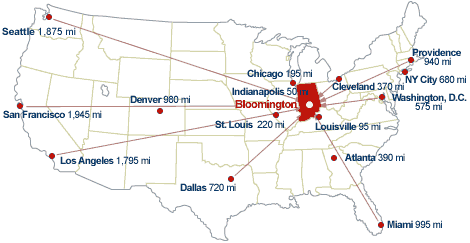
South Beach Hoosier by David Bruce Smith, http://www.southbeachhoosier.blogspot.com/

Memorial Stadium, Bloomington, home of the Hoosiers; Fernando Mendoza TD dive on 4th Down leads to IU's first nat'l football title; The Team; The Head Coach, Curt Cignetti and the Hoosiers 2026 football schedule
Showing posts with label Purdue University. Show all posts
Showing posts with label Purdue University. Show all posts
Thursday, July 10, 2008


Tuesday, June 12, 2007
"Jobs, Taxes Will Ride on Rapid Transit" Charles Whited, Miami Herald March 18, 1979


Last Thursday morning, I had the rare satisfaction that comes from using your foresight wisely, and was at just THE right time at just the right place.
In my case, I'd made it my business to be at the immigration forum sponsored by the Miami-Dade County Hispanic Advisory Board, which was held at the U-M's Bank United Center, in the Cane 100 Room, on the north side of the arena, not far from the court itself.
It was the first time I'd ever been at the arena, having last been around anything involving the U-M and roundball in the late '80's, when during a Christmas visit from D.C., I saw the 'Canes host the Gators at the Knight Center downtown with my then-brother-in-law, Mario.
Maybe it was because everyone else there knew what to expect and acted so blase, but I have to admit now that I was a little perplexed and thrown off-balance once we got in.
It seemed like we were watching a play or tennis match, since, due to the way the U-M basketball court was set-up, all the fans were on the same side of the court.
(That's definitely something that wouldn't have been safe for an IU-Purdue game, no matter how Purdue or the Hoosiers were, whether at home at Assembley Hall or even up Mackey Arena in West Lafayette, which is raised off the ground, like Vanderbilt's old court.
But it was was what "the U" had at the time, and I had a pretty good time, knowing it was far from what I'd been used to seeing from up-close in Bloomington.)
I'll have some posts soon on the forum itself and what I thought of the proceeding, but today, I wanted to share the first in as series of "golden" newspaper articles I dug up out of the Herald archives from the main Miami-Dade Library downtown's Florida room and that neverending insult to technology, microfilm machines.
I'd originally gone in to the library while waiting for the #93 Biscayne Max to whisk me back up towards the Aventura Mall, without the craziness of the 1,001 stops.
But two 93s in a row broke down, and I was getting pissed off as it looked like it was going to rain and I'd have to fight for space under cover with the crowd the Herald just discovered in their story on the horrendous state of downtown Miami.
I decided to make some good use of my time and try to track down some Herald photos from the late '70's of the All-Dade Gymnastics team, most of whom were friends or friends of friends, with one photo in particular in mind.
That was the one I had right near my dorm desk at Briscoe Quad my first two years at IU -the entire All-Dade team on a kid's playground apparatus.
It sounds dopey beyond belief, but it was cleverly executed by the Herald photographer.
Well, apparently, despite the fact that Doritos continues to be the snack choice of millions daily, Frito-Lay continues to tinker with them so they can be new and improved, something that can't be said for microfilm machines, with their blotchy screens, our link to the Guttenberg Bible, where you take your chances with being able to read something onscreen, much less print it correctly and have it not be all helter-skelter.
The first nugget I found and have placed here -thanks to the great guys at Transit Miami www.transitmiami.com ,for giving South Beach Hoosier some nice pub recently for the Macy's vs. Marshall Fields business, and my sense of how apathetic South Florida was about the name change- was from longtime Herald columnist Charles Whited on the upcoming rapid transit system in Miami!
Well, I rode the Metro for the first time in about 15 years -don't forget, I was in DC from1988-2003, using the DC Metro just about everyday- on the way from Government Center to University Station, opposite the Bank United Center.
I took note of fact that according to the information downtown, the northern route that will link the former Joe Robbie Stadium to the rest of the system will be operating in 2013, so I'll have some posts in a day or two on how that might effect Donna Shalala & Company's
impending decision in Coral Gables on moving U-M home games from the Orange Bowl to the former-JRS.
Frankly, I haven't seen anyone else mention this fact yet with regard to the decision, so if you have, please send me a link to the source, since I think it's an important aspect of the debate.
As time allows, I'll try to retype Mr. Whited's column here in case you can't read it easily from the attachment above, but suffice to say, if we only knew then what we know now...
Tuesday, March 20, 2007
IU trustees hire Michael McRobbie to be new IU President
South Beach Hoosier is embarrassed to admit that he only recently became aware of this important news regarding IU's future, two weeks after the fact.
http://www.ibj.com/
Indianapolis Business Journal
Editorial
March 5, 2007
IU recognizes the talent within: McRobbie will provide a fresh start.
Michael McRobbie is from Australia, but he'll be the most Hoosier president of Indiana University since John Ryan stepped down 30 years ago.
And that's something to celebrate.
When the IU trustees on March 1 introduced McRobbie, now interim provost of the Bloomington campus, as the university's next president, they kicked a bad habit that started in 1987: turning over leadership of a state treasure to transient administrators with no previous connection to the university.
McRobbie, who joined IU in 1997 as vice president of information technology, will be the first IU president since Ryan to come from within the university. His welcome hiring rekindles what had been a long tradition of tapping leaders with a genuine passion for IU.
In McRobbie, IU gets a president it's familiar with who is well-versed in its culture. He seems eminently qualified to continue IU's recent successes, many of which he had a hand in, and to shore up weaknesses.
Much of the concern about the university in recent years focused on the perception that its academic reputation was slipping and that outgoing president Adam Herbert, a University of Florida administrator hired in 2003, had failed to communicate a broad vision for IU's future.
Herbert never won the confidence of IU's faculty, which came together early last year to express dissatisfaction with his leadership. Ultimately, McRobbie will have to earn trust with his on-the-job performance, but he's got a big head start on his predecessors in that regard. The faculty already knows him.
McRobbie must also shore up the university's academic reputation and silence critics by being a visible and articulate ambassador for IU. After a decade of learning the institution, it shouldn't take him long to craft a message he can deliver with passion.
He's already well-versed in the role IU plays--along with the state's other major research institutions--in modernizing Indiana's economy. He's been instrumental in securing millions of dollars of grants for scientific research at IU and revamped the university's technology infrastructure, which led to the purchase of the fastest university-owned supercomputer in the country.
More recently, he's been working on a strategy to expand and nurture IU's global presence to create more international work/study opportunities for IU students and faculty.
McRobbie's appointment is already getting high marks from state economic development experts, who believe from working with McRobbie that he'll be an aggressive and effective advocate for programs and policies that attract talent and jobs to IU and the state at large.
It's refreshing--and a bit of a relief--that IU's trustees have finally thrown their support behind an internal candidate for president. Had they ignored the growing call for an inside hire, it would've been a sign that they were badly out of touch with the state they serve.
As it is, the state's oldest and largest public university is once again in familiar--and capable--hands.
___________________________________
Indianapolis Business Journal
March 12, 2007
OPINIONS EYE ON THE PIE Unsolicited advice for IU's next president
Morton Marcus
Congratulations, Dr. McRobbie, on being selected as Indiana University's next president. I've read that you are committed to helping IU become more active in the state's economic development. I've heard that from every IU president since I arrived in 1970. To be successful, it will take major changes.
It is not sufficient to appoint a committee of administrators who then request each part of the university to submit a list of its "economic development activities" for ultimate inclusion in a three-ring binder. Economic development is not advanced by appointing an unqualified faculty member or administrator to reign as czar over an empty realm. Nor will it aid the cause to require some economic development clause in each department's mission statement.
If IU is to become an integral part of and a leader in Indiana's economic development, the commitment must be deeper. Foremost, the faculty must be involved. This is not a case of trying to get faculty in the life sciences to develop patentable products in emulation of Purdue University. IU is an institution where intellect is still valued and, in some areas, still active.
Thus, IU should be the world's foremost academic institution on economic development. Our anthropologists and sociologists must be renowned for their studies of the process of change and the resistance to change.
Some history, literature and philosophy courses could focus on economic and social change as a theme. Undoubtedly, political science professors think they have something to contribute to the subject. In particular, the economics department and business program on each campus have major roles to play in this effort.
The School of Education, a fallow field, should be a major factor in improving the performance of the state's education programs. But, without useful input from our sociologists and anthropologists, I do not see how this can happen. The Kelley School of Business should be the primary source of assistance to existing and newly formed Hoosier firms. The School of Public and Environmental Affairs has a critical role to play in developing public-sector leadership and monitoring environmental issues.
None of this works unless those recruited to the faculty have a proclivity and a preference for such involvement. Faculty must be recognized and rewarded for their economic development efforts, even if these do not result in high-octane journal articles. Thus, existing promotion and tenure policies must be revamped.
IU in the past few years has jumped on the life sciences/biotech bandwagon. It fits with IU's strengths. It fits with the strengths of certain business interests in the state. But is this bandwagon consistent with Indiana's reality today and tomorrow's potential? Here the university must be ready to offer alternatives, based on innovative research, careful analysis and diverse thought that might prove unpopular.
Therein lies the greatest weakness of IU over the past few decades. We have had no stomach to tell truth to the powerful. Our vision has been compromised by the university's fawning obeisance to the governor-of-the-moment and the powerful in the General Assembly. When the president's office does not command the respect of the faculty, and service to the state is unrewarded, faculty members turn to more personal goals.
Finally, the state's economic wellbeing requires earnest and full support from the IU president for each campus. The vision of IU statewide must be robust and funding of regional programs needs to be aggressive. It is time to make the regional campuses full partners in the university or cut them loose from the mother campus's apron strings.
IU presidents have wandered Indiana long enough bemoaning the relative decline of state support. Perhaps if we did more for the state, our efforts would be rewarded.
My best wishes, Dr. McRobbie, for your sanity, the progress of Indiana and the glory of old IU.
Marcus taught economics for more than 30 years at Indiana University and is the former director of IU's Business Research Center. His column appears weekly.
To comment on this column, send e-mail to mortonjmarcus@yahoo.com.
_____________________________________________________
February 26, 2007
Indianapolis Business Journal
IU ready to pick insiderMcRobbie, Pescovitz among finalists for president's job, university trustees confide
By Tracy Donhardt tdonhardt@ibj.com
Indiana University appears poised to choose an internal candidate as president for the first time since it elevated John Ryan to the post 35 years ago. The decision could be announced within days. Two IU trustees confirmed that finalists include Michael McRobbie and Ora Pescovitz, IU administrators well-known to the Indianapolis business community. McRobbie, 56, is interim provost of IU Bloomington and vice president for academic affairs. Pescovitz, 50, is executive associate dean for research affairs at the IU School of Medicine as well as CEO of Riley Hospital for Children.
"I think both of them are eminently qualified," said trustee Philip Eskew, an Indianapolis
doctor. "They're highly respected. We're blessed here. We have two great leaders, either of which we'd be happy with."
Trustee William Cast said that, in addition to McRobbie and Pescovitz, there are two other internal candidates, whom he declined to name. Three of the four, including McRobbie and Pescovitz, "would be high on any recruiter's list," he said.
IU has gone outside the university for its last three presidents-Thomas Ehrlich, Myles Brand and Adam Herbert, who last year announced he would not serve beyond June 2008, when his contract expires. Herbert, a Florida university administrator before assuming IU's presidency in 2004, was widely criticized as having too low a profile and taking too long to make decisions.
Cast said there are clear pluses to pulling a president from the school's ranks.
"One advantage to an inside person is knowledge," said Cast, a Fort Wayne doctor. "It saves a year or more in terms of getting the boat moving forward again."
The nine-person board of trustees will discuss candidates at its next regularly scheduled meeting, which is March 1 and March 2 at IUPUI.
"The plan is, we'd like to announce something" at that time, Eskew said, cautioning that "things do change, however."
Eskew, director of physician and patient relations at St. Vincent Indianapolis Hospital, said the next president needs a background in research, something both McRobbie and Pescovitz have.
Neither McRobbie nor Pescovitz could be reached for comment.
McRobbie joined IU a decade ago as vice president of information technology. In 2003, he also became vice president of research. In that role, he was instrumental in securing multimillion-dollar grants for science initiatives. A year ago, he became interim provost and vice president of academic affairs. His annual salary is $285,600.
Pescovitz, who would be IU's first female president, joined IU 19 years ago. Before becoming CEO of Riley in 2004, she was the top dean of research at the medical school.
In her current post, Pescovitz oversees $210 million in annual grants to the medical school. She also administers the Indiana Genomics Initiative, a research project funded by Lilly Endowment Inc. Her annual salary is $258,500.
Herbert, the outgoing president, earns $359,600.
Eskew hinted the field of candidates from outside IU was disappointing, perhaps because an abundance of other major universities also are trying to fill vacancies.
Two other Big Ten schools are searching for presidents-Purdue and Ohio State-and Harvard University recently chose a new leader, its first female president.
"Competition has caused our search committee to not only look at what candidates are available outside, but also those within our system," Eskew said.
Outside candidates might not have been jumping at the chance to lead IU, he said.
"There are people that feel that we have not had a good run of presidents since John Ryan, so some candidates might be thinking that's not a job they want to apply for," he said. "We need to determine what we need to do. We must improve our image and roll out our life science initiative."
The Purdue post might be drawing more outside interest, he said, because of the perception that outgoing President Martin Jischke has done an outstanding job.
"Many would like to follow him," Eskew speculated.
Sue Talbot, chairwoman of the trustees' search committee, declined to discuss names of candidates. She did confirm that trustees still expect the new leader will be on board by July.
http://www.ibj.com/
Indianapolis Business Journal
Editorial
March 5, 2007
IU recognizes the talent within: McRobbie will provide a fresh start.
Michael McRobbie is from Australia, but he'll be the most Hoosier president of Indiana University since John Ryan stepped down 30 years ago.
And that's something to celebrate.
When the IU trustees on March 1 introduced McRobbie, now interim provost of the Bloomington campus, as the university's next president, they kicked a bad habit that started in 1987: turning over leadership of a state treasure to transient administrators with no previous connection to the university.
McRobbie, who joined IU in 1997 as vice president of information technology, will be the first IU president since Ryan to come from within the university. His welcome hiring rekindles what had been a long tradition of tapping leaders with a genuine passion for IU.
In McRobbie, IU gets a president it's familiar with who is well-versed in its culture. He seems eminently qualified to continue IU's recent successes, many of which he had a hand in, and to shore up weaknesses.
Much of the concern about the university in recent years focused on the perception that its academic reputation was slipping and that outgoing president Adam Herbert, a University of Florida administrator hired in 2003, had failed to communicate a broad vision for IU's future.
Herbert never won the confidence of IU's faculty, which came together early last year to express dissatisfaction with his leadership. Ultimately, McRobbie will have to earn trust with his on-the-job performance, but he's got a big head start on his predecessors in that regard. The faculty already knows him.
McRobbie must also shore up the university's academic reputation and silence critics by being a visible and articulate ambassador for IU. After a decade of learning the institution, it shouldn't take him long to craft a message he can deliver with passion.
He's already well-versed in the role IU plays--along with the state's other major research institutions--in modernizing Indiana's economy. He's been instrumental in securing millions of dollars of grants for scientific research at IU and revamped the university's technology infrastructure, which led to the purchase of the fastest university-owned supercomputer in the country.
More recently, he's been working on a strategy to expand and nurture IU's global presence to create more international work/study opportunities for IU students and faculty.
McRobbie's appointment is already getting high marks from state economic development experts, who believe from working with McRobbie that he'll be an aggressive and effective advocate for programs and policies that attract talent and jobs to IU and the state at large.
It's refreshing--and a bit of a relief--that IU's trustees have finally thrown their support behind an internal candidate for president. Had they ignored the growing call for an inside hire, it would've been a sign that they were badly out of touch with the state they serve.
As it is, the state's oldest and largest public university is once again in familiar--and capable--hands.
___________________________________
Indianapolis Business Journal
March 12, 2007
OPINIONS EYE ON THE PIE Unsolicited advice for IU's next president
Morton Marcus
Congratulations, Dr. McRobbie, on being selected as Indiana University's next president. I've read that you are committed to helping IU become more active in the state's economic development. I've heard that from every IU president since I arrived in 1970. To be successful, it will take major changes.
It is not sufficient to appoint a committee of administrators who then request each part of the university to submit a list of its "economic development activities" for ultimate inclusion in a three-ring binder. Economic development is not advanced by appointing an unqualified faculty member or administrator to reign as czar over an empty realm. Nor will it aid the cause to require some economic development clause in each department's mission statement.
If IU is to become an integral part of and a leader in Indiana's economic development, the commitment must be deeper. Foremost, the faculty must be involved. This is not a case of trying to get faculty in the life sciences to develop patentable products in emulation of Purdue University. IU is an institution where intellect is still valued and, in some areas, still active.
Thus, IU should be the world's foremost academic institution on economic development. Our anthropologists and sociologists must be renowned for their studies of the process of change and the resistance to change.
Some history, literature and philosophy courses could focus on economic and social change as a theme. Undoubtedly, political science professors think they have something to contribute to the subject. In particular, the economics department and business program on each campus have major roles to play in this effort.
The School of Education, a fallow field, should be a major factor in improving the performance of the state's education programs. But, without useful input from our sociologists and anthropologists, I do not see how this can happen. The Kelley School of Business should be the primary source of assistance to existing and newly formed Hoosier firms. The School of Public and Environmental Affairs has a critical role to play in developing public-sector leadership and monitoring environmental issues.
None of this works unless those recruited to the faculty have a proclivity and a preference for such involvement. Faculty must be recognized and rewarded for their economic development efforts, even if these do not result in high-octane journal articles. Thus, existing promotion and tenure policies must be revamped.
IU in the past few years has jumped on the life sciences/biotech bandwagon. It fits with IU's strengths. It fits with the strengths of certain business interests in the state. But is this bandwagon consistent with Indiana's reality today and tomorrow's potential? Here the university must be ready to offer alternatives, based on innovative research, careful analysis and diverse thought that might prove unpopular.
Therein lies the greatest weakness of IU over the past few decades. We have had no stomach to tell truth to the powerful. Our vision has been compromised by the university's fawning obeisance to the governor-of-the-moment and the powerful in the General Assembly. When the president's office does not command the respect of the faculty, and service to the state is unrewarded, faculty members turn to more personal goals.
Finally, the state's economic wellbeing requires earnest and full support from the IU president for each campus. The vision of IU statewide must be robust and funding of regional programs needs to be aggressive. It is time to make the regional campuses full partners in the university or cut them loose from the mother campus's apron strings.
IU presidents have wandered Indiana long enough bemoaning the relative decline of state support. Perhaps if we did more for the state, our efforts would be rewarded.
My best wishes, Dr. McRobbie, for your sanity, the progress of Indiana and the glory of old IU.
Marcus taught economics for more than 30 years at Indiana University and is the former director of IU's Business Research Center. His column appears weekly.
To comment on this column, send e-mail to mortonjmarcus@yahoo.com.
_____________________________________________________
February 26, 2007
Indianapolis Business Journal
IU ready to pick insiderMcRobbie, Pescovitz among finalists for president's job, university trustees confide
By Tracy Donhardt tdonhardt@ibj.com
Indiana University appears poised to choose an internal candidate as president for the first time since it elevated John Ryan to the post 35 years ago. The decision could be announced within days. Two IU trustees confirmed that finalists include Michael McRobbie and Ora Pescovitz, IU administrators well-known to the Indianapolis business community. McRobbie, 56, is interim provost of IU Bloomington and vice president for academic affairs. Pescovitz, 50, is executive associate dean for research affairs at the IU School of Medicine as well as CEO of Riley Hospital for Children.
"I think both of them are eminently qualified," said trustee Philip Eskew, an Indianapolis
doctor. "They're highly respected. We're blessed here. We have two great leaders, either of which we'd be happy with."
Trustee William Cast said that, in addition to McRobbie and Pescovitz, there are two other internal candidates, whom he declined to name. Three of the four, including McRobbie and Pescovitz, "would be high on any recruiter's list," he said.
IU has gone outside the university for its last three presidents-Thomas Ehrlich, Myles Brand and Adam Herbert, who last year announced he would not serve beyond June 2008, when his contract expires. Herbert, a Florida university administrator before assuming IU's presidency in 2004, was widely criticized as having too low a profile and taking too long to make decisions.
Cast said there are clear pluses to pulling a president from the school's ranks.
"One advantage to an inside person is knowledge," said Cast, a Fort Wayne doctor. "It saves a year or more in terms of getting the boat moving forward again."
The nine-person board of trustees will discuss candidates at its next regularly scheduled meeting, which is March 1 and March 2 at IUPUI.
"The plan is, we'd like to announce something" at that time, Eskew said, cautioning that "things do change, however."
Eskew, director of physician and patient relations at St. Vincent Indianapolis Hospital, said the next president needs a background in research, something both McRobbie and Pescovitz have.
Neither McRobbie nor Pescovitz could be reached for comment.
McRobbie joined IU a decade ago as vice president of information technology. In 2003, he also became vice president of research. In that role, he was instrumental in securing multimillion-dollar grants for science initiatives. A year ago, he became interim provost and vice president of academic affairs. His annual salary is $285,600.
Pescovitz, who would be IU's first female president, joined IU 19 years ago. Before becoming CEO of Riley in 2004, she was the top dean of research at the medical school.
In her current post, Pescovitz oversees $210 million in annual grants to the medical school. She also administers the Indiana Genomics Initiative, a research project funded by Lilly Endowment Inc. Her annual salary is $258,500.
Herbert, the outgoing president, earns $359,600.
Eskew hinted the field of candidates from outside IU was disappointing, perhaps because an abundance of other major universities also are trying to fill vacancies.
Two other Big Ten schools are searching for presidents-Purdue and Ohio State-and Harvard University recently chose a new leader, its first female president.
"Competition has caused our search committee to not only look at what candidates are available outside, but also those within our system," Eskew said.
Outside candidates might not have been jumping at the chance to lead IU, he said.
"There are people that feel that we have not had a good run of presidents since John Ryan, so some candidates might be thinking that's not a job they want to apply for," he said. "We need to determine what we need to do. We must improve our image and roll out our life science initiative."
The Purdue post might be drawing more outside interest, he said, because of the perception that outgoing President Martin Jischke has done an outstanding job.
"Many would like to follow him," Eskew speculated.
Sue Talbot, chairwoman of the trustees' search committee, declined to discuss names of candidates. She did confirm that trustees still expect the new leader will be on board by July.
Subscribe to:
Posts (Atom)
In the Heart of a Great Country, Beats the Soul of Hoosier Nation
"In the Heart of a Great Country, Beats the Soul of Hoosier Nation." -South Beach Hoosier, 2007
#IUBB, #bannersix
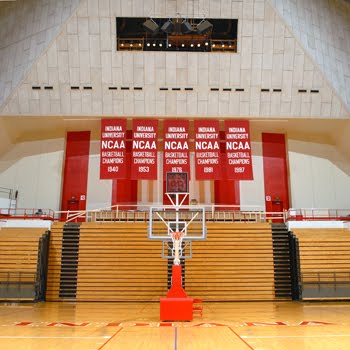
Assembly Hall, Indiana University, Bloomington, Indiana; Click photo to see video of Straight No Chaser's version of Back Home Again In Indiana, 2:37
Hallandale Beach's iconic beachball-colored Water Tower, between beach and A1A/South Ocean Drive

Hallandale Beach, FL; February 16, 2008 photo by South Beach Hoosier
Hollywood in Cartoons, The New Yorker

"Gentlemen, I am happy to announce that as of today we are closing down our Washington news bureau and moving the entire operation to L.A."
Hollywood in Cartoons, The New Yorker
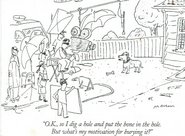
"O.K., so I dig a hole and put the bone in the hole. But what's my motivation for burying it?"
Hollywood in cartoons, 10-21-06 Non-Sequitur by Wiley, www-NON-SEQUITUR.COM
The Magic of Hollywood: A motion has been put forth that we should seek to create rather than imitate. All in favor of killing this silly notion, nod in mindless agreement...
Miami Dolphins
South Beach Hoosier's first Dolphin game at the Orange Bowl came in Dec. 1970, aged 9, a 45-3 win over Buffalo that propelled them into their first ever playoff appearance.
Sebastian the Ibis, the Spirited Mascot of the University of Miami Hurricanes

Before going to my first U-M game at the Orange Bowl in 1972, a friend's father often would bring me home an extra 'Canes game program. That's how I came to have the Alabama at U-M game program from Nov. 16, 1968, which was the first nationally-televised college football night game in color. (A 14-6 loss to the Crimson Tide.) After that first ballgame against Tulane, as l often did for Dolphin games if my father wasn't going, I'd get dropped off at the Levitz parking lot near the 836 & I-95 Cloverleaf in NMB, and catch a Dade County Park & Ride bus, going straight to the Orange Bowl. Onboard, I'd get next to the window and listen to WIOD's pre-game show on my Radio Shack transistor radio. A few times, I was just about the only person onboard besides the bus driver, which was alright by me. Once at the Orange Bowl, if I didn't already have a ticket, I'd buy a game program for myself and one or two for friends or teachers before heading to the ticket window, since you usually couldn't find a program vendor once inside. I probaly had a friend or my father with me for just under 40% of the U-M games I ever went to, but you have to remember that the team, though blessed with several talented players, like Chuck Foreman and Burgess Owens, was just so-so to average at best, and the games were usually played on Friday nights, so it wasn't exactly high on everyone's list of things to do. Depending upon the opponent, if I was alone, I'd often have entire areas of the Orange Bowl to myself. (Wish I had photos of that now!) For instance, I had a good portion of the East (open) End Zone to myself against Oklahoma in the mid-70's, when the Boomer Schooner and the Schooner Crew went out on the field after an Oklahoma TD, and the Schooner received an unsportsmanlike conduct penalty from the refs, as would happen years later in an Orangle Bowl Classic game. (Against FSU?) I was there for the wins and losses under Pete Elliott, Carl Selmer & Lou Saban, and the huge on-field fight in '73 when under eventual national champion Notre Dame (under Ara Parseghian), they called a time-out with less than a minute to go, and already up 37-0. Their rationale? To score another TD and impress the AP football writers; final score 44-0. Well, they got their wish and beat Alabama 24-23 for the title at the Sugar Bowl. A year later, thanks to my Mom's boss, she and I saw Ara's last game as head coach of the Irish in the Orange Bowl Game from the East End Zone -in front of the Alabama cheerleaders!!!- in an exciting 13-11 Notre Dame win over Alabama and Bear Bryant, a rematch of the '73 national title game. I was also present for the U-M's huge 20-15 win under Pete Elliott against Darrel Royal's Texas Longhorns, the week Sports Illustrated's College Football preview issue came out with Texas on the cover, below. I was also present for lots of wins against schools called College of the Pacific, UNLV and Cal-Poly San Luis Obsispo, which I'd then never heard of before.
Miami Dolphins Cheerleaders, April 28, 2007

Photo by Mario J. Bermudez. April 28, 2007 at Dolphins NFL Draft Party at Dolphin HQ, Davie, FL
It's All About "The U"

South Beach Hoosier's first U-M football game at the Orange Bowl was in 1972, age 11, against Tulane in the infamous "Fifth Down" game. In order to drum up support and attendance for the U-M at the Orange Bowl, that game had a promotion whereby South Florida kids who were school safety patrols could get in for free IF they wore their sash. I did. Clearly they knew that it was better to let kids in for free, knowing their parents would give them money to buy food and souvenirs, perhaps become a fan and want to return for future games. The ballgame made an interesting impression on The New York Times, resulting in this gem from the "View of Sport" column of Oct, 14, 1990, labeled 'Fifth Down or Not, It's Over When It's Over.' -"In 1972, aided by a fifth-down officiating gift in the last moments of the game, Miami of Florida defeated Tulane, 24-21. The country and the world was a much different place that fall because The New York Times took time and space to editorialize on the subject. ''Is it right for sportsmen, particularly young athletes, to be penalized or deprived of the goals for which they earnestly competed because responsible officials make mistakes? The ideal of true sportsmanship would be better served if Miami forfeited last week's game.' South Beach Hoosier hardly needs to tell you that this was YET another New York Times editoral that was completely ignored!
The issue I took with me the night of U-M's 20-15 upset of #1 Texas at the Orange Bowl
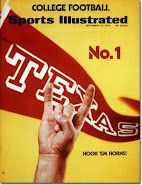
College Football, Texas No. 1, Hook 'em Horns, Sept. 10, 1973. Living in North Miami Beach in the '70's, my Sports Illustrated usually showed up in my mailbox on the Thursday or Friday before the Monday cover date. And was read cover-to-cover by Sunday morning.
The Perfect Storm
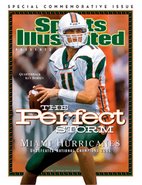
U-M QB Ken Dorsey, Miami Hurricanes Undefeated National Champions 2001, Jan. 2002
Miami's Romp in the Rose
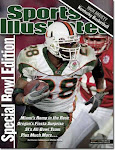
Miami running back Clinton Portis, Jan. 7, 2002
Why the University of Miami should drop football
June 12, 1995
REVENGE!
Steve McGuire and Miami Overpower No.1 Notre Dame, Dec. 4, 1989
How Sweet It Is!
Miami Whips Oklahoma For The National Championship, Pictured: Dennis Kelleher, Jan. 11, 1988
My, Oh My, Miami!
Steve Walsh and the Canes Stun FSU, Oct. 12, 1987
Why Is Miami No. 1?

QB Vinny Testaverde, Nov. 24, 1986
Miracle In Miami
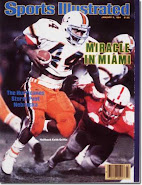
The Hurricanes Storm Past Nebraska, Halfback Keith Griffin, Jan. 9, 1984
Special Issue: College Football
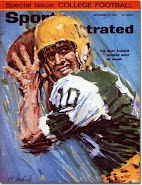
The Best Passer, George Mira of Miami, Sept. 23, 1963
1984 College & Pro Spectatcular
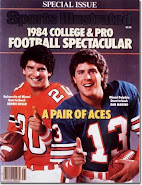
A Pair Of Aces: U-M QB Bernie Kosar & Miami Dolphin QB Dan Marino, Sept. 5, 1984
Pro Football Hall of Fame Special Issue

Dan Marino, Class of 2005, Aug. 2005
FACES OF THE NFL
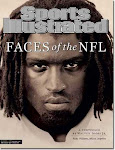
A Portfolio by Walter Iooss Jr., Ricky Williams, Miami Dolphins, Dec. 9, 2002
Coming Back
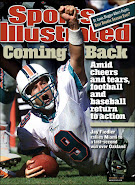
Jay Fiedler rallies Miami to a last-second win over Oakland, Oct. 1, 2001
Dan's Last Stand
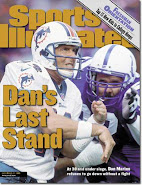
At 38 and under siege, Dan Marino refuses to go down without a fight, Dec. 13, 1999
The War Zone
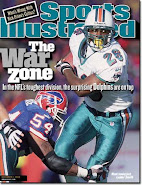
In the NFL's toughest division, the surprising Dolphins are on top, Lamar Smith, Dec. 11, 2000
Down and Dirty
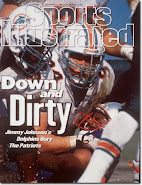
Jimmy Johnson's Dolphins Bury The Patriots, Steve Emtman, Sept. 9, 1996
The Sunshine Boys

Now Playing in Miami: The Dan Marino and Jimmy Johnson Show, May 11, 1996
HOT & NOT
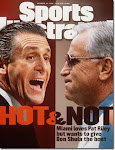
Miami loves Pat Riley but wants to give Don Shula the boot, Dec. 11, 1995
NFL PREVIEW 1995

Which of today's stars are locks for the Hall of Fame? Dan Marino for sure. But who else? To find out, we polled the men who do the voting. Sept. 14, 1995
Sportsman Of The Year
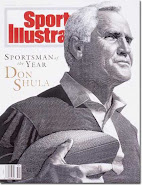
Don Shula, Dec. 20, 1993
Dan The Man
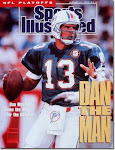
Dan Marino Saves The Day For The Dolphins, Jan. 14, 1991
Dangerous Dan
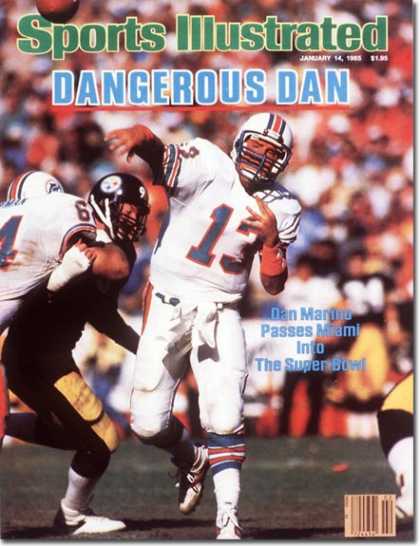
Dan Marino Passes Miami Into The Super Bowl, Jan. 14, 1985
Super Duper!

Wide Receiver Mark Duper Of The Undefeated Dolphins, Nov. 19, 1984
Air Raid! Miami Bombs Washington
+Sep+10,+1984.jpg)
Mark Clayton (burning Darryl Green) Sept. 10, 1984
Rookies On The Rise
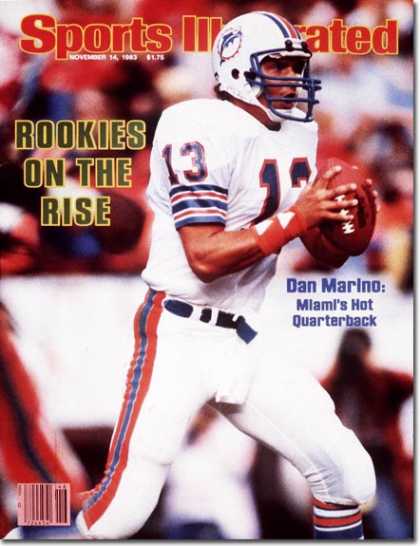
Dan Marino: Miami's Hot Quarterback, Nov. 14, 1983
New Life In The WFL
Warfield, Csonka and Kiick of Memphis, July 28, 1975
Zonk! Miami Massacres Minnesota
Larry Csonka, Jan. 21, 1974
Pro Football, Miami Is Rough And Ready
Larry Csonka & Bob Griese, Sept. 17, 1973
Miami All The Way
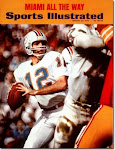
Bob Griese, Jan. 22, 1973
It's Miami and Washington
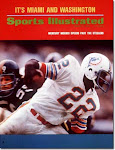
Mercury Morris Speeds Past The Steelers, Jan. 8, 1973
Kiick and Csonka, Miami's Dynamic Duo

Larry Csonka & Jim Kiick, Aug. 7, 1972
Sudden Death at Kansas City
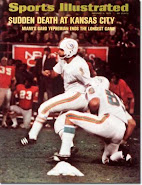
Miami's Garo Yepremian Ends the Longest Game; (kneeling) placekick holder Karl Noonan, Jan. 3, 1972
New Pro in a New Town

Miami's Frank Emanuel, Aug. 8, 1966
Old-style "Obie" the Orange Bowl Committee mascot

The iconic image I grew-up with in Miami, before FedEx got into the picture