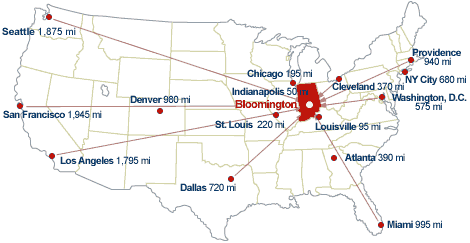
Memorial Stadium, Bloomington, home of the Hoosiers; Fernando Mendoza TD dive on 4th Down leads to IU's first nat'l football title; The Team; The Head Coach, Curt Cignetti and the Hoosiers 2026 football schedule
Showing posts with label University of Miami. Show all posts

Sunday, March 29, 2009

Miami Herald's first online story about Lou Saban's death -wire copy without U-M record. Typical!

Photo of Lou <span class=
Lou Saban, IU football, 1941, 1942, 1942 MVP as QB.

http://iuhoosiers.cstv.com/trads/ind-trads-hof-1982.html


Wrote this first just a little while ago at my other blog, Hallandale Beach Blog.


The Herald's first online story about Lou Saban's death came at 4:40 pm via some wire copy that neglected to include his record at U-M in 1977 and '78 of 3-8 and 6-5, and with a photo that wasn't even of him at Miami, a photo that goes un-credited, like so many photos at the Herald these days not taken by Herald photographers.
I guess the photos just magically appear out of thin air!-


The former IU Hoosier player (IU Hall of Fame, Class of 1982; while I was there) and Hurricanes head coach certainly deserved much better than this crummy lite story, but then so do the much-abused Herald readers!

(A forthcoming blog post here and at South Beach Hoosier, already written, will count the myriad ways that the Herald's sports section has become a veritable laughingstock
over the past five years to any serious sports fan.)

And in case you forgot or never knew, Lou Saban's last game as head coach of the Hurricanes was a 22-21 defeat of the Gators in 1978.
At Gainesville.
That's how you do it!

My guess is that when Randy Shannon finally gets fired early next year, one year too late, it'll be after another in a long line of the very confusing and half-assed losses that have become commonplace under him, begging once more the inevitable question that never really quite goes away: why was someone without any prior major college head coaching
experience ever hired in the first place?-


Longtime football coach Lou Saban dies


BY SPORTS NETWORK


THE SPORTS NETWORK

March 29, 2009

Lou Saban, the longtime college and pro football coach who led the Buffalo Bills to a pair of AFL championships, died early Sunday morning at the age of 87.

Saban coached professional football for 16 years, and most notably led Buffalo to back-to-back AFL titles in 1964-65. He also coached the Boston -- now New England -- Patriots for their first two seasons, in 1960-61 before moving on to Buffalo from 1962-65.

He spent five seasons with Denver (1967-71), overseeing the team through the AFL-NFL merger, and returned to the Bills from 1972-76. Saban's pro teams went 95-99-7.

Away from football, Saban was also president of the New York Yankees from 1981-82.

"He has been my friend and mentor for over 50 years, and one of the people who helped shape my life," Yankees owner and chairperson George M. Steinbrenner said in a statement. "Lou was tough and disciplined, and he earned all the respect and recognition that came his way. He spent a lifetime leading, teaching and inspiring, and took great satisfaction in making the lives around him better. This is a tremendous loss to me personally, and I extend my deepest condolences to his wife, Joyce, and the entire Saban family."

Saban's coaching career also included stints at numerous colleges, Northwestern, Western Illinois, Maryland, Miami, Army and Central Florida.

Saban played college football at Indiana and was with the Cleveland Browns from 1946-49 before moving onto coaching.

___________________________

Former Herald sports writer Jim Martz sets some folks straight who seem

confused about the role of Hurricane QBs in their modern football history.

My first Hurricanes home game was in 1972, and until I left for Bloomington

in August of 1979, I went to well over 95% of their home games at the

Orange Bowl.


Miami Herald

An open letter to UM quarterback Jacory Harris

By Jim Martz, Canesport magazine
October 30, 2008

An open letter to Jacory Harris:

Allow me to invite you to a new history course: Miami Hurricanes Quarterbacks 101. You can bring along fellow freshman quarterbacks Cannon Smith and Taylor Cook. This class should be required for all incoming quarterbacks at the "U." It's not about X's and O's, it's about learning how the great UM quarterbacks became great, how they all needed to be patient and wait their turn.

I'll be the instructor, and I'm not going to talk about reading defenses or calling audibles. I didn't play college football, unless you count being a wide receiver and cornerback on a fraternity flag football team at a Division III school in Michigan. But I have seen every Hurricane team since the 1970s, and I watched the program become Quarterback U, a tradition that has taken a hit lately.

In the modern era of Hurricane football, beginning with 1979 and the arrival of Howard Schnellenberger as coach, there have been seven great quarterbacks: Jim Kelly, Bernie Kosar, Vinny Testaverde, Steve Walsh, Craig Erickson, Gino Torretta and Ken Dorsey. Five of them won national championships. Of the two who didn't, one (Testaverde) won the Heisman Trophy and the other (Kelly) was injured most of his senior year but went on make the Pro Football Hall of Fame.

Here's your first quiz: Do you know what these quarterbacks had in common?

True, they were all right-handed. But that's irrelevant. Answer: Each sat on the bench most or all of their freshman season. They waited their turn. Obviously none transferred. There have been several UM quarterbacks who did transfer. And each one virtually disappeared from the face of college football. The ones who stayed, who paid their dues, so to speak, saw their patience rewarded. You've been patient this season, too, and that paid off in a 49-31 victory at Duke. When Robert Marve struggled, you came in and led the Hurricanes to 35 unanswered points and threw four touchdown passes.

I liked what you said after the game on the Hurricane Sports Network: "I appreciate all the times that Coach Shannon puts me into the game. Whenever it is I'm happy to go into the game, whether it's to bring my team back or keep them ahead. It doesn't matter when I get in or if I get in. I just want the team to win, that's all I worry about."

That's the kind of patience the great ones at UM have needed. Take Testaverde, for instance. He sat for three years before he became "the man," then he led the Hurricanes to the Sugar and Fiesta Bowls, came within one play of winning the national championship and won the Heisman Trophy. He also went on to an NFL career that started before you were born and just ended after 22 years.

Kelly, Kosar, Walsh and Torretta all were redshirted their freshman season. They didn't get quality playing time like you are getting in every game. Yet each one, when he got his chance, played well and took command of the offense.

KELLY'S ODYSSEY

I'll begin these history lessons with Kelly, who was part of Lou Saban's great recruiting class of 1978. That was in the days when the Hurricanes invariably had three quarterbacks -- one departing, one coming and one playing. One quarterback quit in the summer. One incumbent, a senior, was moved to receiver. Another, Kenny McMillian, was injured in the first game. Saban had three freshmen -- Kelly, Mark Richt (now coach at Georgia) and Mike Rodrigue. He went with Rodrigue, who spent most of the season handing off to senior tailback Ottis Anderson, who is still UM's all-time rushing leader.

Saban resigned after that 6-5 season, Schnellenberger took over and started Rodrigue the first seven games in 1979. For the eighth game, the coach decided at the last moment to go with Kelly, who barfed in the locker room before the game, then went on to lead a shocking 26-10 victory at Penn State. That was the genesis of Quarterback U.

The next year Kelly spearheaded the Hurricanes to the Peach Bowl, their first bowl game in 13 seasons. His junior year they went 9-2, losing only to fourth-ranked Texas and 16th-ranked Mississippi State on the road in close games. In the third game of his senior year, 1982, he sustained a dislocated shoulder at Virginia Tech in the third game and was lost for the season.

That same season, the Hurricanes had two freshmen quarterbacks, Kosar and a guy listed in the media guide as Vincent Testaverde. Neither was among the six quarterbacks on the Parade Magazine All-American high school team, but Schnellenberger and his staff rated them as two of the top three quarterbacks in the nation. Plus there was Richt, a senior, and Kyle Vanderwende, a redshirt freshman, who had been all-state at Palm Beach Gardens. That year the Hurricanes arguably had the greatest collection of college quarterbacks in history. Earl Morrall, a former Baltimore Colts and Miami Dolphins star quarterback, was their coach. He attended the flag football game between the Canes and Dolphins in the Orange Bowl's farewell several months ago and agreed this was the best quarterback group ever at one college.

And none transferred.

WAITING THEIR TURN

Jacory, if you want to learn about patience, talk to Kosar and Testaverde. Kosar, who had been Mr. Ohio Football, didn't play at all in 1982. Testaverde, an honorable mention All-American in high school, was fourth string and played briefly in the ninth and 10th games, completing 5 of 12 passes for 79 yards.

Going into the 1983 season, Vanderwende, who went 2-1 as the starter at the end of 1982, and Kosar and Testaverde were considered equal. Schnellenberger picked Kosar "by a whisker" based on "a combination of intelligence, leadership and ability." The Hurricanes lost the opener at Florida 28-3, but Kosar's performance convinced Schnellenberger he had made the right pick. They didn't lose another game, knocking off heavily favored Nebraska in the Orange Bowl Classic to win UM's first national championship.

Testaverde didn't play a down that season. And he was the backup in 1984, Jimmy Johnson's first season, playing in six games and completing 17 of 34 for 184 yards and no touchdowns.

In 1985, when Testaverde became the starter, Walsh arrived as a freshman and was redshirted. As the backup on the great 1986 team, he appeared in two games and completed 1 of 2 passes for 5 yards. He started every game in 1987 as the Hurricanes reloaded and went undefeated to win their second national title. In 1988 he was a first-team All-American as the Canes finished No. 2 behind Notre Dame, which beat them 31-30 at South Bend.

Then it was Erickson's turn. He had been Walsh's backup for two seasons, mostly seeing mop-up duties in lopsided victories. He completed 22 of 37 passes for 307 yards and two touchdowns in 1987 and went 26 for 49 for 379 yards and six TDs in 1988. When he got his chance in 1989 (Dennis Erickson's first year as coach), he led the Hurricanes to their third championship, and in 1990 they finished fourth in the nation.

Enter Torretta, who was redshirted in 1988. As a second-year freshman in 1989 he was thrust into the starting job for four games when Erickson was injured, and he played in six other games. He was Erickson's backup again in 1990, playing in nine games and completing 21 of 41 for 210 yards. When Torretta received his turn, he never lost in two years until his final game and he won the Heisman Trophy. The Canes won the 1991 national title and in 1992 their streak ended in the Sugar Bowl against Alabama.

THE LEAN YEARS

After Torretta, the program went into a lull at quarterback. The Hurricanes had good ones but not great ones -- Frank Costa, Ryan Clement, Ryan Collins, Scott Covington, Kenny Kelly. Also, NCAA sanctions in the mid-1990s cost the team several scholarships. At the end of the decade, Butch Davis built the foundation for the program's rise back to the top. Kenny Kelly might have been the quarterback to take them there, but he was doing double duty as an outfielder in the Tampa Bay Devil Rays organization and opted after the 1999 season to leave school for baseball.

And that opened the door for Dorsey, who in 1999 he became the first true freshman to start at quarterback at UM since Rodrigue in 1978 when he filled in for injured Kelly in three games. Then he started every game for three years, losing only once during the regular season (in 2000), winning the national championship in 2001 and nearly repeating in 2002 while winning the Maxwell Award as the nation's top quarterback. Jacory, you know the history since then, how Brock Berlin and Kyle Wright didn't live up to expectations, how the talent level dropped significantly and the program failed to sign a quarterback in 2005 and 2006.

Now you and redshirt freshman Marve are battling it out. Maybe battling is the wrong word. You guys call it a "partnership," which is rare and I believe is healthy competition. You sounded much older than an 18-year-old after the Duke game when you said, "Robert is a great quarterback and I want everybody to know, because Robert is one of my good friends, I love Robert. So whenever Robert is hot, I want him to stay in. That's how I feel. And vice-versa. We care about each other."

Over the years there have been several quarterbacks who became impatient or frustrated and decided to transfer. Can you name any of them?

Since 1980 they have included Bill Turkowski, Greg Jones, Joe Cole, Bryan Fortay, Alan Hall, Chris Walsh, Steve Kelly, Marc Guillon and even Kirby Freeman, who saw the handwriting on the wall when Marve and you became the heirs apparent.

TRANSFER? PERISH THE THOUGHT

A recent newspaper story quoting your father indicated you might transfer. I know this is a different era than the days of Kosar and Testaverde. These are the days of instant gratification.

But if you want to be one of the great Hurricane quarterbacks, if you want to help build something special with your former Miami Northwestern High School teammates who came to UM with you, eliminate "transfer" from your vocabulary.

I know it has been awkward at times. You started the opener because Marve was suspended for a disciplinary reason, and you looked great, though you beat a Charleston Southern team that your Northwestern Bulls might have defeated. Since then Marve has started every game, but you've seen action in the first half each week. That's meaningful game experience.

There's no way to predict how this will unfold. Marve might struggle so much that coaches have to start you.

Conversely, he might settle down and play great. And you might end up being redshirted next year, creating some separation between you. That's what happened in the Kosar-Testaverde situation. It also helped that Kosar earned his degree in three years and turned pro. Or you and Robert might develop into a two-headed quarterback. I'm sure you've heard the adage that if a team has two quarterbacks it really has none. That's not necessarily true. Florida State ranked sixth in the nation in 1979 and reached the Orange Bowl Classic led by the quarterback tandem of Jimmy Jordan and Wally Woodham. And Florida won the national championship two years ago with Chris Leak starting and Tim Tebow contributing significantly.

Jacory, you remind me and other veteran observers of Dorsey, who was as skinny as a freshman as you are. He was smart and tried to get the ball to the playmakers rather than win the game by himself.

You sounded just like him when you said after the Duke game: 'I'm just having fun running coach [Patrick] Nix's offense. It's a great offense to be in. It gives you a lot of opportunities to make things happen but also to put the ball in playmakers' hands."

You don't have the veteran playmakers he had, but you will. And you have something he lacked -- the ability to run. Just don't run from the "U." Your time will come.

Jim Martz is editor of Canesport magazine.
Below, permanent anchors from my other blog, South Beach Hoosier

IT'S ALL ABOUT "THE U"

It\
South Beach Hoosier's first U-M football game at the Orange Bowl was in 1972, age 11, against Tulane in the infamous "Fifth Down" game. In order to drum up support and attendance for the U-M at the Orange Bowl, that game had a promotion whereby South Florida kids who were school safety patrols could get in for freeIF they wore their sash. I did.
Clearly they knew that it was better to let kids in for free, knowing their parents would give them money to buy food and souvenirs, perhaps become a fan and want to return for future games. The ballgame made an interesting impression on The New York Times, resulting in this gem from the "View of Sport" column of Oct, 14, 1990, labeled 'Fifth Down or Not, It's Over When It's Over.' -"In 1972, aided by a fifth-down officiating gift in the last moments of the game, Miami of Florida defeated Tulane, 24-21.
The country and the world was a much different place that fall because The New York Times took time and space to editorialize on the subject.
''Is it right for sportsmen, particularly young athletes, to be penalized or deprived of the goals for which they earnestly competed because responsible officials make mistakes? The ideal of true sportsmanship would be better served if Miami forfeited last week's game.'
South Beach Hoosier hardly needs to tell you that this was YET another New York Times editorial that was completely ignored!

SEBASTIAN THE IBIS, THE SPIRITED MASCOT OF THE UNIVERSITY OF MIAMI HURRICANES

Sebastian the Ibis, the Spirited Mascot of the University of Miami Hurricanes
Before going to my first U-M game at the Orange Bowl in 1972, a friend's father often would bring me home an extra 'Canes game program. That's how I came to have the Alabama at U-M game program from Nov. 16, 1968, which was the first nationally-televised college football night game in color. (A 14-6 loss to the Crimson Tide.) After that first ballgame against Tulane, as l often did for Dolphin games if my father wasn't going, I'd get dropped off at the Levitz parking lot near the State Road 836 & I-95 Cloverleaf in North Miami Beach, and catch a Dade County Park & Ride bus, going straight to the Orange Bowl. Onboard, I'd get next to the window and listen to WIOD's pre-game show on my Radio Shack transistor radio.
A few times, I was just about the only person onboard besides the bus driver, which was alright by me. Once at the Orange Bowl, if I didn't already have a ticket, I'd buy a game program for myself and one or two for friends or teachers before heading to the ticket window, since you usually couldn't find a program vendor once inside. I probaly had a friend or my father with me for just under 40% of the U-M games I ever went to, but you have to remember that the team, though blessed with several talented players, like Chuck Foreman and Burgess Owens, was just so-so to average at best, and the games were usually played on Friday nights, so it wasn't exactly high on everyone's list of things to do.
Depending upon the opponent, if I was alone, I'd often have entire areas of the Orange Bowl to myself. (Wish I had photos of that now!)
For instance, I had a good portion of the East (open) End Zone to myself against Oklahoma in the mid-70's, when the Boomer Schooner and the Schooner Crew went out on the field after an Oklahoma TD, and the Schooner received an unsportsmanlike conduct penalty from the refs, as would happen years later in an Orangle Bowl Classic game.
(Against FSU?)
I was there for the wins and losses under Pete Elliott, Carl Selmer & Lou Saban, and the huge on-field fight in '73 when under eventual national champion Notre Dame (under Ara Parseghian), they called a time-out with less than a minute to go, and already up 37-0. Their rationale?
To score another TD and impress the AP football writers;
final score 44-0. Well, they got their wish and beat Alabama 24-23 for the title at the Sugar Bowl.
A year later, thanks to my Mom's boss, she and I saw Ara's last game as head coach of the Irish in the Orange Bowl Game from the East End Zone
-in front of the Alabama cheerleaders!!!- in an exciting 13-11 Notre Dame win over Alabama and Bear Bryant, a rematch of the '73 national title game.
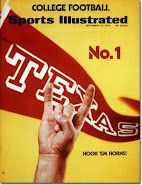
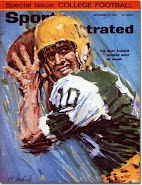
I was also present for the U-M's huge 20-15 win under Pete Elliott against Darrel Royal's Texas Longhorns, the week Sports Illustrated's College Football preview issue came out with Texas on the cover, below.
I was also present for lots of wins against schools called College of the Pacific, UNLV and Cal-Poly San Luis Obsispo, which I'd then never heard of before.

THE ISSUE I TOOK WITH

ME THE NIGHT OF U-M'S

20-15 UPSETOF #1

TEXAS AT THE

ORANGE BOWL

The issue I took with me the night of U-M\
College Football,
Texas No. 1,
Hook 'em Horns,
Sept. 10, 1973.
Living in North Miami
Beach in the '70's,
my Sports Illustrated
usually showed up in
my mailbox on the
Thursday or Friday
before the Monday
cover date.
And was read cover-
to-cover by Sunday
morning.

Canesports is at http://miami.rivals.com/


Hallandale Beach Blog is at http://www.hallandalebeachblog.blogspot.com/


See also: http://www.collegefootballhistory.com/index.htm

Monday, November 26, 2007

Bill Lynch holds Hoosier reins through 2012; Kirby Freeman's future

While I support the decision by IU President Michael McRobbie to give Coach Bill Lynch more time to develop the Hoosier football team into the sort of program that we would all like to see: consistently good, clean and exciting, as a reward for the splendid job he's done of keeping everyone involved in Hoosier football on the same page since Coach Hoeppner's untimely death this past summer, that doesn't mean I think it was quite the 'no-brainer' that I've read and heard many Hoosier fans and columnists say it was since their exciting win over Purdue last Saturday.

IU press release and transcript of Bill Lynch press conference:
http://iuhoosiers.cstv.com/auto_pdf/p_hotos/s_chools/ind/sports/m-footbl/auto_pdf/LynchHC and
http://iuhoosiers.cstv.com/sports/m-footbl/spec-rel/112607aae.html

Letters to the Indy Star re Lynch's future at IU: http://www.indystar.com/apps/pbcs.dll/article?AID=/20071125/SPORTS/711250389/0/LOCAL

Terry Hutchens' take on the contract extension at the Indy Star: http://www.indystar.com/apps/pbcs.dll/article?AID=/20071126/SPORTS0601/711260393/0/LOCAL

Ditto, Doug Wilson's take on it at the Bloomington H-T: http://www.heraldtimesonline.com/stories/2007/11/26/iusports.qp-1049475.sto

Frankly, all these weeks later, I'm STILL trying to digest and make sense of IU's very frustrating 36-31 homecoming loss to Penn State on Oct. 20th, in what was a very winnable game. http://iuhoosiers.cstv.com/sports/m-footbl/recaps/102007aae.html
A classic "trap game" for Penn State one week before their home game against Ohio State.
A win would've gone a long way towards confounding the low expectations that so much of the country still has for the program, especially after a bad 52-27 loss at Michigan State.

(My feeling following that loss to the Nittany Lions was the exact opposite of my mystification at the Hurricanes' improbable victory over FSU up in Tallahassee that same weekend: pleasantly surprised!
Honestly, as a devout Hurricane fan since I was ten-year old in 1971, attending my first 'Canes game, the infamous "Fifth Down" Tulane game, I ask this question: has anyone ever fallen out of favor quicker at the U-M with coaches and fans, and gone straight to 'goat' status quicker than erstwhile 'Cane QB Kirby Freeman after the FSU victory, wherein he was hailed after being pummeled on his winning TD toss, but then could only muster one completed pass a week later at home in the Orange Bowl against a middling North Carolina State team? I think not!

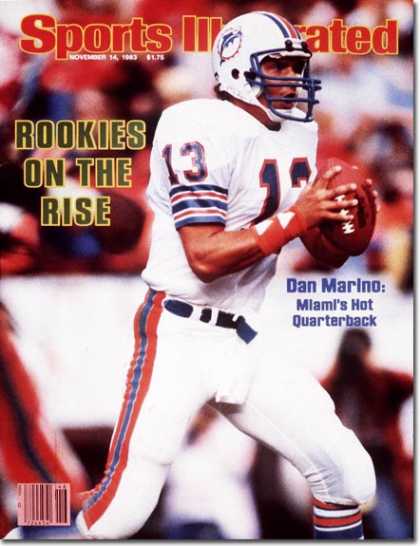
For my two cents, I still think Freeman can contribute, but my suggestion is that he do so by putting on some weight and trying to channel former Dolphin TE -and Boston U. QB- Jim Jensen, one of Dan Marino's favorite targets for so many years, who as any Dolphin fan can tell you, was always clutch with a capital "C."
See Dave Hyde's 1992 Sun-Sentinel piece on Jensen's indispensable role with the team and why fans embraced him: http://www.sun-sentinel.com/sports/football/pro/dolphins/sfl-dolphinsteamjensen07,0,6981786.story
It may come to pass that Kirby Freeman finds that his emotions work better for him as the recipient of a completed pass, rather than as the man behind center. I hope so.)

I'm still upset with Coach Lynch and IU's offensive coordinator , together, channeling former Dolphin head coach and current University of Pittsburgh head man, Dave Wannstedt, late in the second quarter when trailing 20-14.
Pocketing three timeouts while running two ineffective running plays in a row to end the first half, knowing that YOU have to kick off to Penn State to start the second half?
What?

The rather predictable result of this bad strategy after Penn State's first drive of the second half, suddenly trailing 23-14 -and lost momentum!
It's really not brain surgery
.

It reminded me of Wannstedt's infamous clock management skills and overall conservative play-calling, which befell the Dolphins so many times over the years.
In particular, it reminded me of a game at Minnesota in 2000 against a terrific Vikings team just beginning to show their offensive prowess, with Daunte Culpepper, Chris Carter and Randy Moss.

It was the second game of the season and I was temporarily in South Florida for a week, after flying to my dear friend Shannon's wedding near Dallas, where it was only near 110 degrees everyday in the shade, before heading back up to my life in Washington, D.C.
Now any honest and realistic Dolphin fan -not always the majority to be sure- would've told you before the game that IF you could hold the high-powered Vikings to a single field goal in the first half, you'd have taken that in a heartbeat, and taken your chances in the second half.

And that was exactly the situation the Dolphins found themself in, trailing 3-0 with about two minutes to go in the first half.
Close to mid-field right before half-time, Wannstedt pocketed time-outs rather than putting the team in a position where Olindo Mare could at least try a field goal on the last play of the half to tie it, which would surely have given the team a much-needed if only temporary morale boost.
Long story short, Daunte Culpepper, in his second career start, threw for 355 yards in a game the Vikings narrowly won by a margin of 13-7.
It was yet another of a series of never ending missed opportunities I witnessed with the Dolphins, Redskins, Orioles and Hoosiers of that era.

Roughly at the same time as the Penn State loss, I also failed to note the pride I felt in seeing the two lengthy CBS News segments that examined the IU football team's role in the Sideline Response System (SRS), research being done in Bloomington on head injuries and concussions. http://iuhoosiers.cstv.com/sports/m-footbl/spec-rel/102307aab.html

The official CBS version of this, complete with video, is titled "An Electronic Eye On Hard Knocks, New Helmet Can Detect Concussion By Measuring G-Force — And Alerting Doctors" is well worth seeing.
http://www.cbsnews.com/stories/2007/10/17/eveningnews/main3378662.shtml?source=search_story

I first heard about this development in this Ken Kingery story on January 26th, right before the Super Bowl down here between the Colts and the Bears.
http://uits.iu.edu/~ocmhp/2007/01-26/story.php?id=1081
"IU’s squad now equipped with helmets that gauge impact"

See this story, with an excellent photo, in M.I.T.'s Technology Review magazine:
http://www.technologyreview.com/Infotech/19356/?a=f

Saturday, November 10, 2007

U-M saying adios to the Orange Bowl

Excerpt from my Tuesday, August 21, 2007 post
SouthBeachHoosier Time Machine: The Orange Bowl Isn't Worth Drive to Dade

Let me share a piece of SBH trivia so that you have some historical context for understanding my feelings on the Orange Bowl as an institution and the U-M, so you where I'm coming from.
The first time I was ever in the Orange Bowl was the last game of the Dolphins 1970 season, a 45-7 victory over the Buffalo Bills that propelled the Dolphins to their first playoff game, a loss to the Oakland Raiders in the muddy slop that was the Oakland-Alameda Coliseum.
My very first U-M football game in the Orange Bowl was in 1972, when I saw the famous U-M vs. Tulane "Fifth Down" game, which U-M won in Coach Fran Curci's last year.
(This was back in the day when North Miami Beach had LOTS of Tulane and Newcomb alums, many of whom were parents of my friends.)

I'd gone to the game because Mrs. Wharton, the beloved librarian at Fulford Elementary School in North Miami Beach, where I was an eleven-year old 6th grader, told me one day that as the school sponsor for the Fulford safety patrol, she'd gotten word from the U-M that all South Florida kids in the safety patrol wearing their orange/red safety sashes would get into the game for free. (That's how desperate the U-M was for fans back in the day!)

I knew Mrs. Wharton pretty well since I was one of the 4-5 boys at Fulford who had A/V privileges, essentially kids who did well enough in school that if it was okay with my other teachers, if Mrs. Wharton needed help, we'd get out of class and rig up the film projector for her and run it for the younger kids.
She knew I was a devout football fan in general, from my always talking about the Dolphin games -I was a Dolphin season ticket holder for the first time in '72, the Perfect Season, and still recall getting the package in the mail from the Dolphins' then-HQ at 330 Biscayne Blvd., opening it carefully and and staring at all the interconnected, colorful football tickets like they were treasure, too nervous to actually separate them until the day of the game- she thought I'd probably be interested in seeing the Hurricanes.

Mrs. Wharton was 100% right, of course, so I suspect it was a rhetorical question, since she was always joking about my listening and re-listening to an NFL Films record in the library -with huge elementary school-type headphones- that featured all sorts of great play-by-play material, including a snippet of the Don Meredith-led Dallas Cowboys calling a play in the huddle, which I still recall. Since you asked it went exactly like this: "Brown right up, 13 take left, on one, ready, break!"

She said she'd dig up an extra safety patrol sash for me to wear, and about two hours before the game, I and a few other interested prospective U-M fans met her and her husband next to Fulford, giddy about going to the Orange Bowl.
I don't recall all the particulars in great detail, but I do recall that she told us that she and her husband were both U-M alums.
She'd even gone to the trouble of making us a copy of the lyrics to the U-M alma mater song for us to practice in the car drive down to the Orange Bowl, because she said that at some point, the crowd would stand up and sing and she wanted us to be prepared.Believe me, by the time we got there, we knew the first verse!
Oddly enough, a friend of my father had gone to a U-M vs. Alabama game in 1968, the first year we lived here, and bought a game program for me -the first of my collection- so I actually had looked at the lyrics a few times before as I had perused the program over and over again.

It was the first of dozens and dozens of U-M games I'd see over the years before leaving for IU in August of 1979, whether by myself or with friends, often via the Dade County buses that ran from the Levitz furniture parking lot west of the Golden Glades interchange, straight down
I-95 to the ballgame, the same ones that I usually used to get to Dolphin games.

I saw teams that were both known and unknown, ranked and unranked, from UNLV and College of the Pacific, and thanks to Woody Thompson, to the huge upset over Texas the week Sports Illustrated picked them first in their annual college football issue in 1975.
I saw many games against Notre Dame over the years, from the fight-marred game in 1974,Ara Parseghian's last year at ND, when they really got the huge OB crowd into a frenzy by calling a timeout with just seconds left, so they could score another meaningless touchdown to impress the AP football writers who voted in the AP Poll. (This was back in the day when the syndicated Notre Dame football program with veteran broadcaster Lindsey Nelson was telecast locally every Sunday morning, right before the NFL pregame shows, so I knew the ND players as well as I knew the U-M players, if not better.
"We pick up the action later in the third quarter at the Purdue 20-yard line...")

On a trip back from Evanston, I even was able to see the shutout shellacking administered to the ND team led by Heisman trophy winner Tim Brown.

THE highlight of all those games was being at the 1984 Orange Bowl Classic victory over Nebraska, when I was literally touching the railing behind the team bench seconds before running out onto the field with thousands of other delirious U-M fans as the gun sounded, giving them their first national championship.

Saturday, August 25, 2007

Coach Shannon's secrecy concerns

Carolyn Braff has the story on U-M head football coach Randy Shannon's stealthy approach to injuries, like tailback Charlie Jones, and the reporting of same, in her post titled, Not A Word Or A Picture: While some pros are busy faking injuries, Miami is trying to keep theirs as quiet as possible.
http://slog.cstv.com/tapeitup/2007/08/miami_not_a_word_or_a_picture.html

Wednesday, August 22, 2007

U-M President Donna Shalala on move from Orange Bowl

My nephew Mario, who starts his Junior year at the U-M today, thoughtfully sent me this copy of the email that everyone in Hurricane Nation received yesterday about the decision to leave the Orange Bowl for Dolphin Stadium starting next year.
Obviously the U-M letterhead was on the top of the letter, but otherwise it's exactly as it appears in the original letter.
___________________________________
Date: Tue, 21 Aug 2007 11:09:12 -0400
From: umcommunications@MIAMI.EDU
Subject: A Message from President Shalala

If you have problems reading this, visit http://www.miami.edu/president/dialogue/dialogue_08_21_07.html.

August 21, 2007
To the University Community:
We have an extraordinary history and tradition at the Orange Bowl: The players running through the smoke tunnel. “Touchdown Tommy” and his cannon. The Ring of Honor. An incredible winning streak of 58 consecutive home wins. And three of our five national championships were won on that field. I love the Orange Bowl—we all do!
As many of you are aware, the University has been working closely with the City of Miami to assess the feasibility of making much-needed renovations to the Orange Bowl. It has long been our goal to have a first-class football stadium.The City of Miami has been a wonderful partner with us at the Orange Bowl for many years, and they understand how hard we have wrestled with a very difficult decision. Mayor Manny Diaz has been heroic in his efforts to meet our future needs. After much thought, analysis, and discussions with many, many of our trustees, faculty, staff, students, alumni, and fans, we have concluded that we must move our football games to a better facility. The more than $200 million in renovations that the city has proposed would only provide basic and mostly infrastructural upgrades. A part of those funds are not in hand and may or may not be determined until after the proposed construction would be well underway. Overall, the renovations clearly would not address the long-term needs of our athletes and our fans.
The Orange Bowl chapter of our history—in which we can all take great pride—will never close, and we are confident that the legacy of Miami Hurricanes football will live on and thrive as we move to a new location. After an assessment of all options available to us, we have decided reluctantly and painfully to move to Dolphin Stadium for the 2008 season.
Dolphin Stadium is one of the premier football stadiums in the country. At our new home, our student-athletes will have the opportunity to compete in a first-class facility that plays host to the NFL’s Miami Dolphins, the FedEx Orange Bowl, BCS National Championship Game, and that has been the site of recent and upcoming Super Bowls.
Our fans will experience outstanding amenities including one of the world’s largest plasma TV displays, high-definition video boards, club seating and suites, chairbacks on every stadium seat, approximately 14,000 parking spaces, and a large variety of concessions and restaurants.The end zones will be redone so that our shared home will reflect both Miami teams’ pride. The Dolphins are actively pursuing a corporate sponsor so that by 2010 the stadium will have a neutral name.
I want to assure all members of our University community—students, faculty, staff, alumni, trustees, donors, friends—and the tens of thousands of fans who regularly cheer us on, that we looked exhaustively into every aspect of the choices in front of us, and that your needs figured prominently in our final decision. The quality of your experience at our games is of the utmost importance to us.
As always, we would like to hear from you. Please contact us at an e-mail address we have established for your comments: umfootball@miami.edu. If you have any further questions, please go to the Official Athletic Department Web site at hurricanesports.com or call
1-800-GO-CANES.

Thank you, and Go ’Canes!
Sincerely,
Donna E. Shalala

Office of the President
P.O. Box 248006 Coral Gables, Florida 33124-4600
305-284-5155
Fax 305-284-3768

Tuesday, August 21, 2007

SouthBeachHoosier Time Machine: Reviewing the Battle of the Orange Bowl

Continuing with the decision by U-M President Donna Shalala and the U-M Board of Trustees to do what's right for the school, the team and the vast majority of South Florida's Hurricane fans by leaving the Orange Bowl in the rear-view mirror, what follows is the March 16, 1979 Miami Herald story by Bill Rose, which ran about two months before the Bill Braucher column that was the basis for my last post.

It traces the history of how Dolphins owner Joe Robbie got the better of Dade County Mayor Steve Clark and Commissioner J.L Plummer by publicly embarrassing them, simply by telling the truth to the gathered NFL owners in Hawaii, which, unhappily for Clark and Plummer, was a history replete with broken promises to Robbie and the Dolphins and real threats for them to move out of Miami if they didn't like it.

Joe Robbie, who'll be the future subject of a South Beach Hoosier post dealing with his role as the Dade County Democratic Party chair, lived long enough to call their bluff and have the last laugh!

Yes, the fights over beer sales, and the fights in court when the Dolphins prevailed and the govt. didn't like it and appealed and lost again, the threat to prevent the Dolphins from actually playing a preseason game in the Orange Bowl, et al.


This as the NFL owners convened to decide among other things, the site of the 1981 Super Bowl, which turned out to be Detroit, even as Miami officials took it for granted that they were in the driver's seat.
(That was Super Bowl XVI, where the 49ers beat the Bengals 26-21, the first of their Super Bowl meetings, with the second coming in SB XXIII in Miami, with the 49ers winning 20-16.)
Just as was the case with the Braucher column post, I'll try to write out the story in the future here in case you can't read it completely.


Reviewing the Battle of the Orange Bowl, Bill Rose, March 16, 1979, Miami Herald

SouthBeachHoosier Time Machine: The Orange Bowl Isn't Worth Drive to Dade

Well, given both the inevitability and the finality of the news coming out of Coral Gables today regarding the future of the Hurricanes playing at the Orange Bowl, I've been waiting to share the following 1979 archive with you for months, keeping it in my blogging holster, ready to fire when the time was right. That's today.
Miami Herald: UM says so long to the Orange Bowl
http://www.miamiherald.com/598/story/210237.html

South Florida Sun-Sentinel: Hurricanes leaving Orange Bowl for Dolphin Stadium
http://www.sun-sentinel.com/sports/college/hurricanes/sfl-canesmove082107,0,5652498.story?coll=sofla_tab01_layout

Let me share a piece of SBH trivia so that you have some historical context for understanding my context regarding the Orange Bowl as an institution and the U-M, so you where I'm coming from.

The first time I was ever in the Orange Bowl was the last game of the Dolphins 1970 season, a 45-7 victory over the Buffalo Bills that propelled the Dolphins to their first playoff game, a loss to the Oakland Raiders in the muddy slop that was the Oakland-Alameda Coliseum.
My very first U-M football game in the Orange Bowl was in 1972, when I saw the famous
U-M vs. Tulane "Fifth Down" game, which U-M won in Coach Fran Curci's last year.
(This was back in the day when North Miami Beach had lots of Tulane and Newcomb alums, many of whom were parents of my friends.)

I'd gone to the game because Mrs. Wharton, the beloved libararian at Fulford Elementary School in North Miami Beach, where I was an eleven-year old 6th grader, told me one day that as the school sponsor for the Fulford safety patrol, she'd gotten word from the U-M that all South Florida kids in the safety patrol wearing their orange/red safety sashes would get into the game for free. (That's how desperate the U-M was for fans back in the day!)

I knew Mrs. wharton pretty well since I was one of the 4-5 boys at Fulford who had A/V privileges, essentially kids who did well enough in school that if it was okay with my other teachers, if Mrs. Wharton needed help, we'd get out of class and rig up the film projector for her and run it for the younger kids.
She knew I was a devout football fan in general, from my always talking about the Dolphin games -I was a Dolphin season ticket holder for the first time in '72, the Perfect Season, and still recall getting the package in the mail from the Dolphins' then-HQ at 330 Biscayne Blvd., opening it carefully and and staring at all the interconnected, colorful football tickets like they were treasure, too nervous to actually separate them until the day of the game- she thought I'd probably be interested in seeing the Hurricanes.
Mrs. Wharton was 100% right, of course, so I suspect it was a rhetorical question, since she was always joking about my listening and re-listening to an NFL Films record in the library -with huge elementary school-type headphones- that featured all sorts of great play-by-play material, including a snippet of the Don Meredith-led Dallas Cowboys calling a play in the huddle, which I still recall. Since you asked it went exactly like this: "Brown right up, 13 take left, on one, ready, break!"

She said she'd dig up an extra safety patrol sash for me to wear, and about two hours before the game, I and a few other interested prospective U-M fans met her and her husband next to Fulford, giddy about going to the Orange Bowl.
I don't recall all the particulars in great detail, but I do recall that she told us that she and her husband were both U-M alums.

She'd even gone to the trouble of making us a copy of the lyrics to the U-M alma mater song for us to practice in the car drive down to the Orange Bowl, because she said that at some point, the crowd would stand up and sing and she wanted us to be prepared.
Believe me, by the time we got there, we knew the first verse!

Oddly enough, a friend of my father had gone to a U-M vs. Alabama game in 1968, the first year we lived here, and bought a game program for me -the first of my collection- so I actually had looked at the lyrics a few times before as I had perused the program over and over again.

It was the first of dozens and dozens of U-M games I'd see over the years before leaving for IU in August of 1979, whether by myself or with friends, often via the Dade County buses that ran from the Levitz furniture parking lot west of the Golden Glades interchange, straight down I-95
to the ballgame, the same ones that I usually used to get to Dolphin games.
I saw teams that were both known and unknown, ranked and unranked, from UNLV and College of the Pacific, and thanks to Woody Thompson, to the huge upset over Texas the week Sports Illustrated picked them first in their annual college football issue in 1975.
I saw many games against Notre Dame over the years, from the fight-marred game in 1974,
Ara Parseghian's last year at ND, when they really got the huge OB crowd into a frenzy by calling a timeout with just seconds left, so they could score another meaningless touchdown to impress the AP football writers who voted in the AP Poll.
(This was back in the day when the syndicated Notre Dame football program with veteran broadcaster Lindsey Nelson was telecast locally every Sunday morning, right before the NFL pregame shows, so I knew the ND players as well as I knew the U-M players, if not better.
"We pick up the action later in the third quarter at the Purdue 20-yaard line...")
On a trip back from Evanston, I even was able to see the shutout shellacking administered to the ND team led by Heisman trophy winner Tim Brown.
the highlight of all those games was being at the 1984 Orange Bowl Classic victory over Nebraska, when I was literally touching the railing behind the team bench seconds before running out onto the field with thousands of other delirious U-M fans as the gun sounded, giving them their first national championship.

This Bill Braucher story is an insightful piece of South Florida history which, to me at least, speaks volumes for all manner of current and past public policy problems/govt. projects that have beset South Florida for the past forty years: inertia, apathy, incompetency and finances.
I've been keeping it at the ready since first having it printed out at the Miami-Dade County Main Library downtown, and seeing the downtown's myraid problems "up close and personal" for the first time in months.
I knew something was askew when all the library restrooms were closed and patrons were instructed to use a public facilty in the plaza that was the haunt of the homeless and the inebriated.
Lets' just say that you could smell it a block away.
(I'd stopped at the library on my way back up from attending a fascinating immigration forum at the U-M in May, itself a microcosm of the South Florida that wants to cling to the comfortable past and those who want a future built on logic and reason.
Using my power of persuasion, mastery of facts and a general willingness to really grill some of the forum participants, I was able to get some people at the table, one in particular, to admit that perhaps -definitely!- their own personal and professional immigration policy prescriptions have created painful costs for the country as a whole, ones they seem to consciously prefer to ignore.
The result of that kind of thinking was the public's overwhelming rejection of, hate for and the defeat of President Bush's comprehensive immigration package in Congress, despite how the skids were greased, even while the public was kept in the dark about its various provisions .
Okay, since you asked, the one in particular I refer to was Cheryl Little, Executive Director of the Florida Immigration Advocacy Center,
http://www.fiacfla.org/index.php who since then has been on TV as much as ever calling for immigration policies that rely too much on the heart and not enough on the head.
Convenient for her but not so much for the rest of the country who want policies that aren't completely ad hoc but which are based on the law, reason, logic and predictbility.
Which reminds me, I'll finally get around to describing that whole morning there at the U-M's BankUnited Center in an upcoming post, months overdue, complete with a copy of the program, so you know who all the players were.)

This March 18, 1979 Bill Braucher column below, which ran on the front page of the Sunday Broward news section, serves as a painful reminder that even when or IF you were to eliminate all the current incompetent people in the City of Miami responsible for the disgraceful current condition of the Orange Bowl -and have you seen the city's website for the OB, which seems like something a junior high school kid did over a weekend, with none of the sorts of historical photos that you'd expect to give it context,
http://www.orangebowlstadium.com/pages/- it's important to keep in mind that, just like cholesterol, it's not just environment, it's genetics which determines a patient's health. The City of Miami has very recessive genes.
Logical result: The Orange Bowl has been sick for decades!

To read this column from those pre-cable, pre-internet days is to be reminded all over again of the sorts of half-assed things that were commonplace back in 1979, when Dolphins owner Joe Robbie was getting screwed over once again by the kangaroo court that was Miami's powers-that-be, principally Dade County mayor Steve Clark.
To date myself, yours truly was then a senior at North Miami Beach Senior High School, a true-blue fan who never missed a Dolphins or Hurricanes home game.

Titled Orange Bowl Isn't Worth Drive to Dade, Braucher, the Herald's former Dolphin beat writer -who later became their Broward editor- when I was growing up as a kid in the '70's , mentions some very telling anecdotes that perfectly illustrates that the City of Miami's bad attitude isn't just a recent phenomena, rather it's a living, breathing entity that's been around for decades, regardless of its core competency to solve the problem either intelligently or in a financially prudent fashion.

At a future date, I'll try to write it out for those who can't read it completely when you capture it with your computer mouse.


Orange Bowl Isn't Worth Drive to Dade, Bill Braucher, Miami Herald, March 18, 1979

Tuesday, August 14, 2007

Coming Soon: Mistakes of The NY Times

I have news for you today about a new award-winning South Beach Hoosier feature to come, one that you can do your own variation of on your own blog if you so choose, depending upon your particular interests or longstanding bête noire.

You might recall that I hinted at something like this the other day, when telling you about the New York Times finally letting us know via their Corrections box on page 2A -but NOT in their online edition- that the name of the college campus in Coral Gables was the University of Miami and not Miami University.
(You know, the one in the state of Ohio!)

Well, I'm seriously thinking of having a regular review of NYT Corrections on my blog here, one where I can talk and ruminate about what those kind of chronic, deep-seated and engrained misunderstandings of the country, as well as its history, people and pop culture, necessarily portends for the country they're attempting to describe to its millions of readers around the world. (Definitely not good news, that's for sure.)

I say this as someone who had more than a few friends working in the Washington bureau of the New York Times on Eye Street, just two blocks from The White House.

They toiled as reporters, editors and administrators, many of whom I stood up for when necessary, when they were publicly criticized by some for what I saw as overtly political or ideological reasons that lacked a solid foundation in facts.

These were very smart and professional people, folks whom I had meals with, went to ballgames or movies with, and in some cases, I even got to know the names of their kids and spouses -and accompanying family drama.

These were the very people who often told me all sorts of crazy Times insider/bureaucracy dope that I found alternately hilarious or cringe-worthy, and also shared well-founded journalism rumors that I often wished I hadn't known in many cases. Some of them you've no doubt heard of, but most you haven't.

A select few even beat me in the NYT's NCAA tourney pool, which I participated in every year, while still others simply watched as my prescient picks like Valpo sailed thru their brackets.

But it doesn't, of course, make them or their colleagues at the paper immune to reasonable criticism, which is why over the years I've sent more than my share of letters to the Times old ombudsman, Byron Calame, for lapses that should've gotten the reporter sent down to the minors for seasoning and exiled to a small town like, well, to use a Florida reference, Appalachicola.

My first one concerned a beautifully written article regarding a very contentious court case in New York and the rulings issued by the judge. The problem was that the reporter never mentioned the actual name of the judge.

I will take a momentary pass here on the opportunity to get off on a tangent about the desperate need for the Miami Herald to join the 21st century and have a reader ombudsman, though I will mention that I found it very, very curious that in last week's Herald wire coverage of the U.S. National Swimming Championships in Indianapolis, at the beginning of the month, that the Herald sports editor let run at least two stories that NEVER mentioned the name of the venue where the championships was actually held at:

PHELPS WINS; RIVAL IS DQ'D from August 3rd and 'ANOTHER MICHAEL MOMENT' FOR PHELPS from August 2nd.
Hmmm...

South Beach Hoosier, do you mean the national championships at the Indiana University Natatorium, on the campus of IUPUI? Why yes, that one!
Does that make me parochial?
No, just protective of slights to Hoosier Nation, and disappointed that in the year 2007, such a basic aspect of the story doesn't even get mentioned and the Herald sports editor, among many others, is either too stupid or oblivious to notice it
Not that this is a new trend or anything in the Herald's sports section!

Why just today, in their sports TV listings, which as I've detailed here before, is MORE noteworthy for what they often don't include -U-M, FIU and FAU games- as for what they do include, had a Barclay's English Premier League game listed, but listed the league as "Premiere."
http://www.miamiherald.com/671/story/203495.html

It was listed as 3 p.m.: English Premiere League, Reading-Chelsea, FOXESP (Spanish).

Hmmm.. that's funny, the league itself doesn't and never has spelled their name with an "e" at the end, much less on their own website,
http://www.premierleague.com/page/Home/0,,12306,00.html so I guess that's just another classic case of the Herald being the Herald, facts be damned.

By the way, given the huge mistake described below regarding the ongoing case in Newark, confusing actual numbers with percentages, don't hold your breath waiting for the TV networks to make this correction about the horrendous Newark college kids murder case, as at least two of them I watched reported the wrong info last week also.
Even their mistakes are repeated!

Below: Their words, my highlighted italics.
___________________________
CORRECTIONS: FOR THE RECORD
New York Times
August 13, 2007

Correction: An article in Science Times on July 17 about the widespread distribution of "Atlas of Creation," a book with an Islamic creationist point of view, not only incorrectly identified a company involved in shipping some of the books but misstated its role and its responsiveness to questions. The company, SBS Worldwide Ltd. (not SDS Worldwide, as the article had it, and corrected in this space on July 21), says it cleared a shipment of the books through customs but had nothing to do with their further distribution in the United States. SBS Worldwide Ltd. did not return calls and e-mail messages asking about its role before the article was published because it never got any; The Times had sent the questions to the wrong company. This correction was delayed in the confusion.
___________________
Correction: For the Record
New York Times
August 11, 2007

Correction: An article on Tuesday about the challenges faced by Mayor Cory A. Booker of Newark as he struggles to bring down the city's homicide rate referred incorrectly to the drop in shootings in the city over the past year. Before last weekend, when five people were shot -- four fatally -- there were 80 fewer shootings from January through July compared with the same period in 2006 -- not 80 percent fewer.
___________________
Correction: For the Record
New York Times
August 7, 2007

Correction: Because of an editing error, the "Most Popular" listing in the Most Wanted chart in Business Day yesterday, listing top sellers among re-released music CDs, misspelled the name of a singing duo. It is Simon and Garfunkel, not Simon and Garfunkle.
____________________
Corrections: For the Record
New York Times
July 26, 2007

Correction: A "What's On Tonight" television listing on Tuesday about "Into Alaska With Jeff Corwin," on the Travel Channel, referred incorrectly to Alaska. It was the 49th state admitted to the union -- not the 50th, which was Hawaii.

Saturday, August 11, 2007

Correction of the NY Times: Geography Not Our Strong Suit

I've waited patiently since it first ran July 25th in the hard copy of the New York Times, biding my time and thinking every day when I woke up, "Well, perhaps today will be the day that they make that correction to the NYT website.'
Initially, when I first saw it and saw no mention of it anywhere else, I thought that maybe I had imagined it. But there it was in the paper I had set aside in my bedroom, in that pile of stuff to follow-up on.
Then I thought of mentioning this to various media friends, especially as U-M president Donna Shalala seemed to be on TV everywhere for a bit, not just local TV Miami stations but also making headlining appearances on This Week with George Stepohanolpolous, as part of her explaining the findings of her presidential investigation with her co-chair, former Senator Bob Dole, on the deficient health care practices and policies at VA facilities that injured troops have been forced to deal with since returning from Iraq and Afghanistan.
But three weeks later, the New York Times has yet to put this correction on their website or the various databases that have access to The Times, so consider it a community service, a personal privilage if you will, for me to be the first one to share the breaking news: the location of the University of Miami.

July 25, 2007 Corrections: For The Record
An article in the special Education Life section on Sunday about the popularity of Southern colleges misstated the name of one in Coral Gables, Fla. It is the University of Miami, not Miami University.

You'd think the national championships and all the press, both pro and con, might've made an impression, eh?

Besides all the other ways of checking the Times site, I even checked their Education webpage and noticed that, perhaps out of fear of embarrassment, they neglected to mention it there as well. C'est la vie.
As you'll see in future posts, geography, as well as the pop culture they pretend to cover, is NOT the strong suit of the New York Times.

University of Miami
News about the University of Miami, including commentary and archival articles published in The New York Times.
http://topics.nytimes.com/top/reference/timestopics/organizations/u/university_of_miami/index.html

Monday, May 7, 2007

Omar Kelly's sad reminder: U-M player Bryan Pata's murder still unsolved

Go to the Sun-Sentinel website, below, to see some really touching photos as well as a photo gallery of Bryan, his family and U-M teammates, and how they've tried to honor him and keep his spirit alive in them.

Sun-Sentinel Hurricanes beat reporter Omar Kelly, never one to shy away from his feelings, shares some additional thoughts on Bryan Pata:
"Bryan was in my thoughts on draft day. While I watched Jon Beason's family celebrate Beason achieving that life altering dream of making it to the NFL I thought about the pain the Pata family was in. Not just on draft day, but every day."
Read the whole entry on Omar's consistently prescient and insightful blog at:
http://blogs.sun-sentinel.com/sports_college_hurricanes/

The Sun-Sentinel's up-to-date 'Canes site is at:
http://www.sun-sentinel.com/sports/college/hurricanes/
______________________________________________________________
http://www.sun-sentinel.com/sports/sfl-sppata07may07,0,3820662.story
UM player's slaying 6 months ago remains unsolved
By Omar Kelly
South Florida Sun-Sentinel
May 7, 2007

NORTH MIAMI ·

Jeanette Pata's world is still turned upside down.

The Haitian immigrant who worked double shifts as a hotel maid to provide for her nine children can no longer work. She barely eats, and according to her 24-year-old twin sons, Edwin and Edrick Pierre-Pata, their mom still wakes up every other night crying, grieving over her youngest child, Bryan Pata, the University of Miami defensive lineman who was murdered six months ago today.

"She's still stuck thinking that Bryan will appear, come peeking out from around the corner. She still hears his voice, and every time it happens it crushes your spirit," said Edwin, the former Florida State tight end.

He had to leave his Tallahassee apartment to talk about his deceased brother because his mother was staying with him for a few days.

Talking about Bryan usually depressed Jeanette, who chokes up when she hears his name or anything about the Hurricanes. She was in Tallahassee because the NFL Draft took place the previous weekend and Jeanette knew all the buzz was going to be too much for her to avoid and handle.

Everyone who knew Bryan, from Miami Central High, knew he spent most of his life working toward and dreaming about the draft weekend. The signing bonus he anticipated was going to allow him to provide for his family, which had moved at least 20 times throughout his childhood because of financial struggles.

But those dreams ended on Nov. 7. An hour after leaving practice, Bryan Pata was murdered outside his Kendall apartment.The fun-loving, 22-year-old criminology major, whose world centered around his large family, football and tricked-out cars, was shot multiple times in the back of his head.

Instead of experiencing the highs and lows of draft weekend, Bryan, a two-year starter who was projected by some NFL Draft analysts as a potential mid-round selection, was buried Nov. 14 in the beige suit he planned to wear to his draft party.

His grave at Dade North Memorial Park lies across from the football field where he and his older brothers, Edwin and Edrick, who also played college football, grew up training, pushing one another to their limits.

Bryan's father, Junior Pierre, manicures the lawn every two weeks. Jeanette makes sure fresh flowers are always present, growing among the stuffed animals, balloons and a football with R.I.P. written on it. Edrick says every time he visits the grave he notices something new one of Bryan's friends has left, and for a moment, he smiles at the thought of how many lives Bryan touched.

The family plans to move him to a tomb 15 feet away when it finishes paying for the plot. The plan is for all the family someday to be buried around him.
Edrick said there's rarely a minute when he doesn't think about Bryan, and he knows he shares that habit with his siblings since the family's Sunday dinners haven't been the same.

A lot of the dinner discussions are about the investigation. Edrick admits he's obsessed with it.

"They have a lot of information, a lot of leads, but they can only tell us part of what's going on," Edwin said. "We try to fill in the other parts, but we've learned we can't do that."

A week ago, investigators told Edrick the case was starting "to heat up" with more leads. But after six months, there's no motive, no suspects and plenty of suspicion, despite the $25,000 reward for a tip leading to an arrest.

Jada Brody, Pata's girlfriend from West Palm Beach, and Dwayne Hendricks, Bryan's UM teammate who also shared the apartment, found his body just off the complex parking lot. According to Edwin, Brody mourned Bryan as much as the family did and has transferred from UM to Clemson.

Three Miami-Dade investigators call occasionally to update the family on the case and any leads. But when the phone calls stop and detectives take a few days to return messages, the Patas admit they become more discouraged.

Miami-Dade police refuse to discuss the investigation or details of Pata's murder.

"In open homicide investigations, we don't make a lot of comments so we don't take the chance of compromising the investigation," said Detective Mary Walters, a spokeswoman for the Miami-Dade Police Department. "The need to know could run the risk of jeopardizing the case."

The family hired private investigator Greg Slate, hoping he would lead them to something relevant. But Edwin wasn't pleased with Slate's few discoveries and said Slate hasn't been in touch with the family after being featured in HBO's Real Sports segment about Bryan's murder. Attempts to reach Slate were unsuccessful.

Edwin Pata said if Bryan had died in a car accident or by something health-related, his death wouldn't be so unsettling. He suspects the family would have grieved, remembered and "maybe eventually coped." But with Bryan murdered execution style, the family has had a more difficult time.

Edwin, who graduated from FSU last spring and is working on a master's degree in educational leadership, said the only hope he has for closure is finding the killer.

Edrick has theories that his brother was killed by some element of "organized crime." He bases that off the police questions, and things people have told him, but won't elaborate.

"It was premeditated murder. They plotted on my brother," said Edrick, who played receiver at Division II Virginia Union. "They watched him. Someone knew and studied Bryan to the fullest, to the point where they knew what time he leaves practice, the route he took, when he gets home, where he parks his car."

Edrick pointed out that Pata's Infiniti QX56 SUV, a truck his brother-in-law helped him buy, wasn't stolen. Neither was his jewelry, nor the $700 Bryan had in his pocket that day to pay bills.

"They only wanted to kill Bryan," Edrick said. "In the process, they've destroyed my family."

If you have information about the murder of Bryan Pata, call Crime Stoppers, anonymously, at 305-471-TIPS (8477).

Omar Kelly can be reached at okelly@sun-sentinel.com.
Copyright © 2007, South Florida Sun-Sentinel

In the Heart of a Great Country, Beats the Soul of Hoosier Nation

In the Heart of a Great Country, Beats the Soul of Hoosier Nation
"In the Heart of a Great Country, Beats the Soul of Hoosier Nation." -South Beach Hoosier, 2007

#IUBB, #bannersix

#IUBB, #bannersix
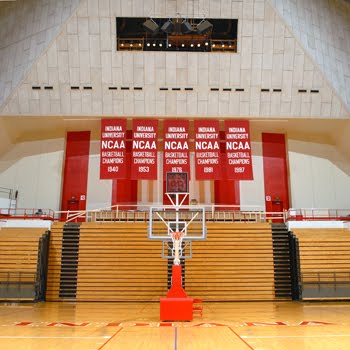
Assembly Hall, Indiana University, Bloomington, Indiana; Click photo to see video of Straight No Chaser's version of Back Home Again In Indiana, 2:37
The South Florida I Grew Up In

Excerpts from Joan Didion's Miami, 1987, Simon & Schuster:

In the continuing opera still called, even by Cubans who have now lived the largest part of their lives in this country, el exilo, the exile, meetings at private homes in Miami Beach are seen to have consequences. The actions of individuals are seen to affect events directly. Revolutions and counter-revolutions are framed in the private sector, and the state security apparatus exists exclusively to be enlisted by one or another private player. That this particular political style, indigenous to the Caribbean and to Central America, has now been naturalized in the United States is one reason why, on the flat coastal swamps of South Florida, where the palmettos once blew over the detritus of a dozen failed booms and the hotels were boarded up six months a year, there has evolved since the early New Year's morning in 1959 when Fulgencio Batista flew for the last time out of Havana a settlement of considerable interest, not exactly an American city as American cities have until recently been understood but a tropical capital: long on rumor, short on memory, overbuilt on the chimera of runaway money and referring not to New York or Boston or Los Angeles or Atlanta but to Caracas and Mexico, to Havana and to Bogota and to Paris and Madrid. Of American cities Miami has since 1959 connected only to Washington, which is the peculiarity of both places, and increasingly the warp...

"The general wildness, the eternal labyrinths of waters and marshes, interlocked and apparently neverending; the whole surrounded by interminable swamps... Here I am then in the Floridas, thought I," John James Audobon wrote to the editor of The Monthly American Journal of Geology and Natural Science during the course of an 1831 foray in the territory then still called the Floridas. The place came first, and to touch down there is to begin to understand why at least six administations now have found South Florida so fecund a colony. I never passed through security for a flight to Miami without experiencing a certain weightlessness, the heightened wariness of having left the developed world for a more fluid atmosphere, one in which the native distrust of extreme possibilities that tended to ground the temperate United States in an obeisance to democratic institutions seemed rooted, if at all, only shallowly.

At the gate for such flights the preferred language was already Spanish. Delays were explained by weather in Panama. The very names of the scheduled destinations suggested a world in which many evangelical inclinations had historically been accomodated, many yearnings toward empire indulged...

In this mood Miami seemed not a city at all but a tale, a romance of the tropics, a kind of waking dream in which any possibility could and would be accomodated...
Hallandale Beach Blog
http://www.hallandalebeachblog.blogspot.com/

Hallandale Beach Blog is where I try to inject or otherwise superimpose a degree of accountability, transparency and much-needed insight onto local Broward County government and public policy issues, which I feel is sorely lacking in local media now, despite all the technological advances that have taken place since I grew-up in South Florida in the 1970's. On this blog, I concentrate my energy, enthusiasm, anger, disdain and laser-like attention primarily on the coastal cities of Aventura, Hollywood and Hallandale Beach.

IF you lived in this part of South Florida, you'd ALREADY be in stultifying traffic, be paying higher-than-necessary taxes, and be continually musing about the chronic lack of any real accountability or transparency among not only elected govt. officials, but also of City, County and State employees as well. Collectively, with a few rare exceptions, they couldn't be farther from the sort of strong results-oriented, work-ethic mentality that citizens here deserve and are paying for.

This is particularly true in the town I live in, the City of Hallandale Beach, just north of Aventura and south of Hollywood. There, the Perfect Storm of years of apathy, incompetency and cronyism are all too readily apparent.
Sadly for its residents, Hallandale Beach is where even the easily-solved or entirely predictable quality-of-life problems are left to fester for YEARS on end, because of myopia, lack of common sense and the unsatisfactory management and coordination of resources and personnel.

It's a city with tremendous potential because of its terrific location and weather, yet its citizens have become numb to its outrages and screw-ups after years of the worst kind of chronic mismanagement and lack of foresight. On a daily basis, they wake up and see the same old problems again that have never being adequately resolved by the city in a logical and responsible fashion. Instead the city government either closes their eyes and hopes you'll forget the problem, or kicks them -once again- further down the road.

I used to ask myself, and not at all rhetorically, "Where are all the enterprising young reporters who want to show through their own hard work and enterprise, what REAL investigative reporting can produce?"

Hearing no response, I decided to start a blog that could do some of these things, taking the p.o.v. of a reasonable-but-skeptical person seeing the situation for the first time.
Someone who wanted questions answered in a honest and forthright fashion that citizens have the right to expect.

Hallandale Beach Blog intends to be a catalyst for positive change. http://www.hallandalebeachblog.blogspot.com/

Hallandale Beach's iconic beachball-colored Water Tower, between beach and A1A/South Ocean Drive

Hallandale Beach's iconic beachball-colored Water Tower, between beach and A1A/South Ocean Drive
Hallandale Beach, FL; February 16, 2008 photo by South Beach Hoosier

Hollywood in Cartoons, The New Yorker

Hollywood in Cartoons, The New Yorker
"Gentlemen, I am happy to announce that as of today we are closing down our Washington news bureau and moving the entire operation to L.A."

Hollywood in Cartoons, The New Yorker

Hollywood in Cartoons, The New Yorker
"O.K., so I dig a hole and put the bone in the hole. But what's my motivation for burying it?"

Hollywood in cartoons, 10-21-06 Non-Sequitur by Wiley, www-NON-SEQUITUR.COM

Hollywood in cartoons, 10-21-06 Non-Sequitur by Wiley, www-NON-SEQUITUR.COM
The Magic of Hollywood: A motion has been put forth that we should seek to create rather than imitate. All in favor of killing this silly notion, nod in mindless agreement...

Miami Dolphins

Miami Dolphins
South Beach Hoosier's first Dolphin game at the Orange Bowl came in Dec. 1970, aged 9, a 45-3 win over Buffalo that propelled them into their first ever playoff appearance.

Sebastian the Ibis, the Spirited Mascot of the University of Miami Hurricanes

Sebastian the Ibis, the Spirited Mascot of the University of Miami Hurricanes
Before going to my first U-M game at the Orange Bowl in 1972, a friend's father often would bring me home an extra 'Canes game program. That's how I came to have the Alabama at U-M game program from Nov. 16, 1968, which was the first nationally-televised college football night game in color. (A 14-6 loss to the Crimson Tide.) After that first ballgame against Tulane, as l often did for Dolphin games if my father wasn't going, I'd get dropped off at the Levitz parking lot near the 836 & I-95 Cloverleaf in NMB, and catch a Dade County Park & Ride bus, going straight to the Orange Bowl. Onboard, I'd get next to the window and listen to WIOD's pre-game show on my Radio Shack transistor radio. A few times, I was just about the only person onboard besides the bus driver, which was alright by me. Once at the Orange Bowl, if I didn't already have a ticket, I'd buy a game program for myself and one or two for friends or teachers before heading to the ticket window, since you usually couldn't find a program vendor once inside. I probaly had a friend or my father with me for just under 40% of the U-M games I ever went to, but you have to remember that the team, though blessed with several talented players, like Chuck Foreman and Burgess Owens, was just so-so to average at best, and the games were usually played on Friday nights, so it wasn't exactly high on everyone's list of things to do. Depending upon the opponent, if I was alone, I'd often have entire areas of the Orange Bowl to myself. (Wish I had photos of that now!) For instance, I had a good portion of the East (open) End Zone to myself against Oklahoma in the mid-70's, when the Boomer Schooner and the Schooner Crew went out on the field after an Oklahoma TD, and the Schooner received an unsportsmanlike conduct penalty from the refs, as would happen years later in an Orangle Bowl Classic game. (Against FSU?) I was there for the wins and losses under Pete Elliott, Carl Selmer & Lou Saban, and the huge on-field fight in '73 when under eventual national champion Notre Dame (under Ara Parseghian), they called a time-out with less than a minute to go, and already up 37-0. Their rationale? To score another TD and impress the AP football writers; final score 44-0. Well, they got their wish and beat Alabama 24-23 for the title at the Sugar Bowl. A year later, thanks to my Mom's boss, she and I saw Ara's last game as head coach of the Irish in the Orange Bowl Game from the East End Zone -in front of the Alabama cheerleaders!!!- in an exciting 13-11 Notre Dame win over Alabama and Bear Bryant, a rematch of the '73 national title game. I was also present for the U-M's huge 20-15 win under Pete Elliott against Darrel Royal's Texas Longhorns, the week Sports Illustrated's College Football preview issue came out with Texas on the cover, below. I was also present for lots of wins against schools called College of the Pacific, UNLV and Cal-Poly San Luis Obsispo, which I'd then never heard of before.

Miami Dolphins Cheerleaders, April 28, 2007

Miami Dolphins Cheerleaders, April 28, 2007
Photo by Mario J. Bermudez. April 28, 2007 at Dolphins NFL Draft Party at Dolphin HQ, Davie, FL

Of cheerleaders past and present

Given South Florida's unique version of the melting pot -con salsa- demographics and mindset, these women in the photo above are surely what most South Floridians would consider attractive women. But for this observer, who's spent hours & hours at IU cheerleader tryouts and who has known dozens of cheerleaders -and wannabes- in North Miami Beach, Bloomington, Evanston and Washington, D.C., the whole time I was watching these members of the Dolphins' squad perform, I couldn't help but compare them and their routines to those of some IU friends of mine who ALWAYS showed true Hoosier spirit & enthusiasm. Sitting at my table right near the stage and still later, while watching the long lines of Dolphin fans of all ages waiting to snap photos of themselves with the cheerleaders, I couldn't help but think about those friends who always left me and other Hoosier fans feeling positive & optimistic. Was there anyone I saw in Davie who possessed these valuable intangibles: the dancing precision of IU Red Stepper -and Captain- Gail Amster, my talented and spirited Phi Beta Kappa pal from Deerfield (IL), who always sat next to me in our Telecom. classes as we took turns entertaining the other; the ebullient spirit & energy of two Hoosier cheerleaders -and captains- from Bloomington, Wendy (Mulholland) Moyle & Sara Cox; the hypnotic, Midwestern, girl-next-door sexiness of Hoosier cheerleader Julie Bymaster, from Brownsburg; or, the adorable Southern girl-next-door appeal of former Hoosier Pom squader Jennifer Grimes, of Louisville, always such a clear distraction while sitting underneath the basket? Nope, not that I could see. But then they were VERY tough acts to follow!!! And that's not to mention my talented & spirited friends like Denise Andrews of Portage, Jody Kosanovich of Hammond & Linda Ahlbrand of Chesterton, all of whom were dynamic cheerleaders -and captains- at very large Hoosier high schools that were always in the championship mix, with Denise's team winning the Ind. football championship her senior year when she was captain -just like in a movie. That Denise, Jody & Linda all lived on the same dorm floor, just three stories above me at Briscoe Quad our freshman year, was one of the greatest coincidences -and strokes of luck for me!- that I could've ever hoped for. You could hardly ask for better ambassadors of IU than THESE very smart, sweet and talented women. In a future SBH post, I'll tell the story of one of the greatest Hoosiers I ever met, the aforementioned Wendy Mulholland, the Bloomington-born captain and emotional heart of the great early '80's IU cheerleading squads, and the daughter of Jack Mulholland, IU's former longtime Treasurer. The acorn doesn't fall far from a tree built on a foundation of integrity & community service! (After he retired, Mr. Mulholland was the first executive director of the Community Foundation of Bloomington and Monroe County. I used to joke with Wendy that her dad's name was the one that was permanently affixed to the bottom of my work-study checks for years, while I worked at the Dept. of Political Science's Library, first, at the Student Building in the old part of campus, and then later, after it was refurbished, in magnificent Woodburn Hall, my favorite building on campus.) In that future post, I'll share some reflections on Wendy's great strength of character and personality; my intentions of returning to Bloomington a few weeks before Fall '82 classes started, so I could help Wendy train and work-out to rehab her knee, so she'd feel confident in trying-out for the squad again, following a bad knee injury that'd left her physically-unable to try-out for the squad the previous spring, a big disappointment to those of us who cared about both Wendy and the team; my incredulity at, quite literally, running into Wendy while walking down a sidewalk one afternoon a few years later in Evanston, IL, when we were astonished to discover we were both living there, with me trying to hook on with a Windy City advertising agency, and Wendy then-attending Kellogg (KGSM) at Northwestern, right when the WSJ had named Kellogg the #1 Business School in the country. I'll also share a story about Wendy performing a true act of kindness towards me in 1982, when I was having a real emergency, and she went above-and-beyond what I had any logical reason to expect. Yet, Wendy, along with her very helpful dad, Jack, came through for me when I was in a very bad time crunch. I've never forgotten Wendy's kindness towards me, and her true Hoosier spirit. There's NOTHING I wouldn't do for Wendy Mulholland.

It's All About "The U"

It's All About "The U"
South Beach Hoosier's first U-M football game at the Orange Bowl was in 1972, age 11, against Tulane in the infamous "Fifth Down" game. In order to drum up support and attendance for the U-M at the Orange Bowl, that game had a promotion whereby South Florida kids who were school safety patrols could get in for free IF they wore their sash. I did. Clearly they knew that it was better to let kids in for free, knowing their parents would give them money to buy food and souvenirs, perhaps become a fan and want to return for future games. The ballgame made an interesting impression on The New York Times, resulting in this gem from the "View of Sport" column of Oct, 14, 1990, labeled 'Fifth Down or Not, It's Over When It's Over.' -"In 1972, aided by a fifth-down officiating gift in the last moments of the game, Miami of Florida defeated Tulane, 24-21. The country and the world was a much different place that fall because The New York Times took time and space to editorialize on the subject. ''Is it right for sportsmen, particularly young athletes, to be penalized or deprived of the goals for which they earnestly competed because responsible officials make mistakes? The ideal of true sportsmanship would be better served if Miami forfeited last week's game.' South Beach Hoosier hardly needs to tell you that this was YET another New York Times editoral that was completely ignored!

The issue I took with me the night of U-M's 20-15 upset of #1 Texas at the Orange Bowl

The issue I took with me the night of U-M's 20-15 upset of #1 Texas at the Orange Bowl
College Football, Texas No. 1, Hook 'em Horns, Sept. 10, 1973. Living in North Miami Beach in the '70's, my Sports Illustrated usually showed up in my mailbox on the Thursday or Friday before the Monday cover date. And was read cover-to-cover by Sunday morning.

The Perfect Storm

The Perfect Storm
U-M QB Ken Dorsey, Miami Hurricanes Undefeated National Champions 2001, Jan. 2002

Miami's Romp in the Rose

Miami's Romp in the Rose
Miami running back Clinton Portis, Jan. 7, 2002

Why the University of Miami should drop football

Why the University of Miami should drop football
June 12, 1995

REVENGE!

REVENGE!
Steve McGuire and Miami Overpower No.1 Notre Dame, Dec. 4, 1989

How Sweet It Is!

How Sweet It Is!
Miami Whips Oklahoma For The National Championship, Pictured: Dennis Kelleher, Jan. 11, 1988

My, Oh My, Miami!

My, Oh My, Miami!
Steve Walsh and the Canes Stun FSU, Oct. 12, 1987

Why Is Miami No. 1?

Why Is Miami No. 1?
QB Vinny Testaverde, Nov. 24, 1986

Miracle In Miami

Miracle In Miami
The Hurricanes Storm Past Nebraska, Halfback Keith Griffin, Jan. 9, 1984

Special Issue: College Football

Special Issue: College Football
The Best Passer, George Mira of Miami, Sept. 23, 1963

1984 College & Pro Spectatcular

1984 College & Pro Spectatcular
A Pair Of Aces: U-M QB Bernie Kosar & Miami Dolphin QB Dan Marino, Sept. 5, 1984

Pro Football Hall of Fame Special Issue

Pro Football Hall of Fame Special Issue
Dan Marino, Class of 2005, Aug. 2005

FACES OF THE NFL

FACES OF THE NFL
A Portfolio by Walter Iooss Jr., Ricky Williams, Miami Dolphins, Dec. 9, 2002

Coming Back

Coming Back
Jay Fiedler rallies Miami to a last-second win over Oakland, Oct. 1, 2001

Dan's Last Stand

Dan's Last Stand
At 38 and under siege, Dan Marino refuses to go down without a fight, Dec. 13, 1999

The War Zone

The War Zone
In the NFL's toughest division, the surprising Dolphins are on top, Lamar Smith, Dec. 11, 2000

Down and Dirty

Down and Dirty
Jimmy Johnson's Dolphins Bury The Patriots, Steve Emtman, Sept. 9, 1996

The Sunshine Boys

The Sunshine Boys
Now Playing in Miami: The Dan Marino and Jimmy Johnson Show, May 11, 1996

HOT & NOT

HOT & NOT
Miami loves Pat Riley but wants to give Don Shula the boot, Dec. 11, 1995

NFL PREVIEW 1995

NFL PREVIEW 1995
Which of today's stars are locks for the Hall of Fame? Dan Marino for sure. But who else? To find out, we polled the men who do the voting. Sept. 14, 1995

Sportsman Of The Year

Sportsman Of The Year
Don Shula, Dec. 20, 1993

Dan The Man

Dan The Man
Dan Marino Saves The Day For The Dolphins, Jan. 14, 1991

Dangerous Dan

Dangerous Dan
Dan Marino Passes Miami Into The Super Bowl, Jan. 14, 1985

Super Duper!

Super Duper!
Wide Receiver Mark Duper Of The Undefeated Dolphins, Nov. 19, 1984

Air Raid! Miami Bombs Washington

Air Raid! Miami Bombs Washington
Mark Clayton (burning Darryl Green) Sept. 10, 1984

Rookies On The Rise

Rookies On The Rise
Dan Marino: Miami's Hot Quarterback, Nov. 14, 1983

New Life In The WFL

New Life In The WFL
Warfield, Csonka and Kiick of Memphis, July 28, 1975

Zonk! Miami Massacres Minnesota

Zonk! Miami Massacres Minnesota
Larry Csonka, Jan. 21, 1974

Pro Football, Miami Is Rough And Ready

Pro Football, Miami Is Rough And Ready
Larry Csonka & Bob Griese, Sept. 17, 1973

Miami All The Way

Miami All The Way
Bob Griese, Jan. 22, 1973

It's Miami and Washington

It's Miami and Washington
Mercury Morris Speeds Past The Steelers, Jan. 8, 1973

Kiick and Csonka, Miami's Dynamic Duo

Kiick and Csonka, Miami's Dynamic Duo
Larry Csonka & Jim Kiick, Aug. 7, 1972

Sudden Death at Kansas City

Sudden Death at Kansas City
Miami's Garo Yepremian Ends the Longest Game; (kneeling) placekick holder Karl Noonan, Jan. 3, 1972

New Pro in a New Town

New Pro in a New Town
Miami's Frank Emanuel, Aug. 8, 1966

Old-style "Obie" the Orange Bowl Committee mascot

Old-style "Obie" the Orange Bowl Committee mascot
The iconic image I grew-up with in Miami, before FedEx got into the picture